ISLAMABAD: Prime Minister Shehbaz Sharif on Thursday asked to improve services at airports across Pakistan to facilitate passengers, tourists, and overseas Pakistanis, Sharif’s office said, amid the country’s efforts to boost tourism.
The prime minister gave the directives while presiding over a meeting with regard to the introduction of reforms in the country’s aviation sector, according to a statement issued by Sharif’s office.
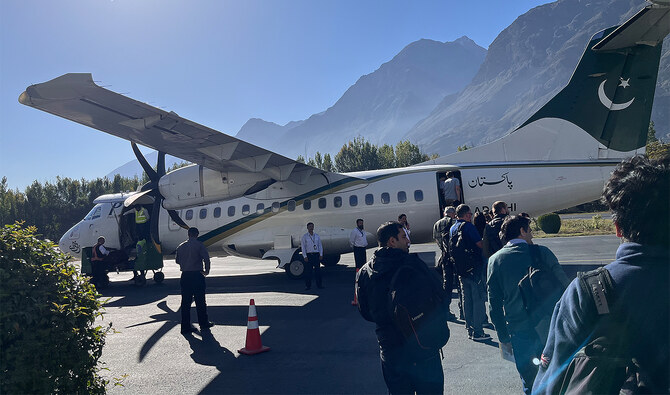
In order to promote tourism, Sharif directed authorities to ensure the provision of best facilities for passengers at the Skardu International airport, days after the South Asian country relaxed its visa policy.
“The prime minister ordered to operate more counters in order to save passengers of international flights from waiting for long,” Sharif’s office said. “He further instructed to devise a comprehensive framework related to the extension of Skardu International and Gilgit airports.”
The two airports are located in Pakistan’s northern Gilgit-Baltistan (GB) region, which is home to scenic valleys and five of the world’s 14 mountains above 8,000 meters, including K2. More than 8,900 foreigners visited the remote Gilgit-Baltistan region in 2023, according to official figures from the government, where the summer climbing season runs from early June to late August.
The South Asian country has other major tourist attractions in several other cities and towns across its length and breadth.
During the meeting, officials briefed Sharif that the airport management authority and the civil aviation authority had been separated to ensure “efficient performance” of duties of operator and regulator under the aviation act.
The number of counters had been increased at the Lahore airport and an existing waiting room had also been expanded for the convenience of passengers, according to officials. Work on feasibility report for the expansion of Skardu airport was due to start soon.
The prime minister expressed his satisfaction over the measures and said additional facilities would also be available to passengers.
Pakistan this month increased the number of countries exempt from visa fees to 126, while it announced on-arrival visas from businessmen from the Gulf nations, including Bahrain, Kuwait, Oman, Qatar, Saudi Arabia and the United Arab Emirates.
Information Minister Ataullah Tarar said on August 13 that people visiting from any of the 126 countries will merely have to fill out a one-page form consisting of 30 questions within a ten-minute process. Visa would be issued directly on the phone through which the form was filled and would be valid for three months apart from also being renewable, he added.
The new visa policy also included religious tourism due to which Sikh pilgrims could easily visit the South Asian country for their religious festivals, according to the minister.

Pakistan PM calls for enhanced airport services amid push to boost tourism
https://arab.news/pexn2
Pakistan PM calls for enhanced airport services amid push to boost tourism
- Pakistan is home to several tourist destinations across its length and breadth as well as five of the world’s 14 tallest mountain peaks
- Islamabad recently increased the number of countries exempt from visa fees to 126, announced on-arrival visas for the Gulf residents
Tens of thousands flee northwest Pakistan over fears of military operation
- More than 70,000 people, mostly women and children, have fled remote Tirah region bordering Afghanistan
- Government says no military operation underway or planned in Tirah, a town in Khyber Pakhtunkhwa province
BARA, Pakistan: More than 70,000 people, mostly women and children, have fled a remote region in northwestern Pakistan bordering Afghanistan over uncertainty of a military operation against the Pakistani Taliban, residents and officials said Tuesday.
Pakistan’s Defense Minister Khawaja Mohammad Asif has denied the claim by residents and provincial authorities. He said no military operation was underway or planned in Tirah, a town in Khyber Pakhtunkhwa province.
Speaking at a news conference in Islamabad, he said harsh weather, rather than military action, was driving the migration. His comments came weeks after residents started fleeing Tirah over fears of a possible army operation.
The exodus began a month after mosque loudspeakers urged residents to leave Tirah by Jan. 23 to avoid potential fighting. Last August, Pakistan launched a military operation against Pakistani Taliban in the Bajau r district in the northwest, displacing hundreds of thousands of people.
Shafi Jan, a spokesman for the provincial government in Khyber Pakhtunkhwa, posted on X that he held the federal government responsible for the ordeal of the displaced people, saying authorities in Islamabad were retracting their earlier position about the military operation.
Khyber Pakhtunkhwa Chief Minister Suhail Afridi, whose party is led by imprisoned former Prime Minister Imran Khan, has criticized the military and said his government will not allow troops to launch a full-scale operation in Tirah.
The military says it will continue intelligence-based operations against Pakistani Taliban, who are known as Tehrik-e-Taliban Pakistan, or TTP. Though a separate group, it has been emboldened since the Afghan
Taliban returned to power in 2021. Authorities say many TTP leaders and fighters have found sanctuary in Afghanistan and that hundreds of them have crossed into Tirah, often using residents as human shields when militant hideouts are raided.
Caught in the middle are the residents of Tirah, who continued arriving in Bara.
So far, local authorities have registered roughly 10,000 families — about 70,000 people — from Tirah, which has a population of around 150,000, said Talha Rafiq Alam, a local government administrator overseeing the relief effort. He said the registration deadline, originally set for Jan. 23, has been extended to Feb. 5.
He said the displaced would be able to return once the law-and-order situation improves.
Among those arriving in Bara and nearby towns was 35-year-old Zar Badshah, who said he left with his wife and four children after the authorities ordered an evacuation. He said mortar shells had exploded in villages in recent weeks, killing a woman and wounding four children in his village. “Community elders told us to leave. They instructed us to evacuate to safer places,” he said.
At a government school in Bara, hundreds of displaced lined up outside registration centers, waiting to be enrolled to receive government assistance. Many complained the process was slow.
Narendra Singh, 27, said members of the minority Sikh community also fled Tirah after food shortages worsened, exacerbated by heavy snowfall and uncertain security.
“There was a severe shortage of food items in Tirah, and that forced us to leave,” he said.
Tirah gained national attention in September, after an explosion at a compound allegedly used to store bomb-making materials killed at least 24 people. Authorities said most of the dead were militants linked to the TTP, though local leaders disputed that account, saying civilians, including women and children, were among the dead.