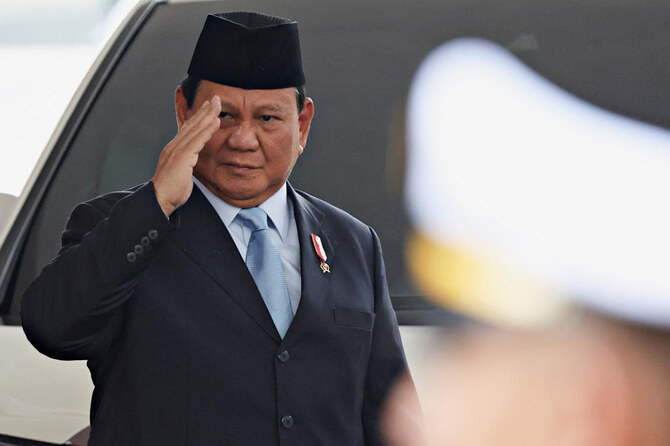
JAKARTA: Indonesia’s president-elect Prabowo Subianto has secured a parliamentary majority after the party that backed his rival in the February elections announced it was joining his big-tent coalition.
The NasDem party, which accounts for about 10 percent of parliament, announced late on Thursday that it would support the incoming administration of Prabowo.
The move will give the Prabowo government control over parliament, boosting its stake from 43 percent to 52 percent.
The parliamentary majority is expected to smooth legislative processes, including approval of the 2025 budget, which outgoing President Joko Widodo, widely known as Jokowi, will announce on Friday.
Ex-commander Prabowo, and vice president-elect Gibran Rakabuming Raka, who is Jokowi’s eldest son, will be sworn into office on October 20.
Nasdem chief Surya Paloh told reporters on Thursday that his decision to join Prabowo would foster a “calmer and more optimistic” atmosphere and ease the work of the incoming administration.
“We agree to cooperate and collaborate to face challenges in the future,” said Prabowo, after meeting Paloh, “Unity is the key to a nation’s success.” Prabowo, whose coalition includes five political parties, is also in talks with the country’s largest Islamic party, which has a 10 percent parliamentary share. NasDem previously backed Anies Baswedan, a former Jakarta governor and vocal government critic, who was defeated by Prabowo in this year’s presidential election.
The party’s decision to join Prabowo has led it to withdraw support for Anies’s bid for Jakarta governor this November. Jokowi’s youngest son Kaesang has in recent weeks been touted as a possible candidate for the post of governor in Jakarta or Central Java.
Anies, who polls show is the frontrunner in the Jakarta race, has been struggling to find enough parties to support him.
Anies told Reuters this week that “despite the pressure” he was optimistic he would ultimately secure the backing of parties with the required threshold of 20 percent of seats in the regional parliament.
The developments follow the shock resignation at the weekend of Airlangga Hartarto as head of Golkar, Indonesia’s second-largest political party, which is also in Prabowo’s camp.
It was expected that Airlangga, a Jokowi and Prabowo ally, would retain chairmanship of the party until its planned December congress. Instead, that congress will be held next week, when a new party chair will be elected.
After a decade in office analysts say Jokowi is seeking control over Golkar to retain influence after he steps down.


![]()

Indonesia’s president-elect Prabowo secures parliamentary majority
Short Url
https://arab.news/99cny
Indonesia’s president-elect Prabowo secures parliamentary majority
- The NasDem party, which accounts for about 10% of parliament, announced it would support the incoming administration of Prabowo Subianto
- The parliamentary majority is expected to smooth legislative processes, including approval of the 2025 budget


Latest updates


© 2026 SAUDI RESEARCH & PUBLISHING COMPANY, All Rights Reserved And subject to Terms of Use Agreement.