

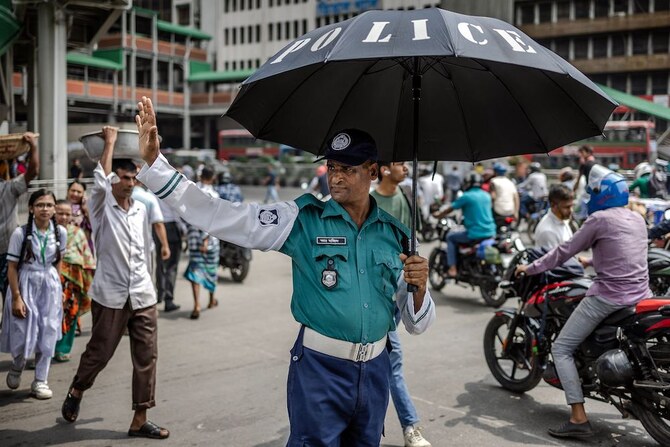

DHAKA: Bangladeshi police resumed patrols of the capital Dhaka on Monday, ending a weeklong strike that left a law and order vacuum following the abrupt ouster of autocratic ex-premier Sheikh Hasina.
Officers vanished from the streets of the sprawling megacity of 20 million people last week after Hasina’s resignation and flight abroad ended her 15-year rule.
Police were loathed for spearheading a lethal crackdown on the weeks of protests that forced her departure, with 42 officers among the more than 450 people killed.
Police had vowed not to resume work until their safety on duty was guaranteed, but they agreed to return after late-night talks with the new interim government, helmed by Nobel laureate Muhammad Yunus.
“It’s good to be back,” assistant commissioner Snehasish Das said while standing at a busy intersection directing traffic.
“As we feel secure now, we are back on duty.”
Student-led protests against Hasina’s government had been largely peaceful until police attempted to violently disperse them.
Around 450 of the country’s 600 police stations were targeted in arson and vandalism attacks over the past month, according to the national police union.
Some began reopening late last week under guard by the army, an institution held in higher esteem for largely refusing to participate in the crackdown.
In the police’s absence, the students who led the protests that toppled Hasina volunteered to restore law and order after looting and reprisal attacks in the hours after her departure.
They acted as traffic wardens, formed overnight neighborhood watch patrols and guarded Hindu temples and other places of worship, quickly settling the unrest.
Das said there was “no tension” between police and the students who had been performing their duties.
“Students have done a tremendous job in the past few days,” he added. “Our thanks to them.”
The volunteers, for their part, said they were relieved to yield back their responsibilities.
“It’s too difficult for us to manage the vehicles,” Chanu Abdullah, 27, said. “I’m really thankful the police came back.”
Yunus’s de facto cabinet now administering the country said it had noted with “grave concern” some attacks on Hindus and other minorities.
In its first official statement on Sunday night, the cabinet said it would work to “find ways to resolve such heinous attacks.”
Bangladeshi Hindus account for around eight percent of the country’s 170 million people and have regularly been the targets of violence during periods of upheaval.
Hundreds have arrived on India’s border since last week, asking to cross.
The leadership of Jamaat, Bangladesh’s largest Islamist party, said it would meet with representatives of the Hindu community and other minority leaders later Monday in a bid to ease tensions.
Hasina, 76, fled by helicopter to neighboring India a week ago as protesters flooded Dhaka’s streets in a dramatic end to her iron-fisted tenure.
Her government was accused of widespread human rights abuses, including the extrajudicial killing of thousands of her political opponents.
But new home minister Sakhawat Hossain said the government had no intention of banning Hasina’s Awami League party, which played a pivotal role in the country’s independence movement.
“The party has made many contributions to Bangladesh — we don’t deny this,” he told reporters.
“When the election comes, (they should) contest the elections.”
Interim leader Yunus returned from Europe on Thursday to head a temporary administration facing the monumental challenge of steering democratic reforms.
The 84-year-old won the Nobel Peace Prize in 2006 for his pioneering work in microfinance, credited with helping millions of Bangladeshis out of grinding poverty.
He took office as “chief adviser” to a caretaker administration — all fellow civilians bar Hossain, a retired brigadier-general — and has said he wants to hold elections “within a few months.”


