Jannatul Prome hopes to leave Bangladesh to study more or possibly find a job after she finishes her university degree, frustrated by a system that she says doesn’t reward merit and offers little opportunity for young people.
“We have very limited scope here,” said the 21-year-old, who would have left sooner if her family had enough money to pay tuition at foreign universities for both her and her older brother at the same time.
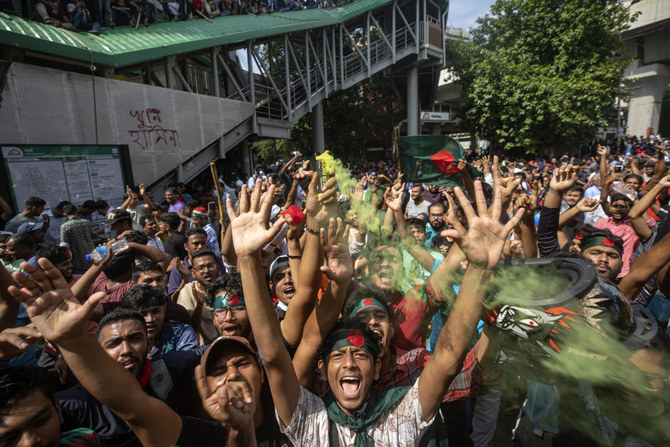
But recent events have given her hope that one day she might be able to return to a transformed Bangladesh: After 15 years in power, Prime Minister Sheikh Hasina resigned and fled the country last week — chased out by young protesters, Prome among them, who say they are fed up with the way her increasingly autocratic rule has stifled dissent, favored the elite and widened inequalities.
Students initially poured into Bangladesh’s streets in June, demanding an end to rules that set aside up to 30 percent of government jobs for the descendants of veterans who fought the country’s 1971 war of independence from Pakistan. Protesters said that benefitted supporters of Hasina’s Awami League, which led that struggle — and who already were part of the elite. The quota and others for marginalized groups meant only 44 percent of civil service jobs were awarded based on merit.
That such jobs lay at the center of the movement was no coincidence: They are some of the most stable and best paying in a country where the economy has boomed in recent years but not created enough solid, professional jobs for its well-educated middle class.
And that Generation Z led this uprising was also not surprising: Young people like Prome are among the most frustrated with and affected by the lack of opportunity in Bangladesh — and at the same time, they are not beholden to the old taboos and narratives that the quota system reflected.
Their willingness to break with the past was clear when Hasina belittled their demands in mid-July, asking who, if not the freedom fighters, should be awarded government jobs.
“Who will? The grandchildren of Razakars?” Hasina retorted, using a deeply offensive word that refers to those who collaborated with Pakistan to quell Bangladesh’s independence struggle.
But the student protesters wore the word as a badge of honor. They marched on Dhaka University’s campus, chanting: “Who are you? Who am I? Razakar. Who said this? The dictator.”
The following day, protesters were killed during clashes with security forces — only galvanizing the demonstrations, which widened into a broader uprising against Hasina’s rule.
Sabrina Karim, a professor at Cornell University who studies political violence and Bangladesh’s military history, said that many of the protesters are so young they cannot remember a time before Hasina was prime minister.
They were raised, like the generations before them, on stories of the independence struggle — with Hasina’s family at the center. Her father, Sheikh Mujibur Rahman, was the first leader of independent Bangladesh and was later assassinated in a military coup. But Karim said this narrative had much less meaning for the young protesters than it did for their grandparents.
“It doesn’t resonate with them anymore as much as it did (before). And they want something new,” she said.
For Nourin Sultana Toma, a 22-year-old student at Dhaka University, Hasina’s equating of the student protesters with traitors made her realize the gulf between what the youth wanted and what the government could provide.
She said that she had watched as Bangladesh was slowly lulled into becoming immune to inequities and people lost hope that things would ever get better.
The country’s longest-serving prime minister prided herself on boosting per capita income and transforming Bangladesh’s economy into a global competitor — fields turned into garment factories and bumpy roads became winding highways. But Toma said she saw the daily struggle of people trying to buy essentials or find work and her demand for basic rights met with insults and violence.
“It could no longer be tolerated,” Toma said.
This economic distress was keenly felt by Bangladesh’s youth. Eighteen million young people — in a country of 170 million — are not working or in school, according to Chietigj Bajpaee, who researches South Asia at the Chatham House think tank. And after the pandemic, private sector jobs became even more scarce.
Many young people try to study abroad or move overseas upon graduation in the hopes of finding decent work, decimating the middle class and resulting in brain drain.
“The class differences have widened,” said Jannatun Nahar Ankan, a 28-year-old who works with a nonprofit in Dhaka and who joined the protests.
Despite these problems, none of the protesters seems to have truly believed that their movement would be able to dethrone Hasina.
Rafij Khan, 24, was on the streets preparing to join a protest when he heard Hasina had resigned and fled the country. He called home repeatedly to see if he could verify the news.
He said that in the last days of the demonstrations, people from all classes, religions and professions had joined the students on the streets. Now they hugged one another, while others just sat on the ground in disbelief.
“I can’t describe the joy that people felt that day,” he said.
Some of that euphoria is wearing off now as the enormity of the task ahead sinks in. Nobel laureate Muhammad Yunus became the interim leader Thursday and he, along with a Cabinet that includes two student protest leaders, will have to restore peace, build institutions and prepare the country for fresh elections.
The hope for most students is that the interim government gets time to repair Bangladesh’s institutions while a new political party — not led by the old political dynasties — is formed.
“If you asked me to vote in elections right now, I don’t know who I’d vote for,” said Khan. “We don’t want to replace one dictatorship with another.”
The young people who took to the streets have often been described as the “I hate politics” generation.
But Azaher Uddin Anik, a 26-year-old digital security specialist and recent graduate of Dhaka University, said that is a misnomer.
They don’t hate all politics — just the divisive politics in Bangladesh.
And although he admits that the structural reforms that the country now needs may be more difficult than removing the prime minister, he is hopeful for the first time in a while.
“My last experience is telling me that the impossible can happen,” he said. “And maybe it isn’t too late.”


![]()

How a young generation in Bangladesh forced out the leader who ruled for much of their lives
Short Url
https://arab.news/8kvy4
How a young generation in Bangladesh forced out the leader who ruled for much of their lives
- Students initially poured into Bangladesh’s streets in June, demanding an end to rules that set aside up to 30 percent of government jobs for the descendants of veterans
- Young people like Prome are among the most frustrated with and affected by the lack of opportunity in Bangladesh


Latest updates


© 2026 SAUDI RESEARCH & PUBLISHING COMPANY, All Rights Reserved And subject to Terms of Use Agreement.