‘I admire Vision 2030’: Bangladesh’s new PM aims for stronger Saudi, GCC ties

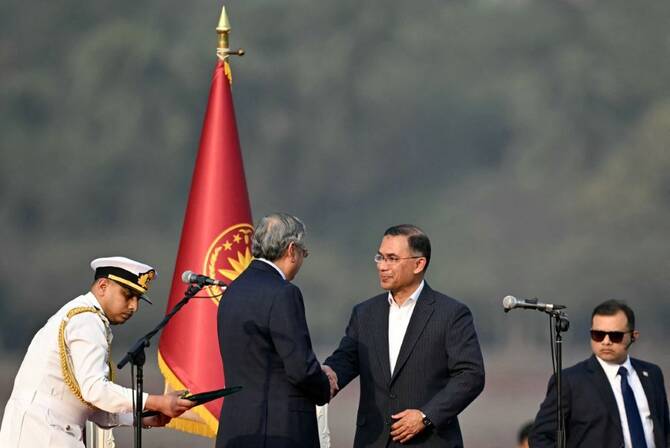
Bangladesh’s new PM Tarique Rahman shakes hands with President Mohammed Shahabuddin during the swearing-in ceremony at the National Parliament in Dhaka on Feb. 17, 2026. (AFP)
Short Url
Updated 18 February 2026
Follow

‘I admire Vision 2030’: Bangladesh’s new PM aims for stronger Saudi, GCC ties

  • Saudi Arabia congratulates Tarique Rahman on assuming Bangladesh’s top office
  • Relations between Bangladesh and Kingdom were formalized during his father’s rule

DHAKA: After 17 years in exile, Tarique Rahman has taken office as prime minister of Bangladesh, inheriting his parents’ political legacy and facing immediate economic and political challenges.

Rahman led his Bangladesh Nationalist Party to a landslide victory in the Feb. 12 general election, winning an absolute majority with 209 of 300 parliamentary seats and marking the party’s return to power after two decades.

The BNP was founded by his father, former President Ziaur Rahman, a 1971 Liberation War hero. After his assassination in 1981, Rahman’s mother, Khaleda Zia, took over the party’s helm and served two full terms as prime minister — in 1991 and 2001.

Rahman and his cabinet, whose members were sworn in alongside him on Tuesday, take over from an interim administration which governed Bangladesh for 18 months after former premier Sheikh Hasina — the BNP’s archrival who ruled consecutively for 15 years — was toppled in the 2024 student-led uprising.

As he begins his term, the new prime minister’s first tasks will be to rebuild the economy — weakened by uncertainty during the interim administration — and to restore political stability. Relations with the Middle East, particularly Saudi Arabia and other GCC states, are also high on his agenda.

“Saudi Arabia is one of our long-standing friends,” Rahman told Arab News at his office in Dhaka, two days before his historic election win.

“I admire the Saudi Vision 2030, and I am sincerely looking forward to working with the leadership of the Kingdom of Saudi Arabia. BNP always had a great relationship with the Muslim world, especially GCC nations — UAE, Qatar, Bahrain, Kuwait and Oman — and I look forward to working closely with GCC countries and their leadership to build a long-term trusting partnership with mutual interest,” Rahman said.

The Saudi government congratulated him on assuming the top office on Tuesday, wishing prosperity to the Bangladeshi people. 

Bangladesh and Saudi Arabia established formal diplomatic relations in August 1975, and the first Bangladeshi ambassador presented his credentials in late 1976, after Rahman’s father rose to power. That year, Bangladesh also started sending laborers, engineers, doctors, and teachers to work in the Kingdom.

Today, more than 3 million Bangladeshis live and work in Saudi Arabia — the largest expat group in the Kingdom and the biggest Bangladeshi community outside the country.

“I recall that when my father, President Ziaur Rahman, was in office, bilateral relations between our two nations were initiated,” Rahman said. “During the tenure of my mother, the late Begum Khaleda Zia, as prime minister, those relations became even stronger.”


Tarique Rahman’s father, Ziaur Rahman, center, performs Hajj on April 29, 1979. (BNP Media Cell) 

Over the decades, Saudi Arabia has not only emerged as the main destination for Bangladesh’s migrant workers but also one of its largest development and emergency aid donors.

Weeks after Rahman’s mother began her first term as prime minister in 1991, Bangladesh was struck by one of the deadliest tropical cyclones in its history. Riyadh was among the first who offered assistance, and Zia visited Saudi Arabia on her earliest foreign tour and performed Hajj in June 1991.

For Rahman, who had been living in London since 2008 and returned to Bangladesh in December — just days before his mother’s death — the Kingdom will also be one of the first countries he plans to visit.

“I would definitely like to visit Saudi Arabia early in my term,” he said. “Personally, I also wish to visit the holy mosque, Al-Masjid Al-Haram, Makkah, to perform Umrah.”


IMF board to review staff-level $8.1 billion agreement for Ukraine in coming days

Updated 8 sec ago
Follow

IMF board to review staff-level $8.1 billion agreement for Ukraine in coming days

  • Ukraine has said it faces a near $140 billion budget shortfall over the next few years
  • Kozack said Ukrainian authorities ⁠had now completed the ⁠prior actions needed to move forward with their request for a new IMF program

WASHINGTON: The International Monetary Fund on Thursday said its board would review a staff-level agreement on an $8.1 billion lending program for Ukraine in coming days, paving the way for approval of a package that will help unlock other international support.
If approved, as widely expected, the program would replace an existing $15.5 billion IMF facility, helping Kyiv maintain economic stability and public spending as the war with Russia grinds into a fifth year. Ukraine has said it faces a near $140 billion budget shortfall over the next few years.
The four-year anniversary of the war is February 24. Since Moscow’s invasion, Ukraine has required hundreds of billions of dollars of support from Western governments and institutions and a more than $20 billion sovereign debt restructuring.
IMF spokeswoman Julie Kozack said Ukrainian authorities ⁠had now completed the ⁠prior actions needed to move forward with their request for a new IMF program, including submission of a draft law on the labor code and adoption of a budget. She told a briefing that Ukraine’s economic growth in 2025 was likely to come in under 2 percent. After four years of war, the country’s economy had settled into a slower growth path with larger fiscal and current account balances, she said, noting that the IMF continues to monitor the situation closely.
“Russia’s invasion continues to take a ⁠heavy toll on Ukraine’s people and its economy,” Kozack said. Intensified aerial attacks by Russia had damaged critical energy and logistics infrastructure, causing disruptions to economic activity, she said.
As of January, she said, 5 million Ukrainian refugees remained in Europe and 3.7 million Ukrainians were displaced inside the country. The World Bank, Ukrainian government and European Union are finalizing a new estimate for the cost to rebuild Ukraine that should be released next week, with experts predicting a significant jump from last year’s $524-billion estimate, given the severity of Russian attacks on energy infrastructure.
IMF Managing Director
Kristalina Georgieva
met with top Ukrainian officials in Kyiv in a surprise visit last month, telling Reuters she expected to submit the new lending program to the Fund’s board for approval in coming weeks.
At the time, she said the situation in Ukraine had ⁠clearly worsened since officials signed ⁠a preliminary lending agreement in November, requiring some changes, but the thrust of the program’s requirements would remain the same.
She said the IMF would assess which measures agreed in November were easily implemented and which needed to be “calibrated” more carefully. For instance, she said the Fund was looking at giving Ukraine a year to drum up support in parliament for passage of a controversial VAT measure.
Ukrainian Prime Minister
Yulia Svyrydenko
on Saturday said Kyiv had agreed with the IMF to ease some conditions for the program, including plans for sensitive tax increases affecting individual entrepreneurs.
The government had agreed to introduce a value-added tax for them, raising the revenue threshold to 4 million hryvnias ($92,592.59) from 1 million hryvnias ($23,148.15). Analysts now expect about 250,000 entrepreneurs to be affected by the increase, instead of over 600,000 in earlier plans.
The preliminary staff agreement assumes the war will end this year but includes a “downside scenario” that the war winds down slowly and does not end until 2028, according to IMF officials.