

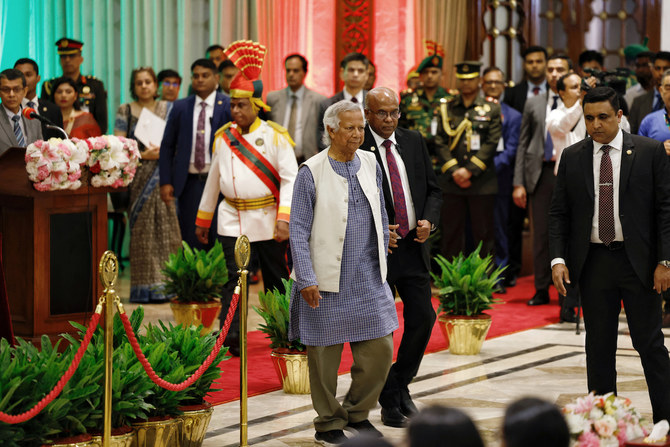

DHAKA: Jubilant and hopeful, Bangladeshis welcomed on Friday their new interim government headed by the Nobel-winning economist Muhammad Yunus and manned by renowned lawyers, academics and leaders of the student movement that has ousted the previous regime.
The new administration took the oath of office at the presidential palace in Dhaka on Thursday night, three days after Prime Minister Sheikh Hasina was forced to resign and fled to neighboring India after weeks of nationwide demonstrations and a deadly crackdown on protesters.
“The brutal, autocratic regime is gone,” Yunus said in a televised address after he was sworn in by President Mohammed Shahabuddin along with more than a dozen members of his caretaker government.
He pledged that “democracy, justice, human rights, and full freedom of fearless expression will be enjoyed by all, regardless of party affiliation.”
The 84-year-old economics professor will lead the country as “chief adviser” and the titles of his Cabinet members advisers too, not ministers.
They include Nahid Islam and Asif Mahmud, top leaders of Students Against Discrimination, a group that led the protests that toppled Hasina, and civil servants such as former Attorney General A.F. Hassan Ariff, former Foreign Secretary Touhid Hossain, and Salehuddin Ahmed — economist and a former governor of the country’s central bank.
There are also Adilur Rahman Khan, a prominent human rights activist, Syeda Rizwana Hasan, an international award-winning environmental lawyer, and Asif Nazrul, a public intellectual, writer and professor of law at Dhaka University.
As the new administration took office, Bangladeshis were enthusiastic about the nominations and hopeful for their country’s future.
“After our total anarchy and a very serious uprising that we experienced very recently, this is a new dynamic,” Gautam Barua, an academic and researcher, told Arab News.
“I’m very hopeful, very, very much hopeful about this interim government … I think they will bring about a beautiful change.”
He was glad to see that famous lawyers and economists would be at the helm.
“This Cabinet, I think, has the finest of the fine of the country … They are globally recognized, and they are domestically, nationally, recognized,” Barua said.
“The country’s present economy needs a notch … It has gone down quite drastically in the last government’s regime. So, I believe they can notch it up. They can turn the wheel of the economy.”
There was also pride in having a government full of celebrity intellectuals and technocrats.
“I think they can bring us a positive change,” said Mahfuz Kaiser, a student in Dhaka. “Dr. Yunus is a very famous person. He’s a Nobel laureate. First Nobel winner in Bangladesh.”
An economics professor, Yunus is a social entrepreneur and banker who was awarded the 2006 Nobel Peace Prize for his pioneering microfinance work that helped alleviate poverty in Bangladesh and has been widely adopted around the world.
“He’s going to help us to build this nation again,” said Jannatul Ferdous Mawa, who is pursuing a degree in media studies and participated in the recent protests.
“I think whatever is happening right now, it’s good for us because we are learning something. From this protest, we learned one thing: that if we are together, we can build this nation again.”
Political transition in Bangladesh, ending 15 years of Hasina’s rule, comes after nationwide protests that began in early July against a quota system for government jobs, which was widely criticized for favoring those with connections to the ruling party.
The demonstrations soon turned violent as security forces clashed with demonstrators, leaving at least 300 people dead.
After the deadly clashes and a week-long communications blackout, the Supreme Court eventually scrapped most of the quotas, but the ruling was followed by a crackdown on protesters.
The arrests of 11,000 participants of the rallies, mostly students, triggered new demonstrations last week, culminating in a civil disobedience movement that on Monday forced Hasina to resign.
A day later, the president dissolved the parliament, clearing the way for the interim administration, which now will preside over new elections.
“There are lots of expectations from this government because this government is headed by the Nobel laureate Prof. Dr. Yunus. I think everyone is looking forward to his work, to his progress, to his visions. He used to say that there are three zeros: zero poverty, zero unemployment and zero net carbon. So, I think he will work on these three issues,” Dr. Rawnak Khan, who teaches anthropology at Dhaka University, told Arab News.
“Our institutional infrastructure, the whole situation — we need to build it up. The government needs to ensure transparency, accountability. My expectation of this government is very high. Not only mine; I think everyone’s because it is headed by Prof. Yunus and it depends on his ability to navigate the complex political landscape of Bangladesh.”


