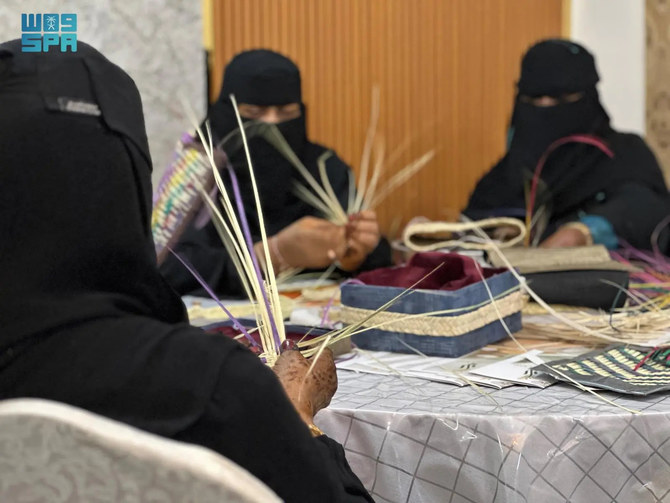
Saudi women in Najran weave success in wicker revival

1 / 2
Wicker weaving has deep roots in Najran, with locals utilizing the region’s abundant palm trees for centuries. (SPA)
2 / 2
Wicker weaving has deep roots in Najran, with locals utilizing the region’s abundant palm trees for centuries. (SPA)
Short Url
Updated 10 August 2024
Follow

Saudi women in Najran weave success in wicker revival

NAJRAN: A group of 15 Saudi women in the Kingdom's southwest is mastering the art of wicker weaving, thanks to a training program organized by the Herfa institute of handicrafts. The month-long course, which runs until August 27, aims to preserve and promote this traditional craft.

Trainees have honed their skills in creating a variety of wicker products, including baskets, bags, and decorative items. 


Wicker weaving has deep roots in Najran, with locals utilizing the region’s abundant palm trees for centuries. (SPA)

Instructor Masouma Al-Hamdan emphasized the importance of preserving this cultural heritage and the economic potential of the wicker industry.

“We are teaching women the entire process, from harvesting palm fibers to weaving intricate designs,” said Al-Hamdan. She added that the goal is to empower these women as entrepreneurs and to revitalize this ancient craft.
 
Wicker weaving has deep roots in Najran, with locals utilizing the region’s abundant palm trees for centuries. The craft has experienced a resurgence in recent years, thanks to government support and growing interest in sustainable and handmade products.


Pioneering electric bus service takes to the road in Makkah

Updated 19 December 2025
Follow

Pioneering electric bus service takes to the road in Makkah

  • The bus rapid transit project, a system designed to have higher capacity and reliability than conventional bus services, is said to be the first of its kind in the Kingdom
  • The vehicles operate in dedicated bus lanes within a network that includes two main bus stations and 11 stops along the route connecting them

MAKKAH: A pioneering electric bus service took to the road in Makkah this week.

Electromin, the developer and operator of the service in partnership with Umm Al-Qura for Development and Construction, said it is expected to serve more than 125 million passengers over the next 15 years, while cutting carbon dioxide emissions by more than 31,500 tonnes compared with traditional vehicles.

The bus rapid transit project, a system designed to have higher capacity and reliability than conventional bus services, is said to be one of the first of its kind in the Kingdom. It was inaugurated on Wednesday by Amr Al-Dabbagh, chairperson of Al-Dabbagh Group; Samir Nawar, managing director of Petromin; and Yasser Abu Ateeq, CEO of Umm Al-Qura.

The bus rapid transit project is designed to have higher capacity and reliability than conventional bus services. (Supplied)

Electromin, a subsidiary of Petromin specializing in energy and mobility solutions, said the new service, which forms part of the Masar Destination mixed-use real estate development project in Makkah, is one the first transport networks of its kind in the country, and represents a significant shift toward a cleaner, more efficient urban transport model.

It operates in dedicated bus lanes, connecting key hubs within Masar and providing safe, reliable and environmentally friendly transportation for residents and visitors, the company added. The network includes two main bus stations and 11 stops along the route connecting them. It has been designed to serve more than 5 million visitors and pilgrims annually, and to be easily accessible to all users.

Operators say the service is designed as a foundation for Makkah’s future transportation system, through its integration with the broader Masar project, which includes pedestrian walkways, more than 5,000 parking spaces, metro services and other urban infrastructure.