

Traditional Saudi crafts showcased to world at Riyadh exhibition

1 / 3
Over a hundred local brands and organizations were displaying a variety of national products at the exhibition. (AN photo by Saad Al-Dosari)
2 / 3
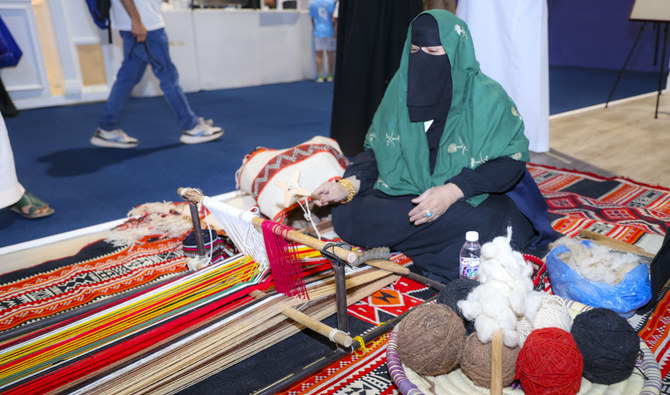
Badriyah Almutairi, a Saudi Sadu trainer, presenting at the Heritage Commission’s booth. (AN photo by Saad Al-Dosari)
3 / 3
Pottery was also highlighted by the Heritage Commission through workshops and a mini art gallery. (AN photo by Saad Al-Dosari)
Short Url
Updated 19 October 2023
Follow

Traditional Saudi crafts showcased to world at Riyadh exhibition

RIYADH: Sadu, a traditional form of weaving historically carried out by Bedouin women, was one the crafts taking center stage at an exhibition showcasing Saudi products to the world.

More than 100 brands and organizations took part in the second edition of the Saudi Made event, held at the Riyadh Front Exhibition and Convention Center.

The four-day industry gathering, which ended on Thursday, saw Saudi products and services being promoted to regional and international markets.

The exhibition aims to help companies in the Kingdom create export opportunities, forge links with key importers, while displaying the country’s craft heritage to visitors.

Badriyah Almutairi, a Saudi Sadu trainer, was presenting at the Heritage Commission’s booth.

She said: “It is beautiful that people can see our tradition in our products. Heritage is the basis of industries.

“Sadu is a purely female craft. It was a Bedouin custom that men did not practice, in the same way that women did not roast, prepare, or drink coffee.”

The embroidered textile is widespread in Bedouin traditions, especially in the Najd region. It is woven in a horizontal pattern using mainly camel or goat hair, or sheep wool.

“We took Sadu from our environment. Women made pillows, tents, and textiles but now it has become a profession, a sustainability profession,” Almutairi added.

Other crafts on show at the exhibition included Al-Qatt Al-Asiri, an ancient interior wall decoration art form using bright colors and common to homes in Asir.

In addition, pottery, Najdi doors, and Arabic calligraphy were also highlighted by the commission through workshops and a mini art gallery.

Many of the Saudi products go on to be displayed by the commission at international craft, fashion, and arts events in countries such as Italy and France.

Bandar Al-Khorayef, the Saudi minister of industry and mineral resources and chairman of the Saudi Export Development Authority, attended the first day of the event along with several other senior figures.


Crown prince sponsors launch of world-class Arabic calligraphy center in Madinah

Updated 23 December 2025
Follow

Crown prince sponsors launch of world-class Arabic calligraphy center in Madinah

  • The Prince Mohammed bin Salman Global Center for Arabic Calligraphy was inaugurated by Prince Salman bin Sultan bin Abdulaziz

RIYADH: A new center for Arabic calligraphy under the patronage of Crown Prince Mohammed bin Salman officially opened in Madinah on Monday.

The Prince Mohammed bin Salman Global Center for Arabic Calligraphy was inaugurated by Prince Salman bin Sultan bin Abdulaziz, governor of Madinah region.

He was joined by Culture Minister Prince Badr bin Abdullah bin Farhan, touring the new facility’s exhibition spaces and receiving briefings on cultural programming and the center’s achievements.

They also viewed collections highlighting Arabic calligraphy’s artistic and historical importance.

Speaking at the opening, Prince Badr said: “From this land of enlightenment and scholarship, we proudly launch a global platform dedicated to Arabic calligraphy as an invaluable cultural asset.”

He went on to credit the crown prince’s “generous and boundless support” for the cultural sector.

The minister said that the center demonstrated to the world the legacy of Arabic calligraphy while underscoring Saudi Arabia’s commitment to safeguarding its cultural identity and heritage.

According to Prince Badr, the facility represents an ambitious vision to elevate Arabic calligraphy as both a universal communication tool and an integral element of Arab heritage, art, architecture and design.

The center further aims to enhance the Kingdom’s cultural identity and strengthen its international presence, targeting calligraphers, emerging talents, visual artists, Islamic arts researchers, educational and cultural institutions, as well as art and heritage enthusiasts worldwide.

It will deliver specialized programs including research and archival services, calligraphy instruction, academic grants, a permanent museum, touring exhibitions, an international calligraphy association and a business incubator supporting calligraphy enterprises.

Additional offerings feature artist residency programs, expert-led workshops, and standardized curriculum development, complemented by international educational partnerships aimed at heritage conservation and expanding global appreciation for this time-honored art form.

The center’s establishment in Madinah carries particular significance, given the city’s historical role as the cradle of Arabic calligraphy and its association with transcribing the Qur’an and preserving Islamic knowledge.