



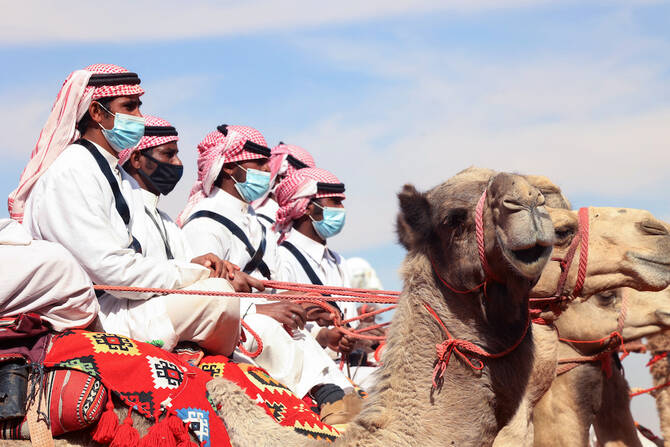

RIYADH: Every country has an animal that captures the imagination of its people and becomes a symbol of the nation.
In Saudi Arabia, camels are the most admired and cherished, and they can sell for millions of riyals.
Camels hold both religious and cultural value, making them prized possessions.
Known as the ships of the desert, they have been widely admired in the Kingdom for centuries and, for many owners, spending time with them has become a refuge from the hustle and bustle of daily life.
Nasser Manea Al-Khelaiwi, owner of the NMKCO Construction Company and camel enthusiast, spoke to Arab News about his passion for the Arabian ungulates.
He said: “I searched for something in which I could find happiness and comfort, and a place where I could spend time at the weekend or times when I wanted to relax, so I started owning camels.”
For Al-Khelaiwi, the mention of camels in the Qur’an gave them a value above other animals.
He said: “When some men who were very ill went to the Prophet, he told them ‘The camels are in front of you, drink from their milk.’ This means that this animal has value.”
Recent scientific studies have corroborated this and show that camel milk has a beneficial effect on organs such as the liver and kidneys.
Among the unique characteristics Al-Khelaiwi noted is that camels do not have a gallbladder. This allows them to survive in harsh environments by enduring thirst in water-scarce deserts.
According to Prof. Shin Nam-sik, from the College of Veterinary Medicine at Seoul National University, camels normally live in arid climates, and are constantly searching for sources of nourishment.
The professor said that the animals are highly adaptable and capable of traveling for more than 10 hours a day, covering 50 km at a time, and can carry loads of around 250 kg in hot environments.
Due to the various ecological advantages of camels, Bedouins in the Arabian Peninsula used to trade in camels inside and outside the Kingdom. This brought income to camel owners which allowed them to import fabrics and other goods.
This tradition of the camel market has been preserved over the years, and has become an established practice for Saudis.
The cost of one camel can reach SR1 million (a little over $250,000), and a good calf can easily cost SR500,000.
Al-Khelaiwi said: “In the past, people would travel in groups from Najd, primarily from the Qassim Region and its surroundings, with about 200 to 250 camels. They would travel to Iraq to sell their camels, to the Levant, to Palestine and to Egypt.
“It would take them two months to reach the market, where they would buy and sell their camels.
“Afterwards they would return with a caravan of about 15 camels, carrying goods such as food, rice, raw materials, and fabrics, taking them back to Najd.”
The tradition of raising camels later became expensive, with drought and desertification creating an increasingly harsh environment for the species, making their survival harder.
“People were providing fodder from money from their own purses and this was a big financial burden,” said Al-Khelaiwi.
Fortunately, the Saudi government was deeply committed to its heritage and sought to preserve it for future generations. National camel markets were established, such as at Umm Ruqayyah in the past and the current festival at Al-Sayahid.
Al-Khelaiwi said: “Prince Mishaal bin Abdulaziz was the person who had the desire to encourage camel owners to hold on to their camels and not neglect them.”
The KIng Abdulaziz Camel Festival is now an annual cultural, economic, sports and entertainment event at which specialized panels also judge camels for their beauty.
Owners from both inside and outside the Kingdom can participate, and the festival features camel races at the King Abdulaziz Camel Racing Track.
Al-Khelaiwi added: “Owners gather, and a large number of camels are present. The price of camels is expensive but an offer would be refused anyway as the owners would say that the animals are too dear to them to sell them.”
Al-Khelaiwi said that Prince Mishaal was among the biggest names who had supported the animal’s heritage, spending his own money to motivate and encourage owners to preserve the tradition.
He said: “He reached the stage where he supported the Bedouins by sending them fodder to use for grazing camels and to help them.
“His most frequent visits, his most frequent presence, and his greatest comfort were with the camel herders.
“In ancient times, a tribe would invade another tribe’s territory for valuable items. For the Bedouins, it was camels.
“Three, five, or 10 camels today are worth millions and what a person pays is all a matter of what they can afford. People used to fight over them, but today a person can buy them with their own money.”


