Trump praised Minnesota Gov. Walz in 2020 for response to unrest over Floyd’s murder, audio shows

1 / 2
Minnesota Governor Tim Walz speaks in St. Paul, Minnesota, on April 20, 2021 after the verdicts in the trial of Derek Chauvin, the former Minneapolis policeman found guilty of killing George Floyd, a Black man, in Minneapolis. (REUTERS/File Photo)
2 / 2
Protests were held in US cities over the death of Floyd, a black man who died after being restrained by Minneapolis police officers on May 25. (Chicago Tribune via AP/File)
Short Url
Updated 08 August 2024
Follow

Trump praised Minnesota Gov. Walz in 2020 for response to unrest over Floyd’s murder, audio shows

  • “What they did in Minneapolis was incredible. They went in and dominated, and it happened immediately,” Trump told Walz and other governors and officials in a phone call on June 1, 2020
  • Protests erupted in Minneapolis and around the world after Floyd was murdered by Derek Chauvin, a white former officer who knelt on the Black man’s neck on May 25, 2020

MINNEAPOLIS: While former President Donald Trump and running mate JD Vance have been hammering Minnesota Gov. Tim Walz over his response to the violence that erupted after George Floyd’s murder, Trump told the governor at the time that he fully agreed with how Walz handled it.
“What they did in Minneapolis was incredible. They went in and dominated, and it happened immediately,” Trump told Walz and other governors and officials in a phone call on June 1, 2020. The Associated Press on Wednesday obtained an audio recording of the call, which has taken on new significance now that Walz has been tapped as Vice President Kamala Harris’ running mate against Trump and Vance.
Other administration officials on the call included Defense Secretary Mark Esper; Army Gen. Mark Milley, chairman of the Joint Chiefs of Staff; and Attorney General William Barr.
ABC News reported on the call earlier Wednesday, a day after Harris introduced Walz as her vice presidential pick. CNN posted a transcript of the call back in 2020.
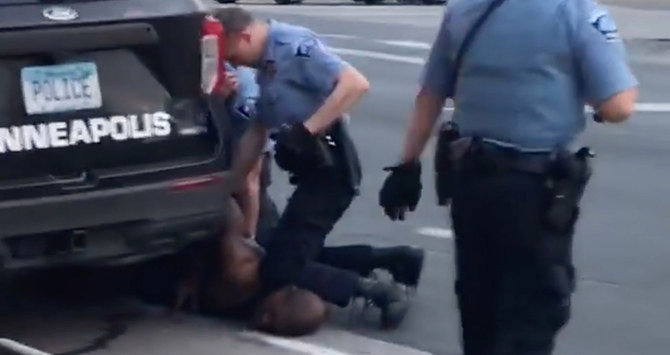


George Floyd died after being restrained by police in Minneapolis. (AFP/File)

Protests erupted in Minneapolis and around the world after Floyd was murdered by Derek Chauvin, a white former officer who knelt on the Black man’s neck for nearly 9 1/2 minutes, on May 25, 2020. A bystander video captured Floyd’s fading cries of “I can’t breathe.” His death forced a reckoning with police brutality and racism. Some of the protests turned violent.
Walz mobilized the Minnesota National Guard three days later to help restore order to Minneapolis after rioting that included the burning of a police station and numerous businesses. Trump offered federal help to Walz later that day, but the governor did not take him up on it.
During a May 2024 fundraiser in St. Paul, Trump repeated a claim he had been making lately that he was responsible for deploying the National Guard. “The entire city was burning down. ... If you didn’t have me as president, you wouldn’t have Minneapolis today,” Trump told a Republican audience. Trump made similar claims at a rally in St. Cloud last month.
It was actually Walz who gave the mobilization order in response to requests from the mayors of Minneapolis and St. Paul. Although Walz came under criticism at the time for not moving faster. There was finger-pointing between Minneapolis Mayor Jacob Frey and Walz on who bore responsibility for the delays.
Trump, in the June 1, 2020, call, described Walz as “an excellent guy” and later said: “I don’t blame you. I blame the mayor.” The president didn’t criticize the governor at the time.
“Tim, you called up big numbers and the big numbers knocked them out so fast, it was like bowling pins,” Trump said.
But Trump campaign spokesperson Karoline Leavitt put a different spin on the call in a statement to the AP on Wednesday.
“Governor Walz allowed Minneapolis to burn for days, despite President Trump’s offer to deploy soldiers and cries for help from the liberal Mayor of Minneapolis,” Leavitt said. “In this daily briefing phone call with Governors on June 1, days after the riots began, President Trump acknowledged Governor Walz for FINALLY taking action to deploy the National Guard to end the violence in the city.”
Walz did thank Trump on the call, as well as Esper and Milley, “for your strategic guidance, very helpful. ... Yeah, our city is grieving and in pain.”


EU leaders to reassess US ties despite Trump U-turn on Greenland

Updated 22 January 2026
Follow

EU leaders to reassess US ties despite Trump U-turn on Greenland

  • Diplomats stressed that, although Thursday’s emergency EU talks in Brussels would now lose some of their urgency, the longer-term issue of how to handle the relationship with the US remained

BRUSSELS: EU leaders will rethink their ties with the US at an emergency summit on Thursday after Donald Trump’s threat of tariffs and even military action to ​acquire Greenland badly shook confidence in the transatlantic relationship, diplomats said.
Trump abruptly stepped back on Wednesday from his threat of tariffs on eight European nations, ruled out using force to take Greenland, a semi-autonomous territory of NATO ally Denmark, and suggested a deal was in sight to end the dispute.
German Chancellor Friedrich Merz, welcoming Trump’s U-turn on Greenland, urged Europeans not to be too quick to write off the transatlantic partnership.
But EU governments remain wary of another change of mind by a mercurial president who is increasingly seen as a bully that Europe will have to stand up to, and they are focused on coming up with a longer-term plan on how to deal with the ‌United States under this ‌administration and possibly its successors too.
“Trump crossed the Rubicon. He might do ‌it ⁠again. ​There is no ‌going back to what it was. And leaders will discuss it,” one EU diplomat said, adding that the bloc needed to move away from its heavy reliance on the US in many areas.
“We need to try to keep him (Trump) close while working on becoming more independent from the US It is a process, probably a long one,” the diplomat said.
EU RELIANCE ON US
After decades of relying on the United States for defense within the NATO alliance, the EU lacks the needed intelligence, transport, missile defense and production capabilities to defend itself against a possible Russian attack. This gives the US substantial leverage.
The US ⁠is also Europe’s biggest trading partner, making the EU vulnerable to Trump’s policies of imposing tariffs to reduce Washington’s trade deficit in goods, and, as in ‌the case of Greenland, to achieve other goals.
“We need to discuss where ‍the red lines are, how we deal with this bully ‍across the Atlantic, where our strengths are,” a second EU diplomat said.
“Trump says no tariffs today, but does ‍that mean also no tariffs tomorrow, or will he again quickly change his mind? We need to discuss what to do then,” the second diplomat said.
The EU had been considering a package of retaliatory tariffs on 93 billion euros ($108.74 billion) on US imports or anti-coercive measures if Trump had gone ahead with his own tariffs, while knowing such a step would harm Europe’s economy as well ​as the United States.
WHAT’S THE GREENLAND DEAL?
Several diplomats noted there were still few details of the new plan for Greenland, agreed between Trump and NATO Secretary General Mark Rutte late on ⁠Wednesday on the sidelines of the World Economic Forum in Davos, Switzerland.
“Nothing much changed. We still need to see details of the Greenland deal. We are a bit fed up with all the bullying. And we need to act on a few things: more resiliency, unity, get our things together on internal market, competitiveness. And no more accepting tariff bullying,” a third diplomat said.
Rutte told Reuters in an interview in Davos on Thursday that under the framework deal he reached with Trump the Western allies would have to step up their presence in the Arctic.
He also said talks would continue between Denmark, Greenland and the US on specific issues.
Diplomats stressed that, although Thursday’s emergency EU talks in Brussels would now lose some of their urgency, the longer-term issue of how to handle the relationship with the US remained.
“The approach of a united front in solidarity with Denmark and Greenland while focusing on de-escalation and finding an off-ramp has worked,” a fourth EU diplomat said.
“At the ‌same time it would be good to reflect on the state of the relationship and how we want to shape this going forward, given the experiences of the past week (and year),” he said.