- Pakistan’s exports have historically been inclined toward western economies, China and Gulf Cooperation Council region
- Pakistan now seeks to explore new export markets including the landlocked Central Asian Republics, South African region
ISLAMABAD: Pakistani Minister for Commerce Jam Kamal Khan chaired a meeting in Islamabad on exploring new export markets, saying the potential for trade with Afghanistan and Central Asia could be enhanced by addressing “political and connectivity challenges.”
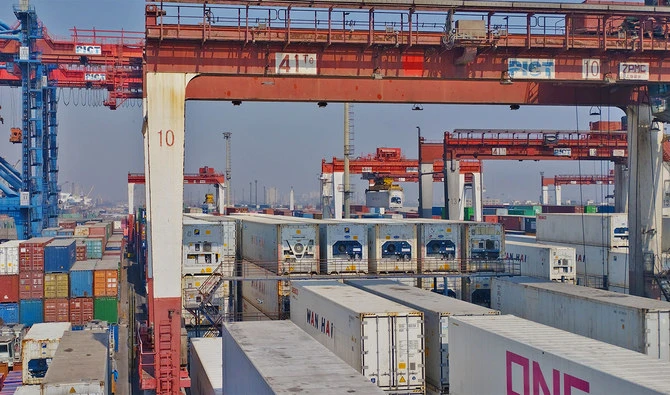
Pakistan’s exports have historically been inclined toward western economies, China and the Gulf Cooperation Council region. However, the country is now seeking to explore new export markets including the landlocked Central Asian Republics (CARs) as well as the South African region for the purpose of export diversification.
Pakistan’s exports to five Central Asian countries, Kazakhstan, Kyrgyzstan, Tajikistan, Turkmenistan and Uzbekistan, rose by 21.17 percent to $158.07 million in July-February 2024 from $130.45 million in the same period the previous year.
“Khan emphasized leveraging Pakistan’s natural assets, including mining, minerals, agro-products, gems, and fisheries, to increase exports,” Radio Pakistan reported about the commerce minister’s meeting where he recommended opening new trade missions in regions with significant trade potential.
“He also observed that export potential to Afghanistan and Central Asian countries could be significantly increased by addressing political and connectivity challenges.”
Pakistan wants to position itself as a regional trade hub and to leverage its strategic geopolitical position and enhance its role as a pivotal trade and transit hub connecting the landlocked CARs with the rest of the world. In recent months, there has been a flurry of visits, investment talks, and economic activity between Pakistan and Central Asian states and meetings with leaders from Uzbekistan, Azerbaijan, Tajikistan, and Turkmenistan.
Afghanistan too is a landlocked country reliant on Pakistan for transit and bilateral trade but tense political and diplomatic ties have put a strain on the development of formal trade.
One of the major issues in trade with the CARs for Pakistan is that the region is landlocked, and the latter has not focused on the logistics of ground transportation up until the recent past.
Pakistan’s export products are usually transported through Afghanistan to the CARs where the Afghan government places a restriction on Pakistani transporters for directly taking cargo from Afghanistan to the CARs. Pakistani transporters must therefore have an Afghan partner to transport their cargo, which has given rise to informal trade as Pakistani exports are often smuggled into the CARs, or to any other country, on Afghan trucks.
These difficulties, combined with expensive transportation logistics, have meant Pakistan’s importance in the Central Asian region is not on par with other regional competitors.