

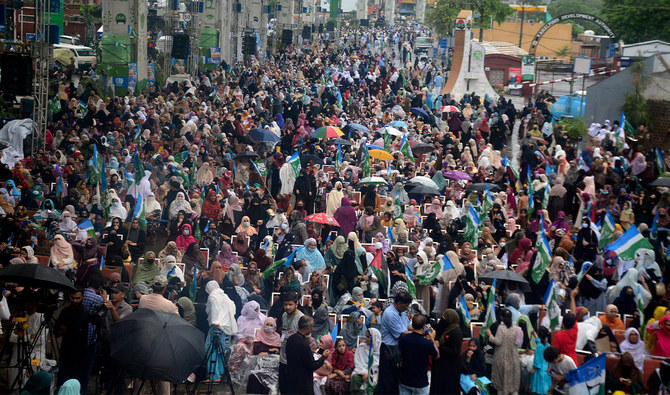

RAWALPINDI: A Pakistani religio-political party has vowed to continue its protest sit-in in Rawalpindi until the government meets its demands to address high costs of living, with the protest entering its fifth day on Tuesday.
Thousands of Jamaat-e-Islami (JI) party supporters have camped at Rawalpindi’s historic Liaqat Bagh ground since Friday to demand the government reduce petroleum levy, slash prices of essential products and revoke additional taxes introduced in last month's budget among other conditions.
JI chief Hafiz Naeem-ur-Rehman has also called for a reduction in power tariffs recommended by the International Monetary Fund (IMF) amid soaring inflation, along with a review of Pakistan’s loss-making agreements with independent power producers (IPPs).
The government of Prime Minister Shehbaz Sharif has formed a three-member negotiating committee, which held its first round of talks with the JI last week. The party laid its 10 demands in the meeting and has since been awaiting the government's response.
“We have presented our demands and now the government will tell us after the meeting of their technical committee and then we will decide [the future course of action] accordingly,” Liaqat Baloch, head of the JI negotiation team told Arab News on Monday.
“These talks [with the government] will continue, but the sit-in will also continue and we are hopeful that we will succeed in our purpose.”
The JI has called on the government to provide a 50 percent “relief” to those who consumed 500 units of electricity, reduce the prices of essential commodities by 20 percent and withdraw taxes on stationery items. It has also demanded the government slash its non-development expenditures by 35 percent and reduce its overall spending.
“The first round of talks happened yesterday and they [the government] have decided that they are forming a technical committee on all the issues so that they can fully review them and then can continue talks,” JI’s Baloch said, adding it was the need of the time that someone should step forward on these basic issues for the public.
FRUSTRATION AND ANGER
Arab News visited the site of the JI sit-in on Monday, where a large number of woman supporters had gathered after the party designated the fourth day of the protest for them.
Fouzia Ghani, a protest organizer from Rawalpindi, said their sit-in would continue until their demands were met, appealing more women to come and join them.
“We demand through this sit-in the government abolish these taxes and provide relief to the people,” she told Arab News.
The public sentiment at the sit-in was marked by widespread frustration and anger as demonstrators voiced their grievances over unfulfilled promises and rising costs of living.
Zahida Malik, a schoolteacher from Mianwali, traveled more than 200 kilometers to join the sit-in, driven by her "frustration over high electricity bills and rampant inflation."
“This issue affects everyone,” she told Arab News. “Women manage the household while men earn, so inflation impacts both.”
Pakistan’s inflation quickened in June for first time in six months as energy costs inched up, while consumer prices rose 12.57% on a year-on-year, according to data released by the country's statistics bureau.
Noor Muhammad, who previously worked at a hotel in Azad Kashmir, demanded the government address poverty and the issue of soaring electricity bills.
"I am unemployed but received a Rs15,000 bill for my home," he said, echoing the sentiments of several others at the protest. "From where should I pay? Should I provide ration or pay the Rs15,000 bill."
Evidently frustrated, Zaheer Abbasi, a security guard in Rawalpindi, called for the government to go home.
“Our first demand is to end this government, and our second demand is to correct our [electricity] bill and end the oppression that is being inflicted on us," he said. "I just came from the WAPDA [Water and Power Development Authority] office, and no one listened to me there."
'POSITIVE OUTCOME'
Speaking to reporters in Rawalpindi on Monday, Information Minister Attaullah Tarar expressed hope for a "positive outcome" of a meeting of the government's technical committee to discuss the protesters' demands.
“The technical committee will discuss all aspects and I hope they will come up with a solution,” he said.
About a possible march by protesters to the Red Zone in Islamabad that houses key government and diplomatic offices, Tarar said it was not permitted and no one would be allowed to enter the Red Zone or to violate the law.


