

Panama expects more Venezuelan migrants after disputed election

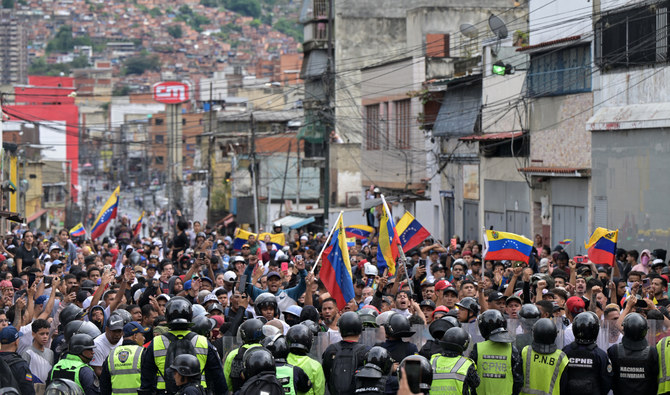
Opponents of Venezuelan President Nicolas Maduro's government protest in front of members of the Bolivarian National Police in the Catia neighborhood of Caracas on July 29, 2024, a day after the Venezuelan presidential election. (AFP)
Short Url
Updated 30 July 2024
Follow

Panama expects more Venezuelan migrants after disputed election

PANAMA CITY: Panama’s president on Monday predicted an increase in the number of US-bound Venezuelan migrants making the dangerous jungle trek from South America after their country’s disputed election.

“I think, and I hope I’m wrong, that the flow of Venezuelans will increase for obvious reasons,” Jose Raul Mulino told a news conference.

“We have to make the necessary decisions to protect their lives... and give expedited passage to people who want to immigrate to the United States,” he added.

The Darien Gap between Colombia and Panama has become a key corridor for Venezuelans and other migrants traveling overland from South America to the United States.

Despite the dangers posed by treacherous terrain and violent criminal gangs, more than half a million undocumented migrants crossed the Darien last year.

So far this year, more than 200,000 people have made the journey, mostly Venezuelans, according to Panamanian authorities.

Mulino vowed during his election campaign to deport migrants and close the key route.

After he took office on July 1, the conservative lawyer signed an agreement with Washington that pledged $6 million in US funding for repatriating undocumented migrants from Panama.

Mulino later appeared to soften his tone, however, saying, “We cannot forcibly repatriate” migrants.

Panama announced that it would withdraw its diplomats from Venezuela and suspend diplomatic ties after President Nicolas Maduro declared victory in Sunday’s election, which was disputed by opposition claims of fraud.


Carney says Canada has no plans to pursue free trade agreement with China as Trump threatens tariffs

Updated 26 January 2026
Follow

Carney says Canada has no plans to pursue free trade agreement with China as Trump threatens tariffs

TORONTO: Canadian Prime Minister Mark Carney said Sunday his country has no intention of pursuing a free trade deal with China. He was responding to US President Donald Trump’s threat to impose a 100 percent tariff on goods imported from Canada if America’s northern neighbor went ahead with a trade deal with Beijing.
Carney said his recent agreement with China merely cuts tariffs on a few sectors that were recently hit with tariffs.
Trump claims otherwise, posting that “China is successfully and completely taking over the once Great Country of Canada. So sad to see it happen. I only hope they leave Ice Hockey alone! President DJT”
The prime minister said under the free trade agreement with the US and Mexico there are commitments not to pursue free trade agreements with nonmarket economies without prior notification.
“We have no intention of doing that with China or any other nonmarket economy,” Carney said. “What we have done with China is to rectify some issues that developed in the last couple of years.”
In 2024, Canada mirrored the United States by putting a 100 percent tariff on electric vehicles from Beijing and a 25 percent tariff on steel and aluminum. China had responded by imposing 100 percent import taxes on Canadian canola oil and meal and 25 percent on pork and seafood.
Breaking with the United States this month during a visit to China, Carney cut its 100 percent tariff on Chinese electric cars in return for lower tariffs on those Canadian products.
Carney has said there would be an initial annual cap of 49,000 vehicles on Chinese EV exports coming into Canada at a tariff rate of 6.1 percent, growing to about 70,000 over five years. He noted there was no cap before 2024. He also has said the initial cap on Chinese EV imports was about 3 percent of the 1.8 million vehicles sold in Canada annually and that, in exchange, China is expected to begin investing in the Canadian auto industry within three years.
Trump posted a video Sunday in which the chief executive of the Canadian Vehicle Manufacturers’ Association warns there will be no Canadian auto industry without US access, while noting the Canadian market alone is too small to justify large scale manufacturing from China.
“A MUST WATCH. Canada is systematically destroying itself. The China deal is a disaster for them. Will go down as one of the worst deals, of any kind, in history. All their businesses are moving to the USA. I want to see Canada SURVIVE AND THRIVE! President DJT,” Trump posted on social media.
Trump’s post on Saturday said that if Carney “thinks he is going to make Canada a ‘Drop Off Port’ for China to send goods and products into the United States, he is sorely mistaken.”
“We can’t let Canada become an opening that the Chinese pour their cheap goods into the U.S,” US Treasury Secretary Scott Bessent said on ABC’s “This Week.”
“We have a , but based off — based on that, which is going to be renegotiated this summer, and I’m not sure what Prime Minister Carney is doing here, other than trying to virtue-signal to his globalist friends at Davos.”
Trump’s threat came amid an escalating war of words with Carney as the Republican president’s push to acquire Greenland strained the NATO alliance.
Carney has emerged as a leader of a movement for countries to find ways to link up and counter the US under Trump. Speaking in Davos before Trump, Carney said, “Middle powers must act together because if you are not at the table, you are on the menu” and he warned about coercion by great powers — without mentioning Trump’s name. The prime minister received widespread praise and attention for his remarks, upstaging Trump at the World Economic Forum.
Trump’s push to acquire Greenland has come after he has repeatedly needled Canada over its sovereignty and suggested it also be absorbed into the United States as a 51st state. He posted an altered image on social media this week showing a map of the United States that included Canada, Venezuela, Greenland and Cuba as part of its territory.