Protest by Baloch ethnic rights group enters third day in southwest Pakistan

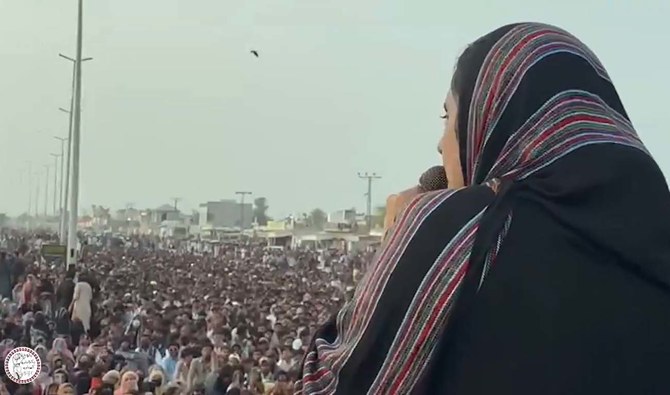
The still image taken from a video shows Baloch human rights activist Dr. Mahrang Baloch addressing a protest gathering in Gwadar, Pakistan, on July 28, 2024. (Photo courtesy: Baloch Yakjehti Committee/X)
Short Url
Updated 29 July 2024
Follow

Protest by Baloch ethnic rights group enters third day in southwest Pakistan

  • Baloch Yakjehti Committee is protesting alleged rights abuses, extra-judicial killings, enforced disappearances in Balochistan 
  • Government and security agencies deny involvement, BYC says will expand protests across province if detained members not released

QUETTA: An ethnic Baloch rights group on Monday gave the provincial government 48 hours to release all detained members, warning that it would expand its ongoing protest, now in its third day, across Pakistan’s southwestern Balochistan province if its demands were not met. 

The Baloch Yakjehti Committee (BYC) led by 31-year-old human rights activist Dr. Mahrang Baloch held a protest gathering on Sunday in the port city of Gwadar against alleged human rights abuses, extra-judicial killings and enforced disappearances in Balochistan that rights activists and the families of victims blame on Pakistani security forces. The government and security agencies deny involvement. 

On Saturday, protest leaders and officials confirmed over a dozen people who were en route to Gwadar to take part in Sunday’s demonstration were injured in clashes with paramilitary forces in Balochistan’s Mastung district. The BYC says one person was also killed in the violence, which officials say they are investigating. There has also been a complete Internet and mobile service blackout in the Gwadar and Kech districts, while the protests are currently centered in the cities of Gwadar, Mastung and Turbat.

“If the government doesn’t accept our demands, we will expand our protests across Balochistan,” Beberg Baloch, a BYC leader who is leading the protests in Mastung, told Arab News on Monday, adding that the group wanted all its arrested members released within 48 hours and provincial highways opened so people could move freely to protest sites. 

Beberg said the group’s leaders, including Dr. Mahrang, were currently in Gwadar and open to talks with the provincial government. 

Deputy Commissioner Quetta Saad Bin Asad said 22 people had been arrested in the provincial capital as they were disrupting traffic by blocking a main road.
 
The Balochistan province, which borders Iran and Afghanistan, has been the site of a low-level separatist insurgency for the last two decades. The insurgents say they are fighting what they see as the unfair exploitation of the province’s mineral wealth by the federation. The Pakistan government and army say they are working for the uplift of the impoverished province. 

Balochistan is also home to Pakistan’s only deep-sea port at Gwadar, a crucial trade route for the $46bn China-Pakistan Economic Corridor (CPEC) that was initiated by the Chinese government to link southwestern China to the Arabian Sea through Pakistan. 

Provincial home minister Meer Zia Ullah Langove said the latest protests were a “conspiracy” against CPEC, alleging a “foreign hand” in instigating the protests. 

“Despite being attacked by the protesters, people of Balochistan, police, and security forces have shown restraint to maintain peace,” Langove told Arab News. 

“The government considers the protesters as our brothers and sisters, we have to treat them with respect and we are ready to talk with them,” Langove added. “But defaming the state and [playing] personal politics on these [rights] issues has escalated the tensions.”

Meanwhile, life in various cities of Balochistan remained at a standstill for the third consecutive day, with protesters still blocking highways N-25 Quetta- Karachi, M-8 Turbat- Hoshab and a coastal highway that connects Gwadar with Pakistan’s commercial hub of Karachi. 

Pakistan says inflation to remain within 5-6 percent range in January

Updated 27 January 2026
Follow

Pakistan says inflation to remain within 5-6 percent range in January

  •  Current account projected to remain in deficit, says Finance Division in monthly economic outlook
  •  Pakistan suffered a financial crisis in 2023, marked by inflation of 38 percent, depleted forex reserves

KARACHI: Inflation is expected to remain within the 5-6 percent range in January, Pakistan’s Finance Division said in its monthly economic outlook report on Tuesday, saying that the country’s economy is well positioned to sustain growth momentum in FY2026. 

Consumer Price Index (CPI) inflation was recorded at 5.6 percent year-on-year (YoY) basis in December 2025 as compared to 6.1 percent in November 2025 and 4.1 percent in December 2024. 

“Inflation is expected to remain within the range of 5.0-6.0 percent in January,” the Finance Division said. 

“On the external front, the current account is projected to remain in a deficit; however, robust remittance inflows and steady performance in IT and services exports are likely to cushion external pressures.”

The report said that the “positive trajectory” of the economy reflects the impact of the government’s prudent policies, ongoing structural reforms and easing of monetary conditions due to subsiding inflationary pressures.

Earlier, Pakistan’s finance ministry adviser Khurram Schehzad said S&P Global Market Intelligence’s latest macroeconomic forecast for Pakistan broadly aligns with projections issued by the State Bank of Pakistan, signaling easing inflation, manageable external balances and a gradual recovery in economic growth.

The assessment came amid stabilizing macroeconomic indicators after Pakistan went through a prolonged financial crisis marked by record inflation of 38 percent, depleted foreign exchange reserves and repeated balance-of-payments pressures, culminating in emergency support from the International Monetary Fund.

Tighter monetary policy, fiscal consolidation and external financing have since helped stabilize prices and ease pressure on the external account, prompting more measured assessments from international credit rating agencies.

“S&P’s projections broadly align with SBP’s outlook, with slight differences on growth and the current account but a shared assessment of easing inflation and gradual economic improvement,” Schehzad said in a statement.

According to S&P, inflation is expected to average 5.1 percent in 2026 and edge up slightly to 5.6 percent in 2027, staying within the SBP’s projected range of 5 percent to 7 percent over the next two years.

On the external front, S&P forecast a current account deficit of 0.5 percent of gross domestic product in 2026, broadly in line with the central bank’s expectation that the deficit will remain between 0 percent and 1 percent of GDP in the fiscal year.

Economic growth is projected to strengthen gradually, with S&P forecasting real GDP growth of 3.5 percent in fiscal year 2026, rising to 4.4 percent the following year. The SBP has projected growth of 3.75 percent to 4.75 percent for FY26.

Both S&P and SBP projections echo the government’s assessment that macroeconomic conditions are stabilizing, as Pakistan seeks to attract foreign investment and push toward export-led growth.