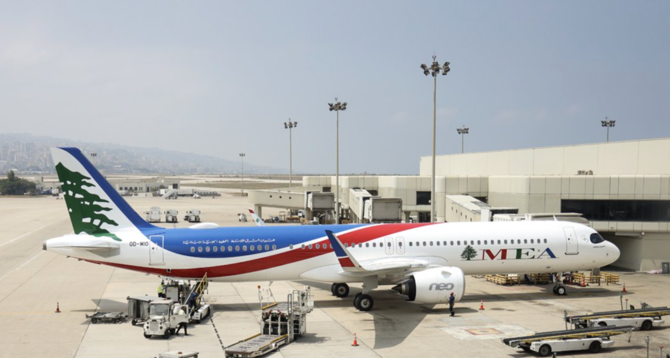
BEIRUT: Lebanon’s Middle East Airlines (MEA) said on Sunday it had delayed the departures of some incoming flights set to land in Beirut overnight to arrive on Monday morning instead.
Israel vowed swift retaliation against the Lebanese armed group Hezbollah after 12 children and teenagers were killed by a rocket in the Israeli-occupied Golan Heights on Saturday. Hezbollah denied responsibility.
Hezbollah and the Israeli military have been trading fire for nearly 10 months in parallel with the Gaza War, which has spread to several fronts across the region. Previous exchanges of fire have disrupted flights across the region.
MEA said in a statement that six flights incoming to Beirut overnight from London, Copenhagen and four other cities in the Middle East would be delayed so that they would instead take off on Monday morning.
MEA chairman Mohamad El-Hout told local broadcaster Al-Jadeed that the flight changes at Beirut’s Rafik Hariri International Airport were due to “insurance risks.”
“We’re not afraid that the airport will be hit, nor do we have any information in that regard. If we were scared, we wouldn’t have left any flights (operating),” he said.
Beirut airport was hit early in the last war between Hezbollah and Israel in 2006.
Passengers were still landing at the airport late on Sunday afternoon, according to a Reuters photographer. People were frantically checking indicator boards to see if more flights would be canceled or delayed.

Lebanon’s MEA delays some Beirut flight arrivals to Monday morning
https://arab.news/6m86r
Lebanon’s MEA delays some Beirut flight arrivals to Monday morning
- MEA said in a statement that six flights incoming to Beirut overnight from London, Copenhagen and four other cities in the Middle East would be delayed
UN rights chief Shocked by ‘unbearable’ Darfur atrocities
- Mediation efforts have failed to produce a ceasefire, even after international outrage intensified last year with reports of mass killings, rape, and abductions during the RSF’s takeover of El-Fasher in Darfur
PORT SUDAN: Nearly three years of war have put the Sudanese people through “hell,” the UN’s rights chief said on Sunday, blasting the vast sums spent on advanced weaponry at the expense of humanitarian aid and the recruitment of child soldiers.
Since April 2023, Sudan has been gripped by a conflict between the army and the paramilitary Rapid Support Forces that has left tens of thousands of people dead and around 11 million displaced.
Speaking in Port Sudan during his first wartime visit, UN Human Rights commissioner Volker Turk said the population had endured “horror and hell,” calling it “despicable” that funds that “should be used to alleviate the suffering of the population” are instead spent on advanced weapons, particularly drones.
More than 21 million people are facing acute food insecurity, and two-thirds of Sudan’s population is in urgent need of humanitarian aid, according to the UN.
In addition to the world’s largest hunger and displacement crisis, Sudan is also facing “the increasing militarization of society by all parties to the conflict, including through the arming of civilians and recruitment and use of children,” Turk added.
He said he had heard testimony of “unbearable” atrocities from survivors of attacks in Darfur, and warned of similar crimes unfolding in the Kordofan region — the current epicenter of the fighting.
Testimony of these atrocities must be heard by “the commanders of this conflict and those who are arming, funding and profiting from this war,” he said.
Mediation efforts have failed to produce a ceasefire, even after international outrage intensified last year with reports of mass killings, rape, and abductions during the RSF’s takeover of El-Fasher in Darfur.
“We must ensure that the perpetrators of these horrific violations face justice regardless of the affiliation,” Turk said on Sunday, adding that repeated attacks on civilian infrastructure could constitute “war crimes.”
He called on both sides to “cease intolerable attacks against civilian objects that are indispensable to the civilian population, including markets, health facilities, schools and shelters.”
Turk again warned on Sunday that crimes similar to those seen in El-Fasher could recur in volatile Kordofan, where the RSF has advanced, besieging and attacking several key cities.
Hundreds of thousands face starvation across the region, where more than 65,000 people have been displaced since October, according to the latest UN figures.


