Pakistan’s finance minister in Beijing to seek debt relief, say sources

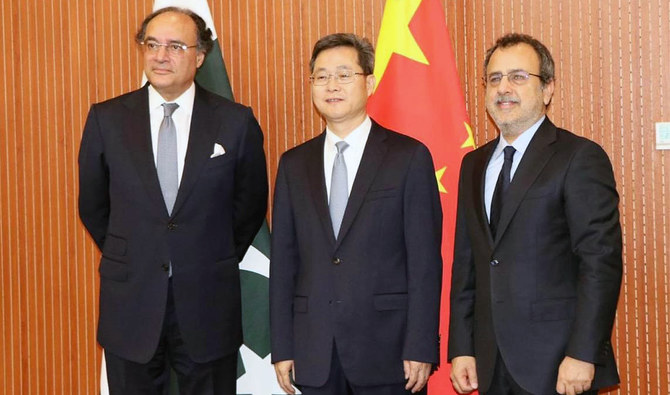
Pakistan's finance minister Muhammad Aurangzeb (left) is pictured with energy minister Sardar Awais Ahmad Khan Leghari (right) and his Chinese counterpart, Lan Fo’an, in Beijing, China, on July 25, 2024. (@akleghari/X)
Short Url
Updated 25 July 2024
Follow

Pakistan’s finance minister in Beijing to seek debt relief, say sources

  • Minister to discuss reprofiling of $15 billion energy sector debt with China, say sources
  • China has set up over $20 billion worth of planned energy projects in Pakistan

ISLAMABAD: Pakistan’s Finance Minister Muhammad Aurangzeb on Thursday arrived in Beijing to open talks on power sector structural reforms suggested by the International Monetary Fund (IMF), two government sources said.

He held a meeting with his Chinese counterpart in Beijing, they said, and added that the finance minister together with Power Minister Awais Leghari is leading a delegation, which will take up several proposals with the Chinese side, including reprofiling of nearly $15 billion energy sector debt.

The countries, which share a border, have been longtime allies.

Rollovers or disbursements on loans from China have helped Pakistan meet its external financing needs in the past.

Pakistan’s finance ministry, junior Finance Minister Ali Pervaiz Malik, and the Chinese finance ministry didn’t respond to a request for a comment.

Both the finance and power ministers told Reuters in interviews last week that they will be discussing the power sector reforms in their Beijing visit, though they did not specify the timing.

China has set up over $20 billion worth of planned energy projects in Pakistan.

The reforms has been suggested by the International Monetary Fund (IMF), which this month agreed on a $7 billion bailout for the heavily indebted South Asian economy.

Pakistan’s power sector has been plagued by high rates of power theft and distribution losses, resulting in accumulating debt across the production chain — a concern raised by the IMF.

The government is implementing structural reforms to reduce “circular debt” — public liabilities that build up in the power sector due to subsidies and unpaid bills — by 100 billion Pakistani rupees ($360 million) a year, Leghari has said.

Poor and middle-class households have been affected by a previous IMF bailout reached last year, which included raising power tariffs as part of the funding program that ended in April. 


Pakistan minister calls for integrating ocean awareness into education to preserve ecosystems

Updated 31 January 2026
Follow

Pakistan minister calls for integrating ocean awareness into education to preserve ecosystems

  • Pakistan’s maritime sector posted a record $360 million profit in 2025 following a year of sweeping reforms
  • Junaid Anwar Chaudhry says education equips youth to make informed decisions, contribute to blue economy

KARACHI: Pakistan’s Maritime Affairs Minister Junaid Anwar Chaudhry has urged integrating ocean awareness into formal education systems and empowering youth as active partners in order to preserve marine ecosystems, his ministry said on Saturday.

Chaudhry said this at a meeting with Minister of State for Education and Professional Training, Wajiha Qamar, who called on him and discussed strategies for enhancing marine education, literacy, and youth engagement in sustainable ocean management.

Pakistan’s maritime sector posted a record Rs100 billion ($360 million) profit in 2025 following a year of sweeping reforms aimed at improving port efficiency, cost-cutting, and safeguarding marine ecosystems to boost the blue economy.

“Understanding our oceans is no longer optional, it is essential for climate resilience, sustainable development, and the long-term health of our maritime resources,” Chaudhry said, highlighting the critical role of marine literacy.

The minister said education equips youth to make informed decisions and actively contribute to marine conservation and the blue economy, urging inclusion of marine ecosystems, conservation and human-ocean interactions into curricula, teacher training and global citizenship programs.

“Initiatives like ‘Ocean Literacy for All’ can mainstream these elements in national policies, school programs, and community workshops to build proactive citizenship on marine challenges,” he added.

Ocean Literacy for All is a UNESCO Intergovernmental Oceanographic Commission–coordinated global initiative under the UN Ocean Decade (2021–2030) that promotes ocean awareness, education, and conservation.

Chaudhry announced reforms in maritime education, including granting degree-awarding status to the Pakistan Marine Academy, and the establishment of the Maritime Educational Endowment Fund (MEEF) to provide scholarships for deserving children from coastal communities.

“The scholarship program promotes inclusive development by enabling access to quality education for youth from over 70 coastal and fishing communities, particularly in Sindh and Balochistan,” he said.

The discussions underscored raising awareness about oceans, coastal ecosystems and marine resources, according to the Pakistani maritime affairs ministry. Both ministers stressed the need to integrate climate and marine education from classrooms

to community programs, addressing risks like rising sea temperatures, coastal erosion, biodiversity loss and pollution.

“Incorporating marine science and ocean literacy into curricula can help students connect local challenges with global trends,” Qamar said, underscoring education’s transformative power in building social resilience.

The meeting explored translating complex marine science into accessible public knowledge through sustained, solution-oriented awareness campaigns, according to the maritime affairs ministry.

With coastline facing pressures from climate change, pollution, and overexploitation, the ministers called for a coordinated approach blending formal education, informal learning and youth-led advocacy.

“A joint effort by the Ministries of Maritime Affairs and Education can cultivate an ocean-literate generation, transforming vulnerability into resilience and ensuring the long-term sustainability of coastal and marine ecosystems,” Chaudhry said.