US banks to begin reporting Russian assets for eventual forfeiture under new law

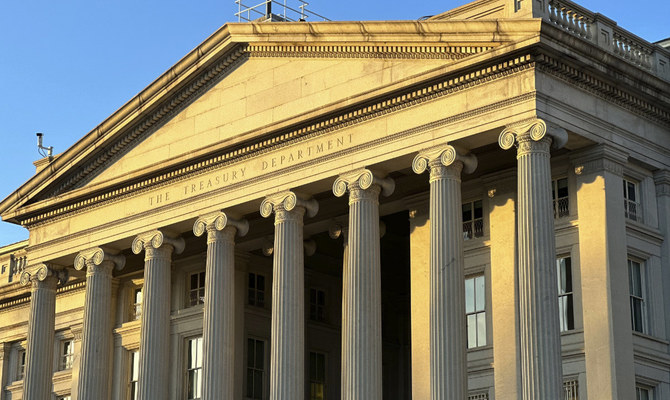
The Treasury Department is seen in Washington, Jan. 18, 2023. The department ordered the nation’s banking industry to start disclosing their holdings of Russian assets on Tuesday, July 23, 2024, with the goal of eventually seizing those billions of dollars in assets and selling them to aid the devastated Ukrainian economy. (AP)
Short Url
Updated 24 July 2024
Follow

US banks to begin reporting Russian assets for eventual forfeiture under new law

  • If a bank discovers any new Russian assets on their books after the deadline, those assets need to be reported within 10 days, the Treasury Department said

NEW YORK: The Treasury Department ordered the nation’s banking industry to start disclosing its holdings of Russian assets on Tuesday, with the goal of eventually seizing those billions of dollars in assets and selling them to aid the devastated Ukrainian economy.
The disclosure is required under a new law passed by Congress earlier this year known as the REPO Act, which gives the US government the authority to seize Russian state assets held by US banks, with the goal of eventually selling them and giving those funds to Ukraine. While the vast bulk of Russian assets are held in Europe, it is estimated that the US banking system holds as much as $6 billion in Russian assets in trust.
Banks will need to report Russian assets on their books no later than Aug. 2 to the Office of Foreign Assets Control. If a bank discovers any new Russian assets on their books after the deadline, those assets need to be reported within 10 days, the Treasury Department said.
Russia’s war in Ukraine, which began in February 2022, has killed tens of thousands but has also caused significant devastation to Ukraine’s economy and infrastructure. The World Bank estimated in February that Ukraine will need $486 billion for recovery and reconstruction, a figure that has only risen as the war has continued.
The US, Canada, France, Germany Italy, the UK and Japan — commonly known as the G7 — froze roughly $300 billion worth of Russian assets at the start of the war. These assets included hard currency, as well as gold and investments in publicly and privately-held companies. But there has been little conversation until this year about what to do with those frozen assets, until the idea of forfeiture and liquidation was included in the REPO Act.


Lithuania to declare ‘emergency situation’ over Belarus balloons: PM

Updated 05 December 2025
Follow

Lithuania to declare ‘emergency situation’ over Belarus balloons: PM

  • “We are currently preparing the legal basis and documents,” Ruginiene told reporters
  • “We do not rule out going further,” Ruginiene added. Declaring a state of emergency is a possible stronger step

VILNIUS: Lithuania’s Prime Minister announced on Friday that the country will declare a national “emergency situation” over the influx of smuggler’s balloons launched from Belarus.
“We are currently preparing the legal basis and documents,” Prime Minister Inga Ruginiene told reporters, calling the emergency declaration “the best course of action at this time.”
The ‘emergency situation’ enables the government and local authorities to dedicate extra resources to combatting the balloons.
“We do not rule out going further,” Ruginiene added. Declaring a state of emergency is a possible stronger step.
As a result of balloon incursions, Lithuania’s two largest airports, in Vilnius and Kaunas, have on several occasions been forced to halt operations.
Lithuanian officials claim that the balloons, which fly up to 10 kilometers (six miles) high, are deliberately being launched into the airport’s flight paths, and constitute an attack on its civil aviation.
Though the balloons, which contain cigarettes, have long been used by smugglers, they have only in the last few months prompted airport closures.
The Baltic state, a member of NATO and the European Union, has long accused Belarus, a close ally of Putin’s Russia, of organizing “hybrid warfare.”
The activity, which amplified in October, caused Lithuania to close its two border crossings with Belarus at the end of the month.
Belarus then prevented Lithuanian trucks from driving on its roads and barred them from leaving the country without first paying a fee, which Vilnius decried as “being held hostage” by Belarus.
Thousands of Lithuanian lorries remain stuck in Belarus, with Minsk calling for consultations with the Lithuanian foreign ministry.
Lithuania has instead called for harsher sanctions on Belarus.