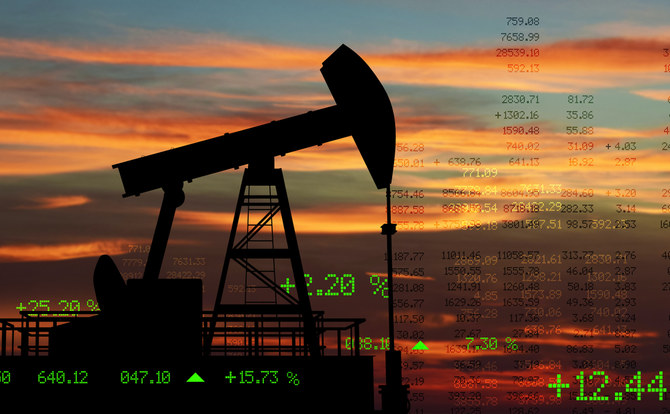
Oil Updates — crude steadies, weighed down by predicted surplus amid weak demand

Brent crude futures for September rose 11 cents to $82.51 a barrel by 09:45 a.m. Saudi time. US West Texas Intermediate crude for September climbed 5 cents to $78.45 per barrel. Shutterstock
Short Url
Updated 23 July 2024
Follow

Oil Updates — crude steadies, weighed down by predicted surplus amid weak demand

SINGAPORE: Oil prices steadied on Tuesday after falling for the past two sessions, as investors remained cautious amidst expectations of plentiful supplies and weak demand, while brushing off the US presidential campaign upheaval, according to Reuters.

Brent crude futures for September rose 11 cents to $82.51 a barrel by 09:45 a.m. Saudi time. US West Texas Intermediate crude for September climbed 5 cents to $78.45 per barrel.

Traders mostly ignored US President Joe Biden’s decision to call off his reelection bid and endorse Vice President Kamala Harris on Sunday. Citi analysts said they believed neither Harris nor Republican nominee Donald Trump would promote policies that would greatly affect oil and gas operations.

Instead, the market focused on fundamentals, which Morgan Stanley analysts said were likely to balance out by the fourth quarter and rise to a supply surplus by next year, which would drag down Brent prices to the mid-to-high $70s per barrel range.

Any uptick in oil prices was more because of market consolidation and dip buying activity, said Priyanka Sachdeva, senior market analyst at Phillip Nova.

“Any further weakening of demand signals, combined with a resolution in Gaza, could lead to a further decrease in oil prices,” Sachdeva said, adding that a swell in US inventories last week would be a sign of dented demand.

The American Petroleum Institute, a trade group, is due to release its estimates for last week’s oil inventories on Tuesday, while official US government data is scheduled to land on Wednesday.

A preliminary Reuters poll of six analysts estimated that US crude stocks, on average, fell by 2.5 million barrels in the week to July 19, while gasoline stocks likely dropped by 500,000 barrels.

The market is also watching developments in Russia. The Tuapse oil refinery, its biggest on the Black Sea, was damaged in a major Ukrainian drone attack that sparked a fire, Russian officials said on Monday, though the extent of the damage was not immediately clear.

“Further strikes on Russian refinery capacity would support refined product prices, due to lower output, and somewhat bearish for crude oil, as it would increase availability of crude oil for export,” said ING market strategists in a note.


Egypt’s annual inflation falls to 10.3% in December: CAMPAS  

Updated 11 January 2026
Follow

Egypt’s annual inflation falls to 10.3% in December: CAMPAS  

RIYADH: Egypt’s annual headline inflation rate slowed sharply to 10.3 percent in December, down from 23.4 percent in the same month a year earlier, official data showed. 

According to the Central Agency for Public Mobilization and Statistics, the overall consumer price index reached 264.2 points in December. On a monthly basis, inflation rose marginally by 0.1 percent. 

CAPMAS attributed the annual deceleration primarily to a decline in food prices, including a 1.1 percent drop in meat and poultry, 1.2 percent in dairy, cheese and eggs, 1 percent in fruits, 2 percent in vegetables, and 0.1 percent in sugar and sugary products. 

Prices of household appliances, audio-visual equipment and information technology devices also declined by 0.5 percent and 0.4 percent, respectively. 

However, other categories recorded increases, including grains and bread by 0.1 percent, oils and fats by 0.3 percent, and beverages such as coffee, tea and cocoa by 0.1 percent. 

Month-on-month inflation showed limited movement, with food and beverage prices falling by 0.8 percent due to similar declines in meat, dairy, fruit and vegetable prices. In contrast, modest cost increases were recorded in grains, oils and beverages. 

Alcohol and tobacco prices rose by 0.2 percent, while clothing and footwear increased by 0.7 percent, driven by higher prices for fabrics, up 1.6 percent, ready-made garments, up 0.4 percent, and footwear, up 1.6 percent. 

Housing and utilities recorded an increase of 1.5 percent, reflecting a 1.9 percent rise in actual rents, a 1.6 percent increase in electricity, gas and other fuels, and a 0.5 percent rise in maintenance costs. 

Furniture and household equipment prices climbed 0.9 percent, while healthcare rose by 0.5 percent, led by outpatient services, up 1 percent, and hospital services, up 1.8 percent. Transport costs increased by 0.2 percent, and recreational and cultural services rose by 0.6 percent, including a 1.5 percent increase in organized travel. 

Annual inflation data showed a broad-based increase across most sectors. Food and beverages rose by 0.9 percent year on year, with fruits up 22.6 percent, despite a 4.1 percent decline in meat and poultry and a 4.8 percent drop in vegetables. 

Alcohol and tobacco prices jumped 18.2 percent, while clothing and footwear climbed 14 percent. Housing and utilities surged 22.5 percent, largely due to higher rents and energy prices. 

Healthcare recorded one of the highest annual increases at 23.9 percent, driven by a 28.9 percent rise in medical equipment prices and a 21 percent increase in hospital services. Transport costs rose by 21.1 percent, education by 10 percent, and restaurants and hotels by 13 percent. 

The category of miscellaneous goods and services registered a 12.2 percent annual increase, with personal care products rising 13 percent and personal belongings up 27.2 percent.