

‘Give me his body’: Relatives grieve victims of Bangladesh unrest

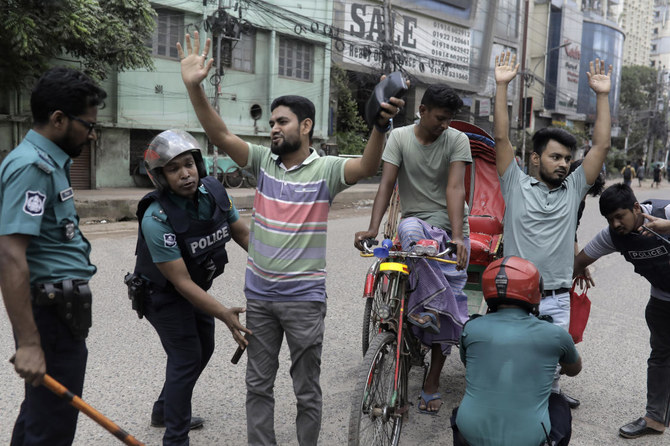
Police officers frisk commuters during a curfew imposed after scores were killed and hundreds injured in clashes over the allocation of civil service jobs, in Dhaka, Bangladesh, Sunday July 21, 2024. (AP)
Short Url
Updated 22 July 2024
Follow

‘Give me his body’: Relatives grieve victims of Bangladesh unrest

  • Faith’s customs dictate that anyone who dies must be given a prompt burial

DHAKA: Grief-stricken widow Fatema Begum wept when hospital staff said her husband had been killed in the unrest that has roiled Bangladesh for nearly a week. She wept again when they refused to hand over his body.
Islam is the majority religion in the south Asian country, where 155 people have died since Tuesday in clashes between student protesters and police over contentious civil service hiring rules.
The faith’s customs dictate that anyone who dies must be given a prompt burial.
But staff at one of the biggest hospitals in the capital Dhaka has a longstanding requirement to only release bodies to relatives with police permission, and that is no longer easily forthcoming.
“Where is my husband?” Begum, 40, shouted at staffers outside the hospital’s morgue, tears streaming down her cheeks. “Give me his body.”
Begum’s husband Kamal Mia, 45, eked out a tough living as a pedal-rickshaw driver, transporting people around the sprawling megacity of 20 million people for the equivalent of a dollar per fare.
The family says he was not taking part in any of the clashes that have wrought widespread destruction around the city, but was killed by stray police fire.
Begum and her two daughters were told to go to a nearby police station for clearance. When her eldest daughter Anika went there, it was barricaded shut.
Officers had closed the station after arson attacks on dozens of police posts by protesters.
Anika was then sent to another police station farther away — a 10-kilometer (six-mile) round trip from the hospital — despite a nationwide government-imposed curfew.
Police there refused to give the necessary permission for the release of the body.
“My father was not a protester,” Anika said. “Why did my father have to die?“

Mia was among more than 60 people whose deaths in the unrest were recorded at Dhaka Medical College Hospital, the country’s largest health care facility in the heart of the capital.
The relentless influx of patients since the start of the police crackdown on protesters has stretched the hospital to its limits.
Ambulances, private cars and rickshaws carrying the wounded were at one point arriving an average of once per minute, an AFP correspondent at the scene saw.
The entry gate of the emergency department, guarded by paramilitary Ansar forces, was blood-stained.
As soon as casualties arrive, staff rush with stretchers and trolleys. Some wounded people were given first aid for a rubber bullet, while others who were hit by injuries had to wait — sometimes for hours — for the doctors on duty.
Some are brought in already dead. Loved ones burst into tears as soon as a doctor or nurse makes it official.
A group of volunteers stood by the emergency department using loudhailers to call for blood donors after the hospital’s stocks were depleted.
Among the dozens of grieving relatives at the hospital, the steps the police took to quell the student demonstrations have prompted untempered fury against Prime Minister Sheikh Hasina’s government.
“Hasina’s police have killed my son to keep her in power,” the father of a 30-year-old mobile phone shop owner shot dead in the capital, who asked not to be identified, told AFP.
“God will punish her for this unjust torture.”


In Ethiopia, Tigrayans fear return to ‘full-scale war’

Updated 02 February 2026
Follow

In Ethiopia, Tigrayans fear return to ‘full-scale war’

  • Flights have been suspended into Tigray since Thursday and local authorities reported drone strikes on goods lorries
  • The international community fears the fighting could turn into an international conflict between Ethiopia and Eritrea

ADDIS ABABA: Tigrayans in northern Ethiopia fear a return to all-out war amid reports that clashes were continuing between local and federal forces on Monday, barely three years after the last devastating conflict in the region.
The civil war of 2020-2022 between the Ethiopian government and Tigray forces killed more than 600,000 people and a peace deal known as the Pretoria Agreement has never fully resolved the tensions.
Fighting broke out again last week in a disputed area of western Tigray called Tselemt and the Afar region to the east of Tigray.
Abel, 38, a teacher in Tigray’s second city Adigrat, said he still hadn’t recovered from the trauma of the last war and had now “entered into another round of high anxiety.”
“If war breaks out now... it could lead to an endless conflict that can even be dangerous to the larger east African region,” added Abel, whose name has been changed along with other interviewees to protect their identity.
Flights have been suspended into Tigray since Thursday and local authorities reported drone strikes on goods lorries on Saturday that killed at least one driver.
In Afar, a humanitarian worker, speaking to AFP on condition of anonymity, said there had been air strikes on Tigrayan forces and that clashes were ongoing on Monday, with tens of thousands of people displaced.
AFP could not independently verify the claims and the government has yet to give any comment on the clashes.
In the regional capital Mekele, Nahom, 35, said many people were booking bus tickets this weekend to leave, fearing that land transport would also be restricted soon.
“My greatest fear is the latest clashes turning into full-scale war and complete siege like what happened before,” he told AFP by phone, adding that he, too, would leave if he could afford it.
Gebremedhin, a 40-year-old civil servant in the city of Axum, said banks had stopped distributing cash and there were shortages in grocery stores.
“This isn’t only a problem of lack of supplies but also hoarding by traders who fear return of conflict and siege,” he said.
The region was placed under a strict lockdown during the last war, with flights suspended, and banking and communications cut off.
The international community fears the fighting could turn into an international conflict between Ethiopia and Eritrea, whose relations have been increasingly tense in recent months.
The Ethiopian government accuses the Tigrayan authorities and Eritrea of forging closer ties.
United Nations Secretary-General Antonio Guterres is “deeply concerned about... the risk of a return to a wider conflict in a region still working to rebuild and recover,” his spokesman said.
The EU said that an “immediate de-escalation is imperative to prevent a renewed conflict.”