

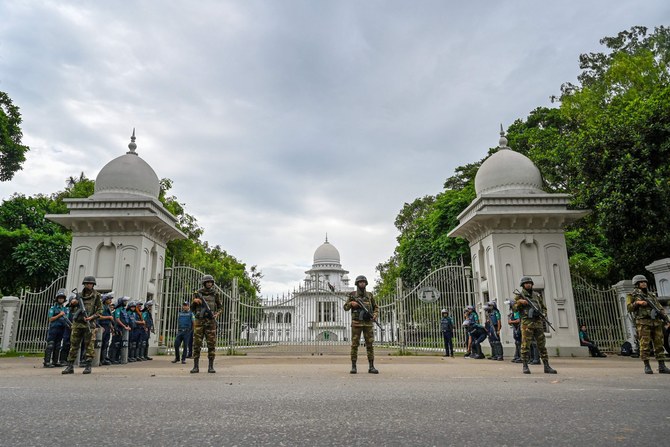

DHAKA: Bangladesh’s Supreme Court on Sunday scrapped most of the quotas on government jobs that had sparked nationwide unrest in the country and resulted in deadly clashes between police and student protesters that killed more than 100 people in the past week.
University students have been demonstrating on campuses since the beginning of July to demand a reformation of the quota system that reserved 30 percent of government jobs for relatives of veterans who fought in Bangladesh’s 1971 liberation war.
The government abolished the quotas after student protests in 2018, but it was reinstated by Bangladesh’s High Court last month, setting off a new round of demonstrations that was met with a harsh crackdown, including a curfew and a communications blackout that left the country of 170 million people cut off from the world.
Ruling on an appeal, Attorney General AM Amin Uddin said the Supreme Court had ordered for the quota reserved for veterans to be cut to 5 percent and for 93 percent of jobs to be allocated on merit. The remaining 2 percent will be reserved for members of ethnic minorities and people with disabilities.
“In the future, the government may change the ratio if needed,” Uddin told Arab News.
“Now, I will send a copy of the verdict to the law minister for the next steps. (I) hope a gazette will be published in this regard within the next couple of days.”
The verdict came after demonstrations spiraled into deadly clashes, prompting authorities to impose a curfew ahead of the Supreme Court hearing, which Home Minister Asaduzzaman Khan told Agence France-Presse news agency will continue “until the situation improves.”
The military was on patrol in the streets of Dhaka, along with riot police and thousands of Border Guard personnel as all gatherings were banned amid an increasing number of casualties.
At least 148 people have been killed in the past week and thousands injured, according to a count based on reports in the local media.
Inamul Haq Sagar, spokesman for the police, told Arab News: “We are on the highest alert across the country to maintain law and order.”
He added that at least three policemen had been killed and about 1,000 police officers injured during clashes in the past few days.
He said: “Since the curfew is underway, I urge all to be respectful to the law of the country and refrain from any destructive activities.”
It was not immediately clear how protesters would react to the decision by the Supreme Court.
Students had taken to the streets as the government quotas, which reserve hundreds of thousands of well-paid government jobs, affect young people directly.
The country’s unemployment rate is highest among people aged between 15 and 29 — more than a quarter of Bangladesh’s population — which constitutes 83 percent of the total without jobs.


