

Pakistan offers counter-terrorism support to Oman after six killed in mosque attack

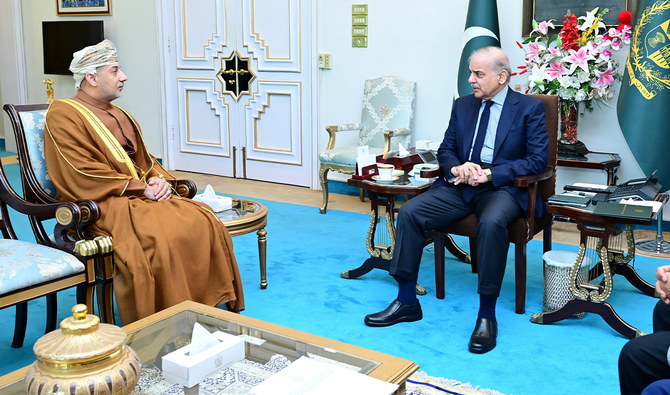
Ambassador of Oman, Fahad Sulaiman Khalaf Al-Kharusi, calls on Prime Minister Shehbaz Sharif in Islamabad, Pakistan on July 19, 2024. (Government of Pakistan)
Short Url
Updated 19 July 2024
Follow

Pakistan offers counter-terrorism support to Oman after six killed in mosque attack

  • Sharif offered support in meeting with Omani ambassador hours after bodies of four Pakistanis were brought home, handed over to families
  • The Pakistan prime minister thanked the Omani envoy for encouraging a trade, investment delegation to undertake a visit to Pakistan next week

ISLAMABAD: Prime Minister Shehbaz Sharif on Friday offered Pakistan’s support to Oman after a mosque attack in Muscat killed six people, including four Pakistanis, and injured dozens of others this week, Sharif's office said.

The statement came after Sharif's meeting with Omani Ambassador Fahad Sulaiman Khalaf Al-Kharusi that followed the arrival of bodies of Pakistanis who were killed in Monday's attack claimed by the Daesh militant group.

The attack unfolded as three gunmen, all brothers and of Omani nationality, opened fire on worshippers at a Shia Muslim mosque. Two others killed in the attack included an Indian and a police officer who responded to the attack.

"The Prime Minister strongly condemned the dastardly terrorist attack on Imam Bargah Ali bin Abu Talib in Wadi Kabir district of Muscat, which resulted in the death of six people, including four Pakistani nationals and over thirty injured, nearly all of whom were Pakistanis," Sharif's office said in a statement. 

"While appreciating Oman’s swift response and cooperation with the Pakistan Mission in repatriation of the dead bodies and treatment of the injured, the Prime Minister said Pakistan had itself been the victim of terrorism for the past several decades. He offered Pakistan’s support to Oman in dealing with the menace of terrorism, which must be eliminated in all its forms."

The statement came hours after bodies of the four Pakistani nationals killed in the Muscat mosque attack were brought back home by the Pakistan International Airlines (PIA) and handed over to their families.

Monday evening marked the beginning of Ashura, an annual period of mourning marked by Shia Muslims to commemorate the 7th-century death of Imam Hussain, a grandson of the Prophet Muhammad (peace be upon him).

Daesh’s operations have indicated the group is attempting a comeback after it was crushed by a US-led coalition following its occupation of large swathes of territory in Iraq and Syria and declared a caliphate. It also inspired lone-wolf attacks in the West.

Any inroads in Gulf Arab oil producers such as Oman would raise fears in Washington and the region which has long viewed militant groups as a major threat.

TRADE AND INVESTMENT

During the meeting, the prime minister conveyed his good wishes for Sultan Haitham bin Tariq and reiterated his invitation to the Omani leader to undertake an official visit to Pakistan at his earliest convenience, according to the statement.

He expressed Pakistan’s desire to further strengthen bilateral cooperation between the two countries, particularly in trade, investment, energy and defense.

"The Prime Minister thanked the Ambassador for encouraging a trade and investment delegation to undertake a visit to Pakistan next week, while assuring him that the concerned authorities would extend full cooperation to the delegation while seeking mutually beneficial outcomes," Sharif's office said.

"The Ambassador thanked the Prime Minister for receiving him and conveyed the greetings of His Majesty the Sultan of Oman. He reaffirmed his country's desire to further enhance its trade and investment relations with Pakistan."

Pakistan, which narrowly escaped a default last year, is currently navigating a tricky path to economic recovery. The South Asian country recently reached a staff-level agreement with the International Monetary Fund (IMF) for a $7 billion loan.

Apart from IMF deal, Islamabad has high-level exchanges with several countries, particularly the Gulf states, in a bid to boost trade and foreign investment in the country to support the $350 billion South Asian economy.


Pakistan minister calls for integrating ocean awareness into education to preserve ecosystems

Updated 5 sec ago
Follow

Pakistan minister calls for integrating ocean awareness into education to preserve ecosystems

  • Pakistan’s maritime sector posted a record $360 million profit in 2025 following a year of sweeping reforms
  • Junaid Anwar Chaudhry says education equips youth to make informed decisions, contribute to blue economy

KARACHI: Pakistan’s Maritime Affairs Junaid Anwar Chaudhry has urged integrating ocean awareness into formal education systems and empowering youth as active partners in order to preserve marine ecosystems, his ministry said on Saturday.

Chaudhry said this at a meeting with Minister of State for Education and Professional Training, Wajiha Qamar, who called on him and discussed strategies for enhancing marine education, literacy, and youth engagement in sustainable ocean management.

Pakistan’s maritime sector posted a record Rs100 billion ($360 million) profit in 2025 following a year of sweeping reforms aimed at improving port efficiency, cost-cutting, and safeguarding marine ecosystems to boost the blue economy.

“Understanding our oceans is no longer optional, it is essential for climate resilience, sustainable development, and the long-term health of our maritime resources,” Chaudhry said, highlighting the critical role of marine literacy.

The minister said education equips youth to make informed decisions and actively contribute to marine conservation and the blue economy, urging inclusion of marine ecosystems, conservation and human-ocean interactions into curricula, teacher training and global citizenship programs.

“Initiatives like ‘Ocean Literacy for All’ can mainstream these elements in national policies, school programs, and community workshops to build proactive citizenship on marine challenges,” he added.

Ocean Literacy for All is a UNESCO Intergovernmental Oceanographic Commission–coordinated global initiative under the UN Ocean Decade (2021–2030) that promotes ocean awareness, education, and conservation.

Chaudhry announced reforms in maritime education, including granting degree-awarding status to the Pakistan Marine Academy, and the establishment of the Maritime Educational Endowment Fund (MEEF) to provide scholarships for deserving children from coastal communities.

“The scholarship program promotes inclusive development by enabling access to quality education for youth from over 70 coastal and fishing communities, particularly in Sindh and Balochistan,” he said.

The discussions underscored raising awareness about oceans, coastal ecosystems and marine resources, according to the Pakistani maritime affairs ministry. Both ministers stressed the need to integrate climate and marine education from classrooms

to community programs, addressing risks like rising sea temperatures, coastal erosion, biodiversity loss and pollution.

“Incorporating marine science and ocean literacy into curricula can help students connect local challenges with global trends,” Qamar said, underscoring education’s transformative power in building social resilience.

The meeting explored translating complex marine science into accessible public knowledge through sustained, solution-oriented awareness campaigns, according to the maritime affairs ministry.

With coastline facing pressures from climate change, pollution, and overexploitation, the ministers called for a coordinated approach blending formal education, informal learning and youth-led advocacy.

“A joint effort by the Ministries of Maritime Affairs and Education can cultivate an ocean-literate generation, transforming vulnerability into resilience and ensuring the long-term sustainability of coastal and marine ecosystems,” Chaudhry said.