

Tel Aviv blast leaves 1 dead, caused by ‘falling aerial target’

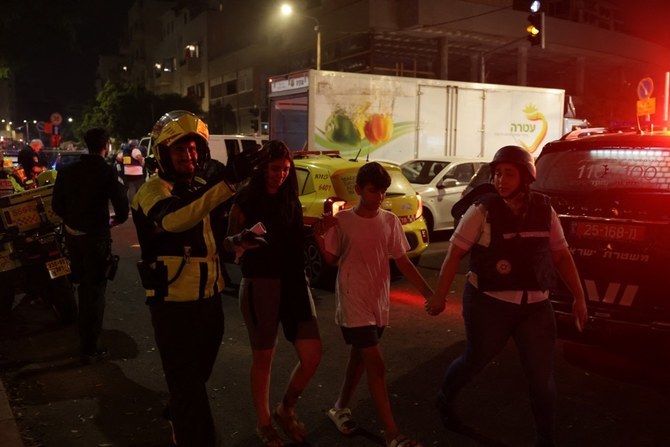
Emergency personnel assist people at the site of an explosion amid the Israel-Hamas conflict in Tel-Aviv, Israel. (Reuters)
Short Url
Updated 19 July 2024
Follow

Tel Aviv blast leaves 1 dead, caused by ‘falling aerial target’

  • Emergency services said the explosion took place around 0015 GMT in a building in the center of the city
  • Police and bomb disposal units were deployed to the scene and conducted searches for suspicious objects

TEL AVIV: An explosion in Tel Aviv early Friday left one person dead, an Israeli emergency services spokesperson said, with the army saying a falling “aerial target” caused the blast.

Emergency services said the explosion took place around 03:15 am (0015 GMT) in a building in the center of the city. Two people were lightly injured, Zaki Heller of the Magen David Adom medical service said.

An earlier police report had said seven people were injured, but they were mainly in a state of shock, Heller added.

The army said an initial inquiry showed that the explosion was “caused by the falling of an aerial target.”

“No sirens were activated,” it said in a statement, adding that the air force had “increased its air patrols in order to protect Israeli airspace.”

A resident of central Tel Aviv said he had been woken by a loud explosion.

“Everything shook,” he said.

Police found a body bearing injuries caused by shrapnel in the building, which is located on the corner of Ben-Yehuda Avenue and Shalom-Aleichem Street, not far from an annex of the US Embassy in Israel, spokesperson Dean Elsdunne said.

“It may have been an aerial explosion... We were very lucky,” said Peretz Amar, a Tel Aviv police commander at the scene, adding an investigation was “ongoing.”

“The police, along with emergency and rescue forces, discovered a man in his 50s in a nearby building who was found dead in his apartment, with shrapnel wounds on his body,” a police statement said.

Another 10 people with minor injuries were taken for medical treatment, it said.

Police and bomb disposal units were deployed to the scene and conducted searches for suspicious objects and additional threats, the statement added.

Residents were urged to “respect safety instructions and not to approach or touch debris or shrapnel that may contain explosives,” it said.


Hezbollah chief accuses Israel of ignoring ceasefire agreement

Updated 3 sec ago
Follow

Hezbollah chief accuses Israel of ignoring ceasefire agreement

  • Naim Qassem says moves to disarm his group in Lebanon are an 'Israeli-American plan'
  • Lebanese military is expected to complete Hezbollah’s disarmament south of Litani River as oart of ceasefire
BEIRUT: Hezbollah leader Naim Qassem on Sunday said moves to disarm the group in Lebanon are an “Israeli-American plan,” accusing Israel of failing to abide by a ceasefire agreement sealed last year.
Under heavy US pressure and fears of expanded Israeli strikes, the Lebanese military is expected to complete Hezbollah’s disarmament south of the Litani River — located about 30 kilometers (19 miles) from the border with Israel — by the end of the year.
It will then tackle disarming the Iran-backed movement in the rest of the country.
“Disarmament is an Israeli-American plan,” Qassem said.
“To demand exclusive arms control while Israel is committing aggression and America is imposing its will on Lebanon, stripping it of its power, means that you are not working in Lebanon’s interest, but rather in the interest of what Israel wants.”
Despite a November 2024 ceasefire that was supposed to end more than a year of hostilities between Israel and the Iran-backed Hezbollah group, Israel has kept up strikes on Lebanon and has maintained troops in five areas it deems strategic.
According to the agreement, Hezbollah was required to pull its forces north of the Litani River and have its military infrastructure in the vacated area dismantled.
Israel has questioned the Lebanese military’s effectiveness and has accused Hezbollah of rearming, while the group itself has rejected calls to surrender its weapons.
“The deployment of the Lebanese army south of the Litani River was required only if Israel had adhered to its commitments... to halting the aggression, withdrawing, releasing prisoners, and having reconstruction commence,” Qassem said in a televised address.
“With the Israeli enemy not implementing any of the steps of the agreement... Lebanon is no longer required to take any action on any level before the Israelis commit to what they are obligated to do.”
Lebanese army chief Rodolphe Haykal told a military meeting on Tuesday “the army is in the process of finishing the first phase of its plan.”
He said the army is carefully planning “for the subsequent phases” of disarmament.