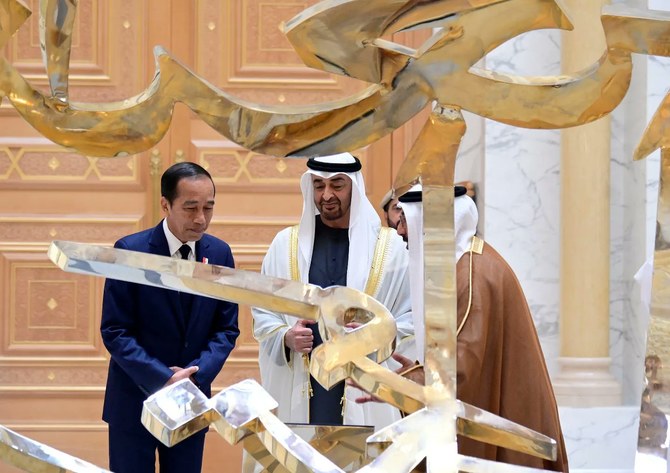

JAKARTA: Indonesian President Joko Widodo secured a deal during his UAE trip to involve Dubai’s financial hub in the new capital project, Nusantara, his office said on Thursday.
Widodo arrived in the UAE on a two-day working visit on Tuesday and was hosted by the Gulf state’s president, Sheikh Mohamed bin Zayed Al-Nahyan.
The two countries agreed to “significant bilateral cooperation in various sectors,” Indonesia’s Cabinet Secretariat said in a statement, as it listed eight agreements signed during the trip, including in the areas of renewable energy, tourism ecosystems, payments systems, and the “MoU (memorandum of understanding) between the international financial hub Dubai International Financial Centre Authority and the Nusantara National Capital Authority.”
Southeast Asia’s largest economy is relocating its capital to Borneo island to replace the overcrowded and sinking Jakarta on Java island, with the $33 billion megaproject scheduled for completion in 2045.
The mammoth undertaking is expected to mostly rely on private investors, with government funding planned to cover 20 percent of the total expenditure.
“In the field of strategic investment, the UEA’s contribution is increasingly significant in the development of the Indonesian Capital City,” Widodo said on X.
While construction works are underway and the central government expected to begin operations in the new city in 2024, the new capital has begun work on its financial center area, where Indonesia’s largest state-owned banks — Bank Mandiri, Bank Rakyat Indonesia, and Bank Negara Indonesia — broke ground on their new corporate offices earlier this year.
The financial center will cover 260 hectares within the city’s broader business district.
Through the MoU between Dubai International Financial Centre and Nusantara Capital City Authority, Indonesia and the UAE are “forming a new framework to ultimately grow the two financial ecosystems,” DIFC governor Essa Kazim said, the UAE state news agency reported on Thursday.
“As the UAE and Indonesia collaborate and innovate to drive economic growth and social impact in both countries, DIFC as MEASA’s (the Middle East, Africa, and Southern Asia) global leading financial center, is perfectly positioned to facilitate significant opportunities by way of this strategic partnership,” he said.
The ambitious move to relocate the capital from Jakarta about 2,000 km away in the middle of a forest is a flagship project for Widodo, who officially launched it in 2019.
The first phase of construction is scheduled for completion in 2024, in what has been widely seen as the president’s attempt to seal his legacy before the end of his second and final term in office in October this year.
During the UAE trip, Sheikh Mohamed presented Widodo with the Order of Zayed for his efforts in strengthening UAE-Indonesian relations.
The order is the highest civilian honor in the UAE and is bestowed upon leaders and heads of state.
During Widodo’s second term, the countries signed a Comprehensive Economic Partnership Agreement in July 2022 — Indonesia’s first free trade deal with a Middle Eastern country.
“Building upon the close and enduring ties between the UAE and Indonesia, we explored opportunities to further expand our economic partnership,” Sheikh Mohamed said on X.
“I extend my sincere thanks to President Widodo for his tireless efforts during his time in office to strengthen the bonds between our two nations.”