JAKARTA: For more than a decade, Ade Koswara has served as a perfusionist of the cardiac surgery team at one of Saudi Arabia’s top hospitals, working alongside some of the best in the field.
The 42-year-old Indonesian, who is originally from Sukabumi, West Java, was responsible for operating the machine that artificially replaces a patient’s heart or lung functions during surgery.
Since joining the King Faisal Specialist Hospital and Research Center in Riyadh in 2010, he said he has been able to develop his skills and has gained new, previously unthinkable, experiences.
“There are many precious things I have gained, especially the knowledge and skills that I acquired,” Koswara told Arab News.
“There are many new devices and equipment that aren’t yet available in Indonesia because they are very expensive, but they have a lot of them here with the amazing support from the government for the people in Saudi Arabia.”
When he decided to move abroad, like many Indonesians Koswara considered the financial benefits of working in the Kingdom, which would have given him about eight times the salary he was earning at the time from a public hospital in his home country.
“There’s a significant difference financially, in terms of material rewards,” he said. “In 2010, I was earning about IDR 6 million ($372) (per month), which included benefits and incentives, but in Saudi Arabia, I would earn about IDR 50 million.”
Since moving to Riyadh, Koswara — who is also head of the Indonesian National Nurses Association’s chapter in Saudi Arabia — has worked alongside doctors from the US and Europe and learned to keep up with the international standard practiced at the hospital, which has sent him abroad for training to upgrade his skills.
“I had the opportunity to go to Germany and it was amazing because there was a time when I’d dreamed of going there and it came true … It makes me happy and motivated,” he said.
“Opportunities here are equal. It’s not just for the Saudis, it’s also there when they see potential in any staff, even when they’re not Saudi nationals.”
Koswara said there is much potential for other Indonesian nurses to pursue a career in Saudi Arabia.
“For Indonesian nurses especially, the opportunity for an international career in the Middle East, especially in Saudi Arabia, is huge. We have the potential to enter this market, to gain new and better experiences, and hopefully a better financial reward,” he said.
Saudi Arabia is among the top destination countries for Indonesian migrant workers and ranked seventh last year, according to government data.
But as most of them are domestic workers, Koswara estimated that there are at least around 600 Indonesian nurses currently working in the Kingdom.
Another one is Akhir Fahruddin, who first went to the Kingdom in 2015 to work under the Ministry of Labor and Social Development, which has since become the Ministry of Human Resources and Social Development.
After working for almost three years, Fahruddin came back to Indonesia to continue his studies before returning to Riyadh in 2021 to work as an occupational health nurse, now specializing in protecting and promoting the health and well-being of workers.
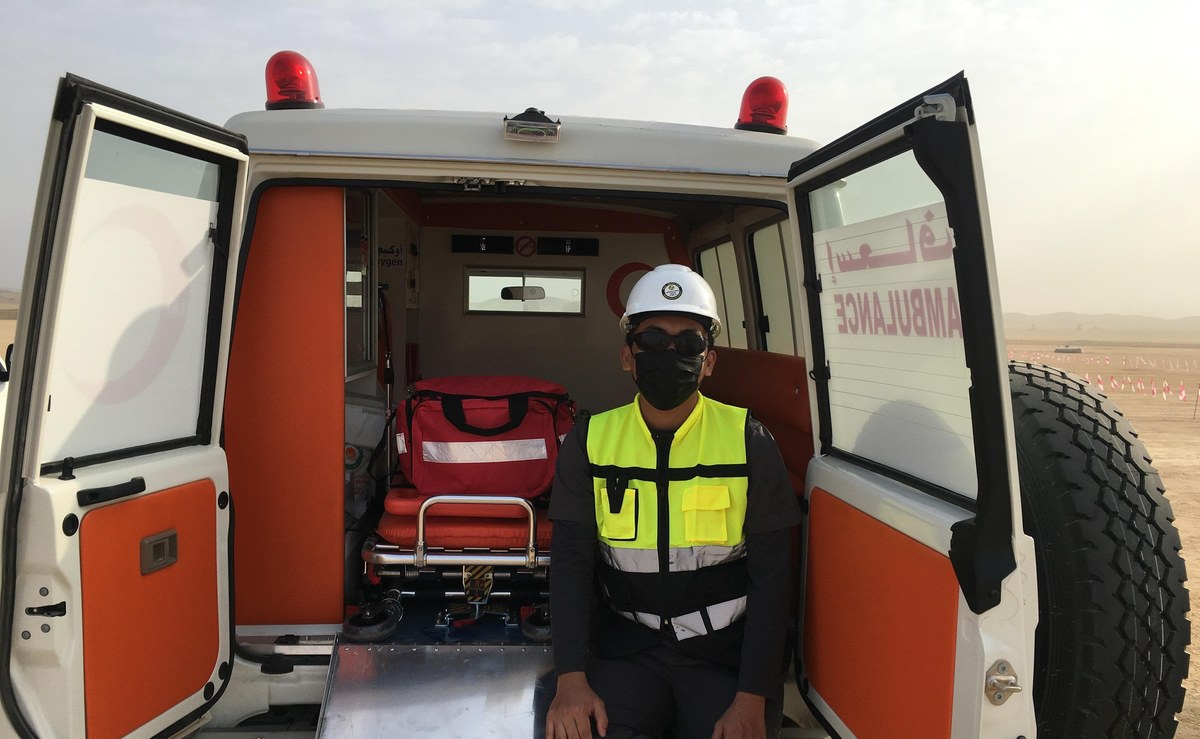
Akhir Fahruddin, an occupational health nurse from Indonesia, sits at the back of an ambulance in Duba, Tabuk while on duty in this photo shared on July 14, 2024. (Supplied/Akhir Fahruddin)
The 33-year-old is now serving a company in Oxagon, a floating port city in the flagship multibillion-dollar NEOM project.
From the Saudi healthcare system, Fahruddin said he learned about the value of collaboration and respect among health workers.
“There is no such thing as one person being more superior than another, it’s a positive thing that I’ve learned while working in Saudi Arabia,” he told Arab News.
“I feel appreciated. When someone appreciates us in practicing our roles, I feel they are valuing my skills, and that’s something that I experienced firsthand.”
He is also grateful for the time he is permitted to offer prayers, which he has learned from friends was not afforded to workers in other countries.
“If I compare myself to two of my friends, who are in Japan and Germany, they encounter limitations in practicing their religion. This is in contrast with my experience in Saudi Arabia, where I am allowed to perform my prayers comfortably, they give me time,” Fahruddin said.
Just four months ago, he experienced a highlight in his career when he resuscitated a patient in an emergency case and was able to save him.
“He survived. It was very memorable for me because I was able to save a patient whose heartbeat had stopped … It allowed me to reflect on how everything I’ve learned all this time, I was able to put it into practice to save a patient,” he said.
Most of all, Fahruddin is thankful that his career in the Kingdom has given him an opportunity to support his family back home in Sumbawa, West Nusa Tenggara.
“I am able to help my family, to help my nieces and nephews to continue their education and my other relatives to pursue higher education,” he said.
“I am also able to save money for my future and buy assets back home. This is the sort of happiness that I’ve gotten through working here.”