Water shortages worsen as funding dries up for northwest Syria displaced

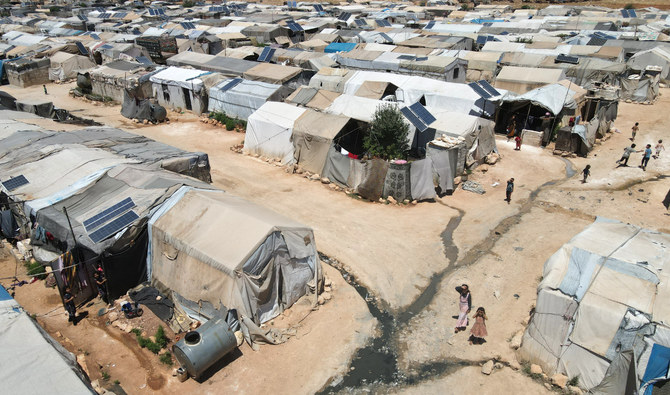
More than five million people, most of them displaced, live in areas outside government control in Syria’s north and northwest, the UN says, and many rely on aid to survive. (AFP/File)
Short Url
Updated 11 July 2024
Follow

Water shortages worsen as funding dries up for northwest Syria displaced

SARMADA, Syria: Hussein Al-Naasan struggles to provide water for his family in the scorching summer, as aid funds have dried up and conditions deteriorated in impoverished displacement camps in Syria’s rebel-held northwest.

“Water is life, it is everything... and now we are being deprived of water,” Naasan told AFP from a camp near Sarmada, close to the Turkish border.

“It’s like they are trying to kill us slowly,” said the 30-year-old father of two, who has been displaced for more than a decade.

After 13 years of conflict, a lack of international funding has severely undercut the provision of basic services such as water, waste disposal and sanitation in displacement camps in northwest Syria, according to the United Nations.

More than five million people, most of them displaced, live in areas outside government control in Syria’s north and northwest, the UN says, and many rely on aid to survive.

Residents told AFP that tap water was unavailable at the camp and aid organizations had stopped trucking water in, blaming aid budget cuts.

Naasan is sharing a water tank with three other families to reduce costs.

“We are finding it very difficult to secure water that we can’t even afford to buy,” he said.

Diminishing water access could lead to a “major disaster,” Naasan warned as the summer sun beat down on the camp.

He said waste was piling up, adding to the risk of disease in an area with war-ravaged medical facilities.

Syria’s war, which broke out after President Bashar Assad repressed anti-government protests in 2011, has killed more than 500,000 people, displaced millions and battered the country’s infrastructure and industry.

In the northwestern Idlib region, some 460 displacement camps hosting around 571,000 people do not have any water, sanitation and hygiene support from UN partner organizations, the UN Office for the Coordination of Humanitarian Affairs (OCHA) told AFP.

“Without increased funding, 111 additional camps hosting nearly 165,000 people will be cut off” from such support by the end of September, it warned in a statement.

About 80 percent of northwest Syria’s population requires water and hygiene support including “access to drinking water, waste disposal, and rehabilitation of sanitation facilities,” OCHA said.

Yet the critical sector is “consistently” neglected, having received only two percent of necessary funding in the first quarter of 2024, it added.

Camp resident Abdel Karim Ezzeddin, a 45-year-old father of nine, filled plastic barrels of water from a nearby well for his family, grateful to have a truck to transport them.

“How can they stop supplying water in the summer?” he said.

“Do they want us to die?“

David Carden, UN deputy regional humanitarian coordinator for the Syria crisis, said conditions in camps in the northwest were “deplorable.”

“Families in worn-out tents face suffocating heat,” he told AFP.

“Rubbish is piling up in camps without sanitation support. Children are getting sick.”

Response Coordination, an umbrella of local organizations in Syria’s northwest, warned skin diseases were spreading in camps as temperatures soar and water becomes scarcer.

“In some camps, more than 90 percent of residents have scabies,” said Fidaa Al-Hamud, a doctor in charge of a mobile clinic near Sarmada, decrying “water scarcity, refuse piling up... and the lack of sewage networks.”

Firas Kardush, a local official in the Idlib region, ruled by the Hayat Tahrir Al-Sham jihadist group, said authorities were “trying to find alternatives” but warned of a “humanitarian catastrophe” if aid money runs dry.

In another camp in the Idlib countryside, Asma Al-Saleh said water scarcity had made it harder to cook and bathe her five children, expressing worry as one of them has a rash.

When she runs out of water, she has to fill containers at a nearby well and walk them back to her tent.

“I do not have a water storage tank... nor am I able to buy one,” Saleh, 32, said.

“We don’t even have cold water to drink” in summer, she added.


Documentary highlights Israeli brutality

Updated 5 sec ago
Follow

Documentary highlights Israeli brutality

  • ‘American Doctor’ shows bravery of men voluntarily going to work in hospitals repeatedly hit by Israeli army
  • Despite a fragile ceasefire in place since October last year, there has been continued violence between Israeli forces and Hamas, which has seen Palestinian non-combatants killed, including dozens of children

PARK CITY, US: At the start of “American Doctor,” a new documentary about US medics working in hospitals in the Gaza Strip during the Israel-Hamas war, director Poh Si Teng initially declines to film pictures of dead Palestinian children that one of the doctors is trying to show her.

Teng worries that she will have to pixelate the gruesome scene to protect the dignity of the children.
“You’re not dignifying them unless you let their memory, their bodies, tell the story of this trauma, of this genocide. You’re not doing them a service by not showing them,” Jewish-American doctor Mark Perlmutter tells her.
“This is what my tax dollars did. That’s what your tax dollars did. That’s what my neighbor’s tax dollars did. They have the right to know the truth.
“You have the responsibility, as I do, to tell the truth. 
You pixelate this, that’s journalistic malpractice.”
Teng’s unflinching film follows Perlmutter and two other American doctors — one Palestinian American and the other a non-practicing 
Zoroastrian — as they try to treat the results of the unspeakable brutality visited on a largely civilian population in Gaza since Israel launched its retaliation for Hamas’s October 2023 attack.
Alongside the severed limbs and the open wounds, the doctors labor on with their Palestinian colleagues, we also see the trio’s attempts at advocacy — in Washington’s corridors of power and in Israeli and American media.
The documentary also depicts the practical difficulties they face — the surgical scrubs and antibiotics they have to smuggle across the border to get around the Israeli blockade, and the last-minute refusals of Israeli authorities to let them in.
And we see the bravery of men voluntarily going to work in hospitals that are repeatedly hit by the Israeli army.
Israel rejects accusations its numerous strikes against Gaza hospitals amount to war crimes, saying it is targeting “terrorists” in these facilities and claims Hamas operatives are holed up in tunnels underneath the hospitals.
The attacks include the so-called “double tap” strike on the Nasser Hospital in Khan Younis, in the south of the Strip, in August 2025 where the three men have worked.
Emergency responders and journalists who had rushed to the scene after a first projectile hit were killed when a second was fired at the same spot.
Feroze Sidwha, perhaps the most eloquent of the three doctors, repeatedly makes the case throughout the film that he has never seen any tunnels and that, in any case, even the presence of wounded fighters in a hospital does not make it a legitimate target.
“Americans deserve the opportunity to know what’s going on, what their money is being used for, and you know, just to decide. ‘Do you really want this being done?’,” he said at the Sundance Film Festival, where the film got its premiere on Friday.
“I’m pretty sure the answer is ‘no’. I just want to keep speaking out and letting people know they don’t have to be an accessory to child murder. But we all are, right now.”
The film is dedicated to the around 1,700 healthcare workers who have been killed since Israel launched its invasion in October 2023.
UN investigators have accused Israel of committing genocide in Gaza, a charge that Israel has denied as “distorted and false,” while accusing the authors of antisemitism.
Despite a fragile ceasefire in place since October last year, there has been continued violence between Israeli forces and Hamas, which has seen Palestinian non-combatants killed, including dozens of children, according to UNICEF.
Reporters Without Borders says nearly 220 journalists have died since the start of the war, making Israel the biggest killer of journalists worldwide for three years running.
The Sundance Film Festival runs until Feb. 1.