

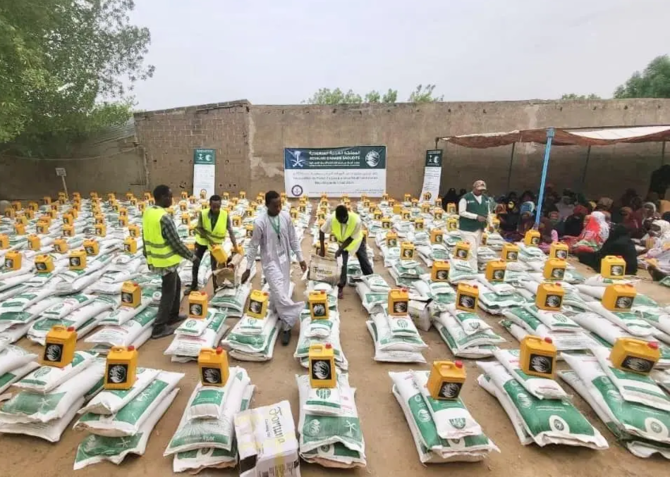
KSrelief continues humanitarian work in Syria, Turkiye, Chad and Sudan

In Chad, 400 food parcels were handed out in the Chari-Baguirmi region, benefiting about 2,400 individuals covered by a KSrelief project to support food security in the country. (SPA)
Short Url
Updated 10 July 2024
Follow

KSrelief continues humanitarian work in Syria, Turkiye, Chad and Sudan

RIYADH: Saudi aid agency KSrelief has continued its humanitarian work in Syria, Turkiye, Chad and Sudan, providing support and aid to those most in need, the state news agency SPA reported on Wednesday.

A training program for earthquake victims in Syria and Turkiye recently concluded in Reyhanli, Turkiye, with 101 Syrian refugees receiving information on how to improve their living standards.

KSrelief medical volunteers also assembled and provided 59 prosthetic limbs and 33 orthotic devices, and conducted 980 physical therapy sessions for patients injured by earthquakes in Syria and Turkiye.

Additionally, psychological support for 701 Turkish individuals and Syrian refugees was also provided to help cope with the disaster.

In Sudan, KSrelief distributed 300 shelter kits and 500 personal hygiene kits to displaced — and the neediest — families in Umbada, benefiting 4,600 individuals, and also gave out 1,500 personal hygiene kits in the Al-Suki locality of Sinnar State, benefiting 8,825 people.

In Chad, 400 food parcels were handed out in the Chari-Baguirmi region, benefiting about 2,400 individuals covered by a KSrelief project to support food security in the country.

In Yemen, the Prosthetics and Rehabilitation Center in the Seiyun district of Hadhramaut governorate provided medical services to 237 Yemenis in May, with KSrelief’s support.

Artificial limbs and prosthetics were measured, manufactured, fitted, delivered and maintained for patients, who also received physiotherapy services, including specialized consultations.


UN-sanctioned migrant smuggler killed in western Libya

A boat used by migrants is seen near the western town of Sabratha, Libya March 19, 2019. (REUTERS)
Updated 13 December 2025
Follow

UN-sanctioned migrant smuggler killed in western Libya

  • In June 2018, the UN Security Council imposed sanctions on Al-Dabbashi, along with another five Libyan traffickers

CAIRO: A notorious militia leader in Libya, sanctioned by the UN for migrant trafficking across the Mediterranean Sea, was killed on Friday in a raid by security forces in the west of the country, according to Libyan authorities.
Ahmed Oumar Al-Fitouri Al-Dabbashi, nicknamed Ammu, was killed in the western city of Sabratha when security forces raided his hideout. The raid came in response to an attack on a security outpost by Al-Dabbashi’s militia, which left six members of the security forces severely wounded, according to a statement issued by the Security Threat Enforcement Agency, a security entity affiliated with Libya’s western government.
Al-Dabbashi, who was also sanctioned by the US Treasury for trafficking, was the leader of a powerful militia, the “Brigade of the Martyr Anas Al-Dabbashi,” in Sabratha, the biggest launching point in Libya for Europe-bound African migrants.
Al-Dabbashi’s brother Saleh Al-Dabbashi, another alleged trafficker, was arrested in the same raid, added the statement.
In June 2018, the UN Security Council imposed sanctions on Al-Dabbashi, along with another five Libyan traffickers. At the time, the UN report said that there was enough evidence that Al-Dabbashi’s militia controlled departure areas for migrants, camps, safe houses and boats.
Al-Dabbashi himself exposed migrants, including children, to “fatal circumstances” on land and at sea, and of threatening peace and stability in Libya and neighboring countries, according to the same report.
Al-Dabbashi was also sanctioned by the US Treasury for the same reason.
Libya has been a main transit point for migrants fleeing war and poverty in Africa and the Middle East. The country was plunged into chaos following a NATO-backed uprising that toppled and killed longtime autocrat Muammar Qaddafi in 2011.
The country has been fragmented for years between rival administrations based in the east and the west of Libya, each backed by various armed militias and foreign governments.