

Pak-China trade drives cross-border traffic surge at Khunjerab Pass— state media 

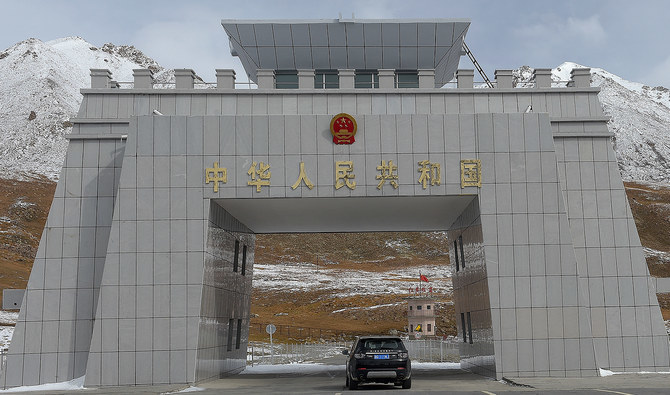
In this photograph taken on September 29, 2015, a car carrying Chinese nationals crosses at the Pak-China Khunjerab Pass, the world's highest paved border crossing at 4,600 metres above sea level. (Photo courtesy: AFP/File)
Short Url
Updated 10 July 2024
Follow

Pak-China trade drives cross-border traffic surge at Khunjerab Pass— state media 

  • Khunjerab Pass sees 110 percent year-on-year increase in cross-border traffic, says state media 
  • Pass linking Pakistan to China is highest paved international border at 4,600 meters above sea level 

ISLAMABAD: Increasing trade between Pakistan and China caused a significant surge in cross-border traffic in the first half of 2024, the state-run Associated Press of Pakistan (APP) reported on Wednesday. 

Pakistan and China opened the Khunjerab Pass for trade and travel in April 2024 after it remained closed for four months. Both sides had agreed in October 2023 to ensure the pass remained open for trade and travel throughout the year. 

Recognized as the highest paved international border at more than 4,600 meters (15,000 feet) above sea level, the Khunjerab Pass is closed during winter months because of harsh weather.

“The Khunjerab Pass in Xinjiang, China, experienced a significant rise in cross-border traffic in the first half of this year, with 21,000 travelers, representing a 110 percent year-on-year increase,” APP said. 

It said the border cleared 1,123 people in a single day on June 11, which was a new record. The APP said the Khunjerab Border Inspection Station attributes this remarkable growth to the increasing number of Pakistani traders and cross-border tourists. 

The APP credited increased travel enthusiasm among Chinese travelers to Beijing’s National Immigration Administration’s revised entry-exit policies, saying they had introduced a series of facilitation measures that boosted trade and travel. 

“Pakistani merchants have been actively transporting goods such as pine nuts, herbs, copperware, carpets, and jade crafts to China for sale, while bringing back daily necessities to Pakistan,” the report said. 

China is a major ally and investor in Pakistan. The two countries collaborate on the China-Pakistan Economic Corridor, a flagship project under China’s Belt and Road Initiative, with more than $65 billion pledged for road, rail, and other infrastructure developments in the South Asian nation.


Security forces kill four militants in Pakistan’s volatile southwest, military says

Updated 13 January 2026
Follow

Security forces kill four militants in Pakistan’s volatile southwest, military says

  • Balochistan, Pakistan’s largest province by land area bordering Iran and Afghanistan, has long been the site of a low-level insurgency
  • The Balochistan government has recently established a threat assessment center to strengthen early warning, prevent ‘terrorism’ incidents

ISLAMABAD: Pakistani security forces gunned down four militants in an intelligence-based operation in the southwestern Balochistan province, the military said on Tuesday.

The operation was conducted in Balochistan’s Kalat district on reports about the presence of militants, according to the Inter-Services Public Relations (ISPR), the Pakistani military’s media wing.

The “Indian-sponsored militants” were killed in an exchange of fire during the operation, while weapons and ammunition were also recovered from the deceased, who remained actively involved in numerous militant activities.

“Sanitization operations are being conducted to eliminate any other Indian-sponsored terrorist found in the area,” the ISPR said in a statement.

There was no immediate response from New Delhi to the statement.

Balochistan, Pakistan’s largest province by land area bordering Iran and Afghanistan, has long been the site of a low-level insurgency involving Baloch separatist groups, including the Balochistan Liberation Army (BLA) and the Balochistan Liberation Front (BLF).

Pakistan accuses India of supporting these separatist militant groups and describes them as “Fitna Al-Hindustan.” New Delhi denies the allegation.

The government in Balochistan has also established a state-of-the-art threat assessment center to strengthen early warning and prevention against “terrorism” incidents, a senior official said this week.

“Information that was once scattered is now shared and acted upon in time, allowing the state to move from reacting after incidents to preventing them before they occur,” Balochistan Additional Chief Secretary Hamza Shafqaat wrote on X.

The development follows a steep rise in militancy-related deaths in Pakistan in 2025. According to statistics released by the Pakistan Institute for Conflict and Security Studies (PICSS) last month, combat-related deaths in 2025 rose 73 percent to 3,387.

These included 2,115 militants, 664 security forces personnel, 580 civilians and 28 members of pro-government peace committees, the think tank said.