

Explainer: After French election no party has a majority, so what comes next?

1 / 2
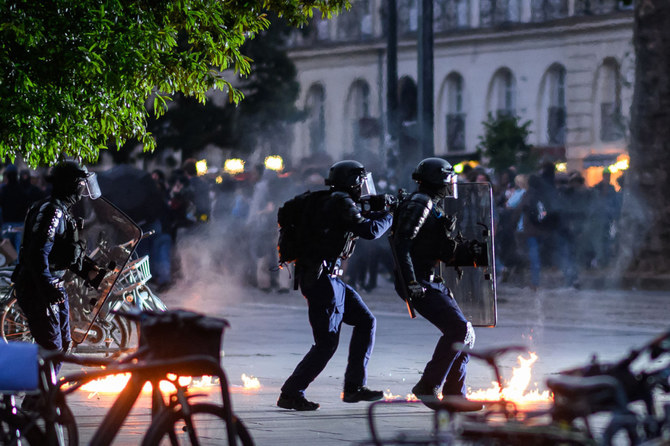
Anti-riot police officers received a molotov cocktail during a demonstration following the announcement of the first results of the second round of France’s crunch legislative elections in Nantes, western France on July 7, 2024. (AFP)
2 / 2
People gather in front of "Le triomphe de la Republique" statue in Paris on July 7, 2024, during an election night rally following the first results of the second round of France's legislative election. (AFP)
Short Url
Updated 08 July 2024
Follow

Explainer: After French election no party has a majority, so what comes next?

  • With all three major blocs falling short of 289 needed to secure an outright majority, none of them can form a majority government and would need support from others to pass legislation

Here’s what may come next after France’s election on Sunday looked set to produce a hung parliament, with a leftist alliance in the lead but without a absolute majority.

What happened in Sunday’s second round vote?
The left-wing New Popular Front alliance was on track to win the biggest number of seats, according to pollsters’ projected results, but it will fall short of the 289 needed to secure an outright majority in the lower house.
The outcome delivers a stinging defeat to the far-right National Rally (RN) party, which had been projected to win the vote but suffered after the NFP and President Emmanuel Macron’s Together bloc worked together between the first and second rounds of voting to create an anti-RN vote.
Projections showed the RN finishing third, behind Together.
It means none of the three blocs can form a majority government and would need support from others to pass legislation.

Will a left-leaning coalition form?
This is far from certain.
France is not accustomed to the kind of post-election coalition-building that is common in northern European parliamentary democracies like Germany or the Netherlands.
Its Fifth Republic was designed in 1958 by war hero Charles de Gaulle to give large, stable parliamentary majorities to presidents and that has created a confrontational political culture with no tradition of consensus and compromises.
Moderate leftwing politician Raphael Glucksmann, a lawmaker in the European Parliament, said the political class would have to “act like grown-ups.”
Jean-Luc Melenchon, leader of the hard-left France Unbowed (LFI), ruled out a broad coalition of parties of different stripes. He said Macron had a duty to call on the leftist alliance to rule.
In the centrist camp, Macron’s party head, Stephane Sejourne, said he was ready to work with mainstream parties but ruled out any deal with Melenchon’s LFI. Former Prime Minister Edouard Philippe also ruled out any deal with the hard-left party.
Macron himself said he will wait for the new assembly to have found some “structure” to decide his next move.

What if no agreement can be found?
That would be uncharted territory for France. The constitution says Macron cannot call new parliamentary elections for another 12 months.
Prime Minister Gabriel Attal said he would tender his resignation to Macron on Monday morning, but that he was available to act in a care-taker capacity.
The constitution says Macron decides who to ask to form a government. But whoever he picks faces a confidence vote in the National Assembly, which will convene for 15 days on July 18. This means Macron needs to name someone acceptable to a majority of lawmakers.
Macron will likely be hoping to peel off Socialists and Greens from the leftist alliance, isolating France Unbowed, to form a center-left coalition with his own bloc.
However, there was no sign of an imminent break-up of the New Popular Front at this stage.
Another possibility is a government of technocrats that would manage day-to-day affairs but not oversee structural changes.
It was not clear the left-wing bloc would support this scenario, which would still require the backing of parliament.


US bombers join Japanese jets in show of force after China–Russia drills

Updated 8 sec ago
Follow

US bombers join Japanese jets in show of force after China–Russia drills

  • Japan says US B-52 bombers flew with Japanese F-35s and F-15s
  • South Korea and Japan have scrambled jets during Chinese and Russian drills

TOKYO: US nuclear-capable bombers flew over the Sea of Japan alongside Japanese fighter jets on Wednesday, Tokyo said, in a show of force following Chinese and Russian drills in the skies and seas around Japan and South Korea.
Japan and the US “reaffirmed their strong resolve to prevent any unilateral attempt to change the status quo by force and confirmed the readiness posture of both the Self-Defense Forces (SDF) and US forces,” Japan’s defense ministry said in a press release on Thursday.
The flight of two US B-52 strategic bombers with three Japanese F-35 stealth fighters and three F-15 air-superiority jets was the first time the US had asserted its military presence since China began military exercises in the region last week.
The display follows a joint flight of Chinese and Russian strategic bombers in the East China Sea and western Pacific on Tuesday and separate Chinese aircraft carrier drills that prompted Japan to scramble jets that Tokyo said were targeted by radar beams.

A Russian Tu-95 nuclear-capable strategic bomber which flew from the Sea of Japan to the East China Sea to rendezvous with two Chinese H-6 bombers before heading into the Western Pacific on December 9, 2025. (Japan Self Defense Forces/Handout via REUTERS)

The encounter drew criticism from Washington, which said the incident was “not conducive to regional peace and stability” and reaffirmed that its alliance with Japan was “unwavering.”
Both Japan and South Korea host US forces, with Japan home to the biggest concentration of American military power overseas, including an aircraft carrier strike group and a US Marine expeditionary force.
China denied Tokyo’s accusation, saying Japanese jets flying near the carrier had endangered its air operations south of Japan.

South Korea’s military said it also scrambled fighter jets when the Chinese and Russian aircraft entered its air defense identification zone on Tuesday, an area that extends beyond its airspace and is used for early warning.
 

Chinese H6 nuclear-capable strategic bomber flies from the East China Sea over the Miyako Strait into the Western Pacific on December 9, 2025. (Japan Self Defense Forces/Handout via REUTERS)

Regional tensions have risen since Japanese Prime Minister Sanae Takaichi triggered a dispute with Beijing last month with her remarks on how Tokyo might react to a hypothetical Chinese attack on Taiwan.
China claims democratically governed Taiwan and has not ruled out using force to take control of the island, which sits just over 100 km (62 miles) from Japanese territory and is surrounded by sea lanes on which Tokyo relies.