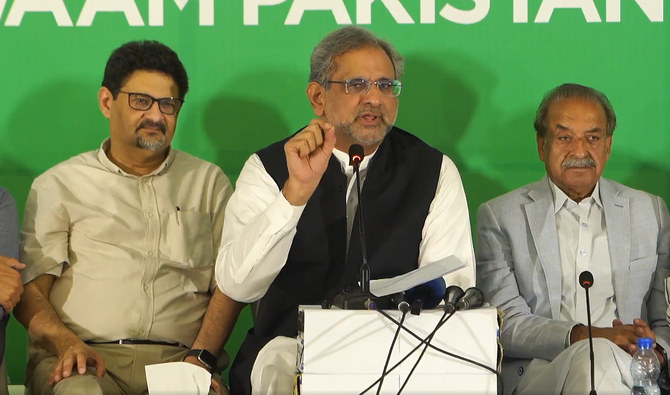
ISLAMABAD: Pakistan’s former prime minister Shahid Khaqan Abbasi and ex-finance minister Miftah Ismail formally launched a new political party on Saturday, calling for individuals with “ability and influence” to join their ranks to bring about change in the country amid a deeply polarized environment.
Both politicians were senior members of the ruling Pakistan Muslim League-Nawaz (PML-N) party but recently decided to part ways due to growing differences with its leadership.
Ismail, who took over as finance minister two years ago during a critical period for Pakistan’s economy, advocated for strict structural reforms recommended by the International Monetary Fund (IMF), which led to significant economic hardships for the population. His decisions were later criticized by party colleagues for being detrimental to PML-N’s political standing, leading to his sidelining by the current deputy prime minister, Ishaq Dar, who is closely aligned with the Sharif family.
Abbasi criticized the broader approach of PML-N politics, arguing that despite multiple opportunities to govern, the party had failed to effect meaningful change for the people.
Together, the two politicians have decided to mobilize the public to “change the system” to create promising economic opportunities for everyone.
“To be in Awaam Pakistan, you need ability and influence,” Abbasi said while launching the new political faction. “If you have neither, you cannot be a part of this party.”
He said there was a long list of the political parties which had been created by the establishment, a euphemism for the country’s powerful military that has directly ruled the country for nearly three decades since independence in 1947.
“People ask us directly or indirectly, is the establishment with you? Have you got their permission? This is the biggest argument that highlights the failure of Pakistan’s politics,” he continued.
“Today, a common man in this country realizes and thinks there is no politics without the establishment,” he said, adding that all state institutions should have a constitutional relationship.
Addressing the gathering, Ismail said that Pakistan had become a “predatory” state where the rulers and the state were like a hunter and the public had been reduced to a prey.
“This budget is a reflection of the rulers’ priorities,” he said, referring to the finance bill approved last month while lamenting that taxes had been doubled for the salaried class.
“You all have to join politics,” he continued. “Politics can’t be left to politicians only, common people have to join it as well.”
The former finance minister informed all positions in the newly launched party had a term limit.
“No one will have a position for more than two terms,” he added. “Merit must be promoted on every level.”


Former PM Abbasi, ex-finance minister Ismail launch new political party amid polarized environment
https://arab.news/r9znv
Former PM Abbasi, ex-finance minister Ismail launch new political party amid polarized environment

- The former PML-N leaders emphasize meritocracy, say all office bearers will serve for two terms
- Miftah Ismail calls Pakistan ‘predatory’ state, laments more taxes on the salaried class in the budget

Pakistan minister calls for integrating ocean awareness into education to preserve ecosystems
- Pakistan’s maritime sector posted a record $360 million profit in 2025 following a year of sweeping reforms
- Junaid Anwar Chaudhry says education equips youth to make informed decisions, contribute to blue economy
KARACHI: Pakistan’s Maritime Affairs Minister Junaid Anwar Chaudhry has urged integrating ocean awareness into formal education systems and empowering youth as active partners in order to preserve marine ecosystems, his ministry said on Saturday.
Chaudhry said this at a meeting with Minister of State for Education and Professional Training, Wajiha Qamar, who called on him and discussed strategies for enhancing marine education, literacy, and youth engagement in sustainable ocean management.
Pakistan’s maritime sector posted a record Rs100 billion ($360 million) profit in 2025 following a year of sweeping reforms aimed at improving port efficiency, cost-cutting, and safeguarding marine ecosystems to boost the blue economy.
“Understanding our oceans is no longer optional, it is essential for climate resilience, sustainable development, and the long-term health of our maritime resources,” Chaudhry said, highlighting the critical role of marine literacy.
The minister said education equips youth to make informed decisions and actively contribute to marine conservation and the blue economy, urging inclusion of marine ecosystems, conservation and human-ocean interactions into curricula, teacher training and global citizenship programs.
“Initiatives like ‘Ocean Literacy for All’ can mainstream these elements in national policies, school programs, and community workshops to build proactive citizenship on marine challenges,” he added.
Ocean Literacy for All is a UNESCO Intergovernmental Oceanographic Commission–coordinated global initiative under the UN Ocean Decade (2021–2030) that promotes ocean awareness, education, and conservation.
Chaudhry announced reforms in maritime education, including granting degree-awarding status to the Pakistan Marine Academy, and the establishment of the Maritime Educational Endowment Fund (MEEF) to provide scholarships for deserving children from coastal communities.
“The scholarship program promotes inclusive development by enabling access to quality education for youth from over 70 coastal and fishing communities, particularly in Sindh and Balochistan,” he said.
The discussions underscored raising awareness about oceans, coastal ecosystems and marine resources, according to the Pakistani maritime affairs ministry. Both ministers stressed the need to integrate climate and marine education from classrooms
to community programs, addressing risks like rising sea temperatures, coastal erosion, biodiversity loss and pollution.
“Incorporating marine science and ocean literacy into curricula can help students connect local challenges with global trends,” Qamar said, underscoring education’s transformative power in building social resilience.
The meeting explored translating complex marine science into accessible public knowledge through sustained, solution-oriented awareness campaigns, according to the maritime affairs ministry.
With coastline facing pressures from climate change, pollution, and overexploitation, the ministers called for a coordinated approach blending formal education, informal learning and youth-led advocacy.
“A joint effort by the Ministries of Maritime Affairs and Education can cultivate an ocean-literate generation, transforming vulnerability into resilience and ensuring the long-term sustainability of coastal and marine ecosystems,” Chaudhry said.


