

Pakistan’s disaster management authority forecasts ‘significant’ rainfall, flash floods across country till July 9

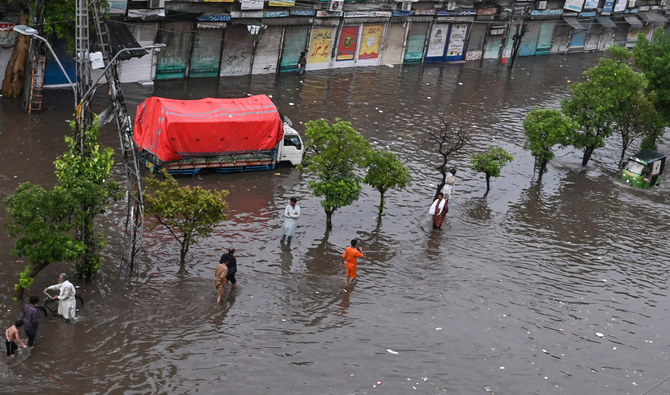
Commuters make their way through a flooded street after a heavy rainfall near row of shops in Lahore on July 1, 2024. (AFP/File)
Short Url
Updated 04 July 2024
Follow

Pakistan’s disaster management authority forecasts ‘significant’ rainfall, flash floods across country till July 9

  • Heavy rains may cause flash floods across northern Punjab, Khyber Pakhtunkhwa and Azad Kashmir, warns disaster management authority 
  • Advises authorities and masses to take necessary precautions to mitigate potential impacts of floods and landslides across Pakistan 

ISLAMABAD: Pakistan’s National Disaster Management Authority (NDMA) on Thursday forecast “significant rainfall” in many regions of the country till July 9, warning the downpours could cause flash floods. 

Last week, the NDMA warned of heavy rains in Pakistan’s Sindh and Punjab provinces, saying they could face an “emergency” situation. Pakistan is recognized as one of the most vulnerable countries to climate change effects in the world. Unusually heavy rains in June 2022 triggered flash floods in many parts of the country, killing over 1,700 people, inflicting losses of around $30 billion, and affecting at least 30 million people.

Prime Minister Shehbaz Sharif formed a high-level committee to tackle any potential emergencies brought about by the monsoon floods. 

“NDMA’s National Emergencies Operation Center (NEOC) anticipated significant rainfall across various regions of Pakistan until 9th July, 2024,” the disaster management authority said. It added that the heavy rainfall may cause urban flooding and rapid rises in water levels in nullahs and trigger flash floods across northern Punjab (Sialkot), KP and Azad Kashmir. 

“Additionally, this precipitation is expected to result in high discharge levels within the eastern rivers,” the NDMA said. “Sutlej River is expected to experience a low flood stage with approximately 50,000 cusecs of water while Kabul River is predicted to reach a medium flood level with approximately 95,000 cusecs.”

The NDMA said extreme rainfall may also trigger additional releases from Indian reservoirs such as Salal, Bhakra, and Pong Dam, which could directly impact the Chenab and Sutlej rivers in Pakistan.

The NEOC predicted moderate to heavy rainfall in GB until July 8, 2024, warning it could trigger flash floods in local nullahs putting areas such as Chigar and Khaplu. 

“Slightly heavy rainfall is expected in Gilgit-Baltistan, KPK, northern parts of Balochistan, and AJK until July 8, 2024,” the NDMA said. “The persistent heavy to moderate rains may cause localized landslides at Karakoram Highway along Hunza and some of the areas of District Nagar, Gilgit, Diamir, Kohistan, Battagram, Mansehra, and Abbottabad, potentially disrupting traffic flows and cutting off far-flung areas from main roads.”

The disaster management authority warned authorities and masses to take all necessary precautions to mitigate the impact of the floods and landslides. It said emergency response teams had been alerted and resources are being mobilized to ensure a “swift response” to any arising situations. 

“Tourists are advised to avoid traveling to these areas during the forecasted period,” the NDMA said. 


Pakistan says mosque bomber identified, accuses India and Afghanistan of backing attack

Updated 6 sec ago
Follow

Pakistan says mosque bomber identified, accuses India and Afghanistan of backing attack

  • Suicide bombing at mosque on Islamabad’s outskirts kills at least 31, injures 169
  • Minister says attacker not an Afghan national but had travel history to Afghanistan

ISLAMABAD: Pakistan said on Friday it had identified the suicide bomber responsible for an attack on a mosque on the outskirts of the capital that killed at least 31 people, with the government saying the incident was carried out by militants sponsored by India and supported by Afghanistan.

The explosion took place during Friday prayers in the Tarlai area, a densely populated suburb of the capital, with hundreds of worshippers inside the mosque. Islamabad’s district administration said 169 people were also injured, several of them critically. 

The attack comes amid a renewed surge in militant violence in Pakistan and follows a suicide bombing outside a district court complex in Islamabad in November last year that killed at least 12 people and wounded dozens, underscoring growing security concerns even in heavily guarded urban centers.

Talal Chaudhry, Pakistan’s minister of state for interior, told reporters at the blast site, an imambargah, or a place of worship for the Shi’ite Muslim community, that the attacker had been identified as a suicide bomber following forensic analysis.

“We have now received information about the terrorist who carried out the suicide bombing here,” Chaudhry said. “He is not an Afghan national, but details of how many times he traveled to Afghanistan have been obtained.”

He said investigators were trying to piece together more evidence, though he added he could not share some of the information at this time.

Chaudhry accused neighboring countries of backing militant violence in Pakistan, saying the attack followed a familiar pattern. 

“Those who carried out the attack are the same [groups that are] sponsored and supported by our neighbors, sponsored by India and supported by Afghanistan,” he added.

Islamabad has long accused Kabul of allowing its soil to be used by militant groups and New Delhi of backing their cross-border attacks against Pakistani civilians and security forces. However, the Afghan and Indian governments have consistently denied the allegations.

India also issued a statement during the day, condemning the attack and condoling the loss of life while calling Islamabad’s accusation against it “as baseless as it is pointless.”

However, Chaudhry said the authorities had also detained militants and their facilitators in the past who were linked to earlier attacks in the capital, as he pledged to do the same again.

“Be assured that the previous terrorists and their handlers involved in Islamabad attacks were arrested and are being dealt with according to the law,” he continued, adding those responsible for targeting the mosque would also be arrested.

No militant group has so far claimed responsibility for the attack.

Rescue teams reached the scene within minutes, Chaudhry said, and an emergency was imposed at major hospitals, including the Pakistan Institute of Medical Sciences, Polyclinic Hospital and the Capital Development Authority Hospital. 

Chaudhry said the attackers had deliberately targeted civilians.

Islamabad has generally been less affected by militant attacks than Pakistan’s northwestern and southwestern regions, but the scale of the casualties has heightened concerns about security in the capital amid a broader resurgence of violence nationwide.