

Pakistan seeks to strengthen ties with new Bangladeshi leadership after BNP claims election win

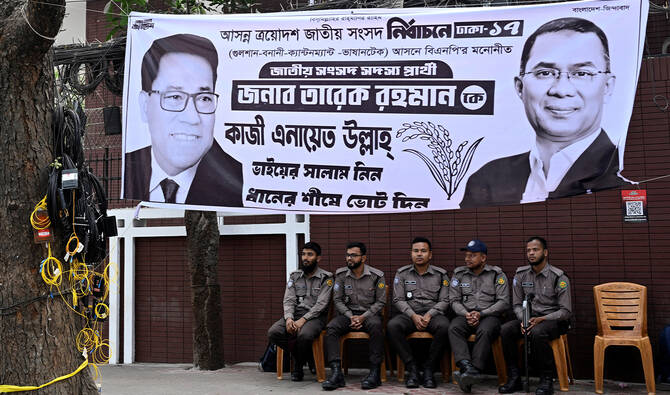
Police officers sit outside a party office of Bangladesh Nationalist Party (BNP), a day after the national election in Dhaka, Bangladesh, on February 13, 2026. (REUTERS/File)
Short Url
Updated 13 February 2026
Follow

Pakistan seeks to strengthen ties with new Bangladeshi leadership after BNP claims election win

  • The election comes nearly a year and half after the ouster of Sheikh Hasina in a deadly uprising in the South Asian nation
  • At 60, BNP’s Tarique Rahman is preparing to take charge of Bangladesh, driven by what he calls an ambition to ‘do better’

ISLAMABAD: Pakistan Prime Minister Shehbaz Sharif on Friday congratulated Tarique Rahman on the “resounding victory” of his Bangladesh Nationalist Party (BNP) in parliamentary elections, saying that he looked forward to working closely with the new Bangladeshi leadership.

BNP’s media unit said on X Friday it had secured enough seats in Parliament to govern on its own, though rival group Jamaat-e-Islami raised concerns over delayed results. The final tally has not yet been announced by the Election Commission, but several local media outlets reported the BNP crossing the 151-seat threshold needed for a majority in the 300-member Parliament.

BNP is headed by the 60-year-old Rahman, its prime ministerial candidate who returned to Bangladesh in December after 17 years in self-exile in London. He is the son of former Prime Minister Khaleda Zia, who died in December.

“I extend my warmest felicitations to Mr. Tarique Rahman on leading the BNP to a resounding victory in the Parliamentary elections in Bangladesh. I also congratulate the people of Bangladesh on the successful conduct of the elections,” Sharif said on X.

“I look forward to working closely with the new Bangladesh leadership to further strengthen our historic, brotherly multifaceted bilateral relations and advance our shared goals of peace, stability, and development in South Asia and beyond,” Sharif said.

Sharif’s statement comes amid Islamabad’s efforts to rebuild relations with Bangladesh, amid a thaw in relations between the two countries. Pakistan and Bangladesh were part of the same country until Bangladesh’s secession following a bloody civil war in 1971, an event that long cast a shadow over bilateral ties.

Both countries have moved closer since August 2024 following the ouster of Hasina, who was considered an India ally, in a mass uprising. 

Separately, Pakistan President Asif Ali Zardari extended his felicitations to the BNP and its leader, Rahman, on securing a “landslide majority” in the national elections and receiving the mandate to form the next government, the state-run Radio Pakistan broadcaster reported.

Pakistan looks forward to working with the new government to strengthen cooperation in trade, defense, cultural exchanges and regional forums, he was quoted as saying.


Sindh assembly passes resolution rejecting move to separate Karachi

Updated 21 February 2026
Follow

Sindh assembly passes resolution rejecting move to separate Karachi

  • Chief Minister Shah cites constitutional safeguards against altering provincial boundaries
  • Calls to separate Karachi intensified amid governance concerns after a mall fire last month

ISLAMABAD: The provincial assembly of Pakistan’s southern Sindh province on Saturday passed a resolution rejecting any move to separate Karachi, declaring its territorial integrity “non-negotiable” amid political calls to carve the city out as a separate administrative unit.

The resolution comes after fresh demands by the Muttahida Qaumi Movement (MQM) and other voices to grant Karachi provincial or federal status following governance challenges highlighted by the deadly Gul Plaza fire earlier this year that killed 80 people.

Karachi, Pakistan’s largest and most densely populated city, is the country’s main commercial hub and contributes a significant share to the national economy.

Chief Minister Syed Murad Ali Shah tabled the resolution in the assembly, condemning what he described as “divisive statements” about breaking up Sindh or detaching Karachi.

“The province that played a foundational role in the creation of Pakistan cannot allow the fragmentation of its own historic homeland,” Shah told lawmakers, adding that any attempt to divide Sindh or separate Karachi was contrary to the constitution and democratic norms.

Citing Article 239 of Pakistan’s 1973 Constitution, which requires the consent of not less than two-thirds of a provincial assembly to alter provincial boundaries, Shah said any such move could not proceed without the assembly’s approval.

“If any such move is attempted, it is this Assembly — by a two-thirds majority — that will decide,” he said.

The resolution reaffirmed that Karachi would “forever remain” an integral part of Sindh and directed the provincial government to forward the motion to the president, prime minister and parliamentary leadership for record.

Shah said the resolution was not aimed at anyone but referred to the shifting stance of MQM in the debate while warning that opposing the resolution would amount to supporting the division of Sindh.

The party has been a major political force in Karachi with a significant vote bank in the city and has frequently criticized Shah’s provincial administration over its governance of Pakistan’s largest metropolis.

Taha Ahmed Khan, a senior MQM leader, acknowledged that his party had “presented its demand openly on television channels with clear and logical arguments” to separate Karachi from Sindh.

“It is a purely constitutional debate,” he told Arab News by phone. “We are aware that the Pakistan Peoples Party, which rules the province, holds a two-thirds majority and that a new province cannot be created at this stage. But that does not mean new provinces can never be formed.”

Calls to alter Karachi’s status have periodically surfaced amid longstanding complaints over governance, infrastructure and administrative control in the megacity, though no formal proposal to redraw provincial boundaries has been introduced at the federal level.