

Pakistani PM on official visit to Tajikistan today, will attend twin SCO summits in Kazakhstan

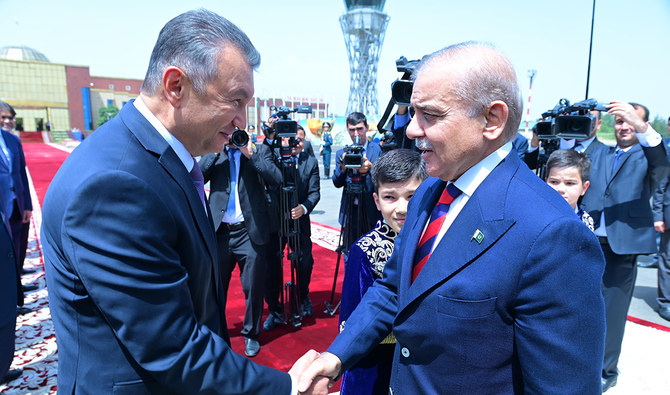
Prime Minister Shehbaz Sharif arrives at Dushanbe Airport official visit of Tajikistan on July 2, 2024. (PMO)
Short Url
Updated 02 July 2024
Follow

Pakistani PM on official visit to Tajikistan today, will attend twin SCO summits in Kazakhstan

  • Islamabad wants to enhance its role as trade hub connecting landlocked Central Asia with rest of the world 
  • In April, Pakistan opened its trade gateway to Central Asia with the first potato shipment to Tajikistan

ISLAMABAD: Pakistani Prime Minister Shehbaz Sharif arrived on an official visit to Tajikistan on Tuesday, the foreign office said, which will be followed by a trip to Kazakhstan for twin summits of the Shanghai Cooperation Organization (SCO).

Pakistan is pushing to enhance its role as a pivotal trade and transit hub connecting the landlocked Central Asian states with the rest of the world, leveraging its strategic geographical position. 

In recent weeks, there has been a flurry of visits, investment talks and economic activity between Pakistan and Central Asian states and last week, Sharif chaired a special meeting attended by senior government ministers on how to enhance relations with the region, particularly in the areas of economy and investment.

“At the invitation of President of Tajikistan, Emomali Rahmon, Prime Minister Muhammad Shehbaz Sharif will undertake an official visit to Dushanbe, Tajikistan from 2-3 July 2024,” the foreign office said. 

“In Dushanbe, the Prime Minister will meet President Emomali Rahmon, Chairman of Majlisi Namoyandagon of Majlisi Oli Mahmadtoir Zoir Zokirzoda and Prime Minister Qohir Rasulzoda.”

The foreign office said the two sides would engage in “wide-ranging discussions on areas of mutual interest” to deepen cooperation, especially in the areas of regional connectivity, trade, people-to-people contacts and energy.

“The two sides will also sign agreements and MoUs in diverse areas of cooperation,” the foreign office added.

After Tajikistan, Sharif will travel to Kazakhstan for twin summits of the Shanghai Cooperation Organization (SCO) Council of Heads of State (CHS) and the SCO Plus from July 3-4 in Astana.

“At the SCO Council of Heads of Summit Meeting, the Prime Minister will share Pakistan’s perspective on important regional and global issues and underline the importance Pakistan accords to regional connectivity and cooperation with SCO member countries,” state-run APP reported. 

The PM will also address the SCO Plus summit that brings together SCO member states as well as invited dialogue partners, observer states, guests of the chair and international organizations.

“He would share Pakistan’s perspective on important regional and global issues and underline the importance of strengthening the organization for the benefit of the peoples of the SCO region,” APP added. 

On Monday, Sharif also received the ambassador of Kazakhstan to Pakistan, Yerzhan Kistafin, at his office in Islamabad. 

“The Prime Minister conveyed his greetings to the President of Kazakhstan, H.E. Kassym-Jomart Tokayev and expressed his desire to strengthen the excellent bilateral relations between Pakistan and Kazakhstan,” the PM office said. “He said he was looking forward to his meeting with President Tokayev during his upcoming visit to Astana for the SCO Council of Heads of State meeting on 3-4 July, 2024.”

During the meeting, Sharif emphasized the “need to enhance trade and investment, while also focusing on regional connectivity and security.”

In May, Pakistan’s investment minister reaffirmed the country’s resolve to cooperate with Central Asian states as Islamabad pushes forward an ambitious agenda to bolster trade activities while grappling with a macroeconomic crisis.

“Pakistan has reaffirmed the resolve to cooperate with Central Asian countries to boost economic and trade activities in the region,” the state-run Radio Pakistan reported, quoting Pakistan’s Investment Minister Abdul Aleem Khan.

“He said Pakistan’s Port Qasim and Gwadar port are available for Central Asia’s trade routes.”

In April, Pakistan opened its trade gateway to Central Asia with the first potato shipment to Tajikistan.


Imran Khan’s party shutdown draws mixed response; government calls it ‘ineffective’

Updated 4 sec ago
Follow

Imran Khan’s party shutdown draws mixed response; government calls it ‘ineffective’

  • Ex-PM Khan’s PTI party had called for a ‘shutter-down strike’ to protest Feb. 8, 2024 general election results
  • While businesses reportedly remained closed in Khyber Pakhtunkhwa, they continued as normal elsewhere

ISLAMABAD: A nationwide “shutter-down strike” called by former prime minister Imran Khan’s party drew a mixed response in Pakistan on Sunday, underscoring political polarization in the country two years after a controversial general election.

Khan’s Pakistan Tehreek-e-Insaf (PIT) opposition party had urged the masses to shut businesses across the country to protest alleged rigging on the second anniversary of the Feb. 8, 2024 general election.

Local media reported a majority of businesses remained closed in the Khyber Pakhtunkhwa (KP) province, governed by the PTI, while business continued as normal in other provinces as several trade associations distanced themselves from the strike call.

Arab News visited major markets in Islamabad’s G-6, G-9, I-8 and F-6 sectors, as well as commercial hubs in Rawalpindi, which largely remained operational on Sunday, a public holiday when shops, restaurants and malls typically remain open in Pakistan.

“Pakistan’s constitution says people will elect their representatives. But on 8th February 2024, people were barred from exercising their voting right freely,” Allama Raja Nasir Abbas Jafri, the PTI opposition leader in the Senate, said at a protest march near Islamabad’s iconic Faisal Mosque.

Millions of Pakistanis voted for national and provincial candidates during the Feb. 8, 2024 election, which was marred by a nationwide shutdown of cellphone networks and delayed results, leading to widespread allegations of election manipulation by the PTI and other opposition parties. The caretaker government at the time and the Election Commission of Pakistan (ECP) both rejected the allegations.

Khan’s PTI candidates contested the Feb. 8 elections as independents after the party was barred from the polls. They won the most seats but fell short of the majority needed to form a government, which was made by a smattering of rival political parties led by Prime Minister Shehbaz Sharif. The government insists the polling was conducted transparently and that Khan’s party was not denied a fair chance.

Authorities in the Pakistani capital deployed a heavy police contingent on the main road leading to the Faisal Mosque on Sunday. Despite police presence and the reported arrest of some PTI workers, Jafri led local PTI members and dozens of supporters who chanted slogans against the government at the march.

“We promise we will never forget 8th February,” Jafri said.

The PTI said its strike call was “successful” and shared videos on official social media accounts showing closed shops and markets in various parts of the country.

The government, however, dismissed the protest as “ineffective.”

“The public is fed up with protest politics and has strongly rejected PTI’s call,” Pakistan’s Information Minister Attaullah Tarar said on X.

“It’s Sunday, yet there is still hustle and bustle.”

Ajmal Baloch, All Pakistan Traders Association president, said they neither support such protest calls, nor prevent individuals from closing shops based on personal political affiliation.

“It’s a call from a political party and we do not close businesses on calls of any political party,” Baloch told Arab News.

“We only give calls of strike on issues related to traders.”

Khan was ousted from power in April 2022 after what is widely believed to be a falling out with the country’s powerful generals. The army denies it interferes in politics. Khan has been in prison since August 2023 and faces a slew of legal challenges that ruled him out of the Feb. 8 general elections and which he says are politically motivated to keep him and his party away from power.

In Jan. 2025, an accountability court convicted Khan and his wife in the £190 million Al-Qadir Trust land corruption case, sentencing him to 14 years and her to seven years after finding that the trust was used to acquire land and funds in exchange for alleged favors. The couple denies any wrongdoing.
