

Saudi energy minister announces discovery of seven oil, gas deposits

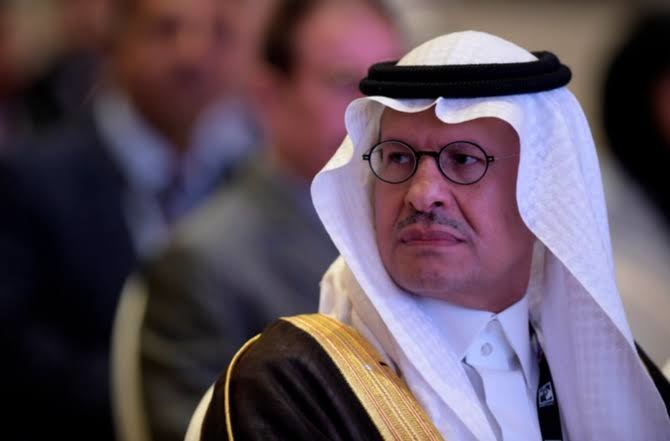
Prince Abdulaziz bin Salman said Saudi Aramco had discovered seven oil, gas deposits. (File/AFP)
Short Url
Updated 01 July 2024
Follow

Saudi energy minister announces discovery of seven oil, gas deposits

  • Aramco discovers “two unconventional oil fields, reservoir of light Arabian oil, two natural gas fields, and two natural gas reservoirs”
  • Unconventional oil fields and one reservoir discovered in Eastern Province while two natural gas fields and two reservoirs in Empty Quarter

RIYADH: Saudi Arabia’s energy minister announced the discovery of seven oil and gas deposits in the Kingdom’s Eastern Province and Empty Quarter, Saudi Press Agency reported on Monday.

Prince Abdulaziz bin Salman said Saudi Aramco had discovered “two unconventional oil fields, a reservoir of light Arabian oil, two natural gas fields, and two natural gas reservoirs,” SPA said.

Two unconventional oil fields and one reservoir were discovered in the Kingdom’s Eastern Province while two natural gas fields and two reservoirs in the Empty Quarter.

The “Ladam” unconventional oil field was discovered in the Eastern Province after the flow of very light Arabian oil in the Ladam-2 well at a rate of 5,100 barrels per day, accompanied by about 4.9 million standard cubic feet of gas per day.

“Al-Farouk” unconventional oil field was discovered in the Eastern Province after Arab ultra-light oil flowed from the Al-Farouk-4 well at a rate of 4,557 barrels per day, accompanied by about 3.79 million standard cubic feet of gas per day.

The “Unayzah B/C” reservoir was discovered in the “Mazalij” field in the Eastern Province, after Arab Light oil flowed from the Mazalij-62 well at a rate of 1,780 barrels per day, accompanied by about 0.7 million standard cubic feet of gas per day.

“Al-Jahaq” field was discovered in the Empty Quarter after natural gas flowed from the “Al-Arab-C” reservoir in Al-Jahaq-1 well at a rate of 5.3 million standard cubic feet per day, and from the “Al-Arab-D” reservoir in the same well at a rate of 1.1 million standard cubic feet per day.

“Al-Katuf” field was discovered in the Empty Quarter after natural gas flowed into Al-Katuf-1 well at a rate of 7.6 million standard cubic feet per day, accompanied by about 40 barrels per day of condensate.

The “Hanifa” reservoir was also discovered in the “Asikra” field in the Empty Quarter after natural gas flowed in the Asikra-6 well at a rate of 4.9 million standard cubic feet per day.

Natural gas flowed into the same well from “Al-Fadhili” reservoir at a rate of 0.6 million standard cubic feet per day, accompanied by about 100 barrels of condensate per day.


Riyadh exhibition brings Saudi and Chinese contemporary art into dialogue

Updated 5 sec ago
Follow

Riyadh exhibition brings Saudi and Chinese contemporary art into dialogue

RIYADH: Saudi Arabia’s Ministry of Culture has announced that the Common Ground Festival, produced by Benchmark, will take place from Dec. 24, 2025 to Jan. 6, 2026 at Misk City, Riyadh.

The exhibition celebrates the Saudi-Chinese Cultural Year 2025 and 35 years of diplomatic relations between the two countries.

The Sigg Art Foundation presents “When the Wind Turns East,” a landmark exhibition as part of the festival, featuring works by more than 60 contemporary artists from Saudi Arabia and China.

Among the works on display are significant pieces from the Uli Sigg Collection composed of Chinese contemporary art and the Pierre Sigg Collection of Saudi contemporary art, alongside works from other important collections and directly from artists’ studios.

The Uli Sigg Collection, one of the most comprehensive assemblages of Chinese contemporary art in the world, chronicles the evolution of Chinese artistic practice from the late 20th century to the present.

Uli Sigg, former Swiss ambassador to China, began collecting in the 1980s, with much of his collection donated to Hong Kong’s M+ museum.

The Pierre Sigg Collection encompasses a large body of works, from Modern Art and Post War work to very young artists.

It also documents the dynamic evolution of Saudi artistic practice, capturing a generation of Saudi artists engaging with heritage, innovation, and contemporary identity.

Founded by Pierre Sigg, the collection represents a commitment to preserving and promoting Saudi contemporary art.

“For these two collections to contribute to this exhibition in Riyadh, at a moment celebrating Saudi-Chinese cultural exchange, feels like a natural evolution of what we have always believed: that art transcends borders and speaks a universal language,” Pierre Sigg said.

Among the 60-plus artists presented in “When the Wind Turns East,” these works from the Uli Sigg and Pierre Sigg collections exemplify the exhibition’s dialogue between Saudi and Chinese contemporary art:

From the Pierre Sigg Collection (Saudi artists): Nabila Abuljadayel — The Kiswa, Threads of Faith Crafted in Silk; Manal Al-Dowayan — The Emerging VIII, acrylic on natural linen; Lulwah Al-Homoud — The Language of Existence Series – Al Qudous, mixed media archival paper; and Rashed Al-Shashai — Brand 5, lightbox and mixed media.

From the Uli Sigg Collection (Chinese artists): Gao Weigang — Mountainside, oil on canvas; and Xue Feng — Domains, oil on canvas.

These works, alongside pieces by more than 55 other artists, span painting, textile, photography, sculpture, mixed media, and light-based installation, reflecting the extraordinary diversity of contemporary practice in both artistic communities.

“When the Wind Turns East” is the art centerpiece of the Common Ground Festival, a multidisciplinary cultural celebration exploring Saudi-Chinese exchange through visual arts, performing arts, culinary traditions, and craft demonstrations.