

Pakistani religious party to hold Islamabad sit-in on July 12 against taxes, electricity prices

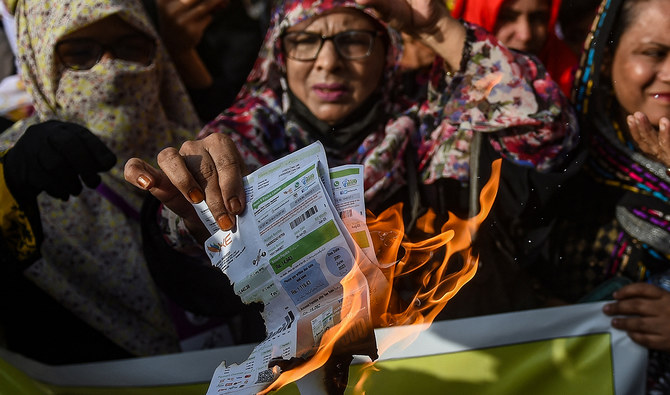
Women activists of Pakistani right wing religious party Jamat-e-Islami set electricity bills on fire during a protest against the surge in electricity prices along a street in Karachi on August 31, 2023. (AFP/File)
Short Url
Updated 01 July 2024
Follow

Pakistani religious party to hold Islamabad sit-in on July 12 against taxes, electricity prices

  • Pakistan’s tax-heavy $67.76 billion budget for the new fiscal year came into effect Monday
  • Last five months have seen steep increases in elec­tricity and gas bills of consumers, industry

ISLAMABAD: The chief of Pakistani religious-political party, the Jamaat-e-Islami (JI), said on Monday it would hold a sit-in in Islamabad on July 12 to exert pressure on the federal government to lower taxes and reduce electricity bills.

Pakistan’s tax-heavy $67.76 billion budget for the new fiscal year came into effect today, Monday, amid an annual inflation projection of up to 13.5 percent for June. 

The ambitious budget with a challenging tax revenue target of Rs13 trillion ($46.66 billion) has drawn the ire of the government’s allies and opposition alike. The revenue collection target for the new fiscal year is almost 40 percent higher than the last fiscal year. The last five months have also seen steep increases in elec­tricity and gas bills of consumers and industries. 

“Today, a joint meeting of party representatives from all over the country was conducted and we decided to hold a large dharna in Islamabad on July 12,” the JI party chief Hafiz Naeem-ur-Rehman said on Monday at a press conference in the southern port city of Karachi, the country’s commercial hub. “The sit-in will be held to lower taxes and also the per unit value of electricity.”

Lamenting the increase in the new budget on the tax liability of the salaried class, Rehman said many working professionals, including doctors, engineers and chartered accountants, were leaving Pakistan due to the unfair policies. 

“Everybody is trying to get out of Pakistan due to inflation, unemployment and increased taxes,” the JI chief said.

The rise in the Pakistan government’s tax target is made up of a 48 percent increase in direct taxes and a 35 percent hike in indirect taxes over revised estimates of the current year. Non-tax revenue, including petroleum levies, is seen increasing by 64 percent. The tax would increase to 18 percent on textile and leather products as well as mobile phones besides a hike in the tax on capital gains from real estate. Workers will also get hit with more direct tax on income.

Opposition parties, mainly parliamentarians backed by the jailed former Prime Minister Imran Khan, and major trade bodies have rejected the budget, saying it will be highly inflationary and lead to industry shutdowns.


Pakistan’s seafood exports to China hit nearly $255 million in 2025 as market reach widens

Updated 26 January 2026
Follow

Pakistan’s seafood exports to China hit nearly $255 million in 2025 as market reach widens

  • Frozen fish and cephalopods lead exports as shipments expand beyond China’s coastal hubs
  • Growth reflects Pakistan’s push to diversify exports and tap China’s inland consumer markets

ISLAMABAD: Pakistan’s seafood exports to China rose to nearly $255 million in 2025, underscoring Beijing’s growing importance as a destination for Pakistani marine products, according to data from China’s General Administration of Customs (GACC) published by state-run APP on Monday.

The figures point to a broader geographic and product diversification of Pakistan’s seafood trade with China at a time when Islamabad is seeking to boost foreign exchange earnings and reduce reliance on a narrow set of export sectors.

“The gains were driven by sustained demand for frozen fish, cephalopods, and a growing range of processed seafood products in both coastal and inland markets,” APP said in a report, citing China Customs data.

Frozen fish remained the single largest export category, contributing about $64.6 million to Pakistan’s seafood shipments to China. Imports were concentrated in major coastal and metropolitan entry points, with Guangdong province emerging as the largest destination by value and volume, importing 8.48 million kilograms worth $15.7 million. Shandong and Beijing followed, each exceeding 7 million kilograms, while Shanghai, Tianjin and Zhejiang also recorded substantial volumes.

At the same time, smaller but notable shipments were recorded in inland provinces including Sichuan, Yunnan, Guizhou and Chongqing, suggesting a widening distribution footprint supported by expanding cold-chain logistics and growing demand away from China’s traditional port cities.

Cephalopods emerged as another key growth pillar. Exports of frozen cuttlefish and squid reached nearly $31 million, while frozen octopus rose to almost $12 million, reflecting demand from catering chains and seafood processors supplying China’s foodservice and ready-to-cook segments.

Affordable pelagic fish also performed strongly. Frozen sardines, sardinella, brisling and sprats recorded imports of around $14.9 million, supported by household consumption and mass-market food manufacturers.

In addition to core frozen categories, Pakistan exported roughly $14.4 million each in two higher-value segments classified by China Customs as “fish” and “fish products,” indicating a gradual shift toward processed and value-added seafood lines.

Analysts cited in the APP report attributed the overall growth to improved compliance with Chinese food safety standards, expanded approvals for Pakistani processing facilities and competitive pricing backed by Pakistan’s marine resource base. Investments in cold-chain logistics and streamlined customs procedures were also seen as supporting higher volumes and broader market access.