France detains two filmmakers over sexual abuse allegations

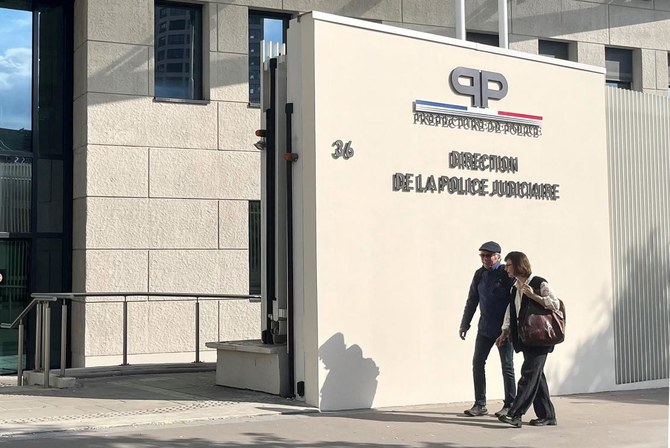
French film director Jacques Doillon, left, arrives at the Direction de la Police Judiciaire for questioning over accusations of sexual abuse in Paris on July 1, 2024. (AFP)
Short Url
Updated 01 July 2024
Follow

France detains two filmmakers over sexual abuse allegations

  • Renewed #MeToo reckoning rocks France’s film industry
  • Directors interrogated over alleged sexual abuse, some dating back to the 1980s

PARIS: French authorities Monday detained leading arthouse film directors Benoit Jacquot and Jacques Doillon for questioning over accusations of sexual abuse, as a renewed #MeToo reckoning rocks France’s film industry.
Their interrogation over the alleged abuse, some dating back to the 1980s and all of which they deny, comes as activists say cinema has too long provided cover for abuse.
An AFP journalist saw Jacquot, 77, and Doillon, 80, arrive at a Paris police station on Monday morning accompanied by their lawyers.
Judith Godreche, a 52-year-old actor and director, earlier this year formally accused Jacquot of rape and Doillon of sexual assault when she was a minor, accusations both men deny.
She has described Jacquot as having had an unhealthy “hold” over her during a relationship with him that started when she was 14, from 1986 to 1992.
And she has accused Doillon of groping her during an unplanned sex scene in one of his films when she was 15.
Several other actors have also filed complaints against both men.
Isild Le Besco, 41, has accused Jacquot of raping her between 1998 and 2007 during a toxic relationship that started when she was 16 and he was 52.
Julia Roy, a 34-year-old actor who has appeared in several of his films, has accused him of sexual assault in “a context of violence and moral constraint which lasted several years,” a source close to the case said.
Le Besco has also charged Doillon made advances during work sessions, while actor Anna Mouglalis alleged the filmmaker forcefully kissed her in 2011.
The directors’ lawyers said there had been no need to detain them in order to question them, and stressed they should be considered innocent until proven guilty.
Jacquot’s lawyer, Julia Minkowski, said her client would “finally be able to express himself before the law,” slamming what she called the “unacceptable excesses” of media coverage on the issue.
Doillon’s attorney, Marie Dose, said no legal criteria could justify his being detained for questioning “36 years” after the incident alleged by Godreche, adding he could have answered queries without being held in custody.
Sources close to the case said their interrogation could include a confrontation with those accusing them.
Godreche on Instagram said she was deeply moved.
“I’m crying,” she wrote.
“I don’t know if I have the strength, but I will have it. I will have it... For her,” she wrote, posting a picture of her teenage self next to Jacquot, 25 years her senior.
Her lawyer, Laure Heinich, did not wish to comment.
Since breaking her silence, Godreche has become a leading voice in France’s #MeToo movement.
After she appealed for a cinema oversight body, parliament in May voted to create a commission to investigate sexual and gender-based violence in the film industry and other cultural sectors.
The head of France’s top cinema institution, Dominique Boutonnat, stepped down on Friday after he was convicted of sexually assaulting his godson in 2020.
And cinema legend Gerard Depardieu, 75, is to stand trial in October for sexually assaulting two women.
He also risks a second trial after he was charged in 2020 with rape after actor Charlotte Arnould alleged he raped her in 2018 when she was 22 and anorexic.
He denies all claims.


UN slams world’s ‘apathy’ in launching aid appeal for 2026

Updated 24 min 34 sec ago
Follow

UN slams world’s ‘apathy’ in launching aid appeal for 2026

  • ‘Prioritized’ plan to raise at least $23 billion to help 87 million people in the world’s most dangerous places such as Gaza and Ukraine

UNITED NATIONS, United States:  The United Nations on Monday hit out at global “apathy” over widespread suffering as it launched its 2026 appeal for humanitarian assistance, which is limited in scope as aid operations confront major funding cuts.

“This is a time of brutality, impunity and indifference,” UN humanitarian chief Tom Fletcher told reporters, condemning “the ferocity and the intensity of the killing, the complete disregard for international law, horrific levels of sexual violence” he had seen on the ground in 2025.

“This is a time when the rules are in retreat, when the scaffolding of coexistence is under sustained attack, when our survival antennae have been numbed by distraction and corroded by apathy,” he said.

He said it was also a time “when politicians boast of cutting aid,” as he unveiled a streamlined plan to raise at least $23 billion to help 87 million people in the world’s most dangerous places such as Gaza, Ukraine, Sudan, Haiti and Myanmar.

The United Nations would like to ultimately raise $33 billion to help 135 million people in 2026 — but is painfully aware that its overall goal may be difficult to reach, given US President Donald Trump’s slashing of foreign aid.

Fletcher said the “highly prioritized appeal” was “based on excruciating life-and-death choices,” adding that he hoped Washington would see the choices made, and the reforms undertaken to improve aid efficiency, and choose to “renew that commitment” to help.

The world body estimates that 240 million people in conflict zones, suffering from epidemics, or victims of natural disasters and climate change are in need of emergency aid.

‘Lowest in a decade’

In 2025, the UN’s appeal for more than $45 billion was only funded to the $12 billion mark — the lowest in a decade, the world body said.

That only allowed it to help 98 million people, 25 million fewer than the year before.

According to UN data, the United States remains the top humanitarian aid donor in the world, but that amount fell dramatically in 2025 to $2.7 billion, down from $11 billion in 2024.

Atop the list of priorities for 2026 are Gaza and the West Bank.

The UN is asking for $4.1 billion for the occupied Palestinian territories, in order to provide assistance to three million people.

Another country with urgent need is Sudan, where deadly conflict has displaced millions: the UN is hoping to collect $2.9 billion to help 20 million people.

In Tawila, where residents of Sudan’s western city of El-Fasher fled ethnically targeted violence, Fletcher said he met a young mother who saw her husband and child murdered.

She fled, with the malnourished baby of her slain neighbors along what he called “the most dangerous road in the world” to Tawila.

Men “attacked her, raped her, broke her leg, and yet something kept her going through the horror and the brutality,” he said.

“Does anyone, wherever you come from, whatever you believe, however you vote, not think that we should be there for her?”

The United Nations will ask member states top open their government coffers over the next 87 days — one day for each million people who need assistance.

And if the UN comes up short, Fletcher predicts it will widen the campaign, appealing to civil society, the corporate world and everyday people who he says are drowning in disinformation suggesting their tax dollars are all going abroad.

“We’re asking for only just over one percent of what the world is spending on arms and defense right now,” Fletcher said.

“I’m not asking people to choose between a hospital in Brooklyn and a hospital in Kandahar — I’m asking the world to spend less on defense and more on humanitarian support.”