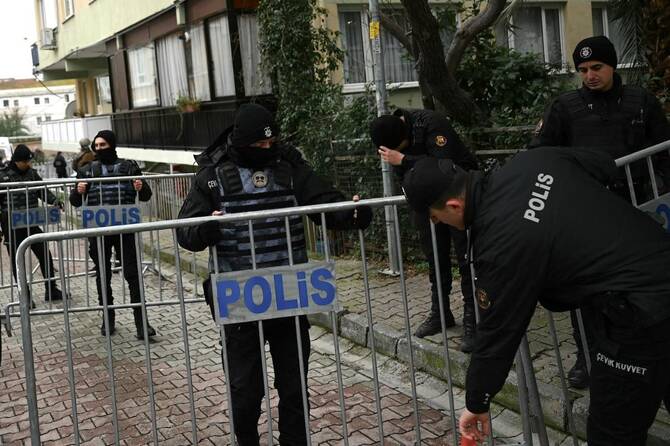
ISTANBUL: A police officer died Monday after being shot and seriously wounded during an early morning drug raid in Istanbul, Turkish officials said.
Officer Emre Albayrak died of his wounds in a hospital. He was part of a special operations team carrying out the raid in the Cekmekoy district on Istanbul’s Asian side.
“Our police officer Emre Albayrak, who was seriously injured in a narcotics operation in the Cekmekoy district, could not be saved despite all interventions in the hospital to which he was taken and became a martyr,” Istanbul Governor’s Office said in a statement.
The man who opened fire on police was killed and two other suspects were detained, the office said.
Turkiye has experienced a rise in drug-related crime in recent years. There was a 23 percent rise in drug-related incidents last year compared to 2023, according to a National Police Counter-Narcotics Department report.
Interior Minister Ali Yerlikaya said in a social media post Monday that 970 suspects had been detained in nationwide counter-narcotics operations over the previous week.

Turkish police officer dies from gunshot wounds suffered in Istanbul drug raid
https://arab.news/pcjun
Turkish police officer dies from gunshot wounds suffered in Istanbul drug raid
- The man who opened fire on police was killed and two other suspects were detained
Israel spied on US forces at Gaza aid base: Sources
- US commander summoned Israeli counterpart to say: ‘Recording has to stop here’
- Staff, visitors from other partner countries have also raised concerns about Israeli surveillance
LONDON: Israel conducted widespread surveillance of US forces involved in an aid mechanism for Gaza, The Guardian reported.
The Civil-Military Coordination Center in southern Israel was launched in October as a joint body to monitor the ceasefire and oversee the entry of aid into the war-torn Palestinian enclave.
But sources with knowledge of internal disputes told The Guardian that open and covert recordings of meetings at the CMCC had prompted disputes between the two partners.
Lt. Gen. Patrick Frank, the US commander of the center, summoned his Israeli counterpart to explain that “recording has to stop here.”
Other countries, including the UK and UAE, are also involved in the CMCC. Staff and visitors from partner countries have likewise raised concerns about Israeli surveillance activities at the center.
When the CMCC began operations, media in the US and Israel reported that the latter was handing over authority to American forces.
Yet Israel still retains effective control over what enters the territory despite Washington’s considerable leverage, according to one US official.
US forces who arrived at the CMCC, including logistics experts, were keen to increase the flow of aid into Gaza.
But they soon discovered that Israel had implemented a wide range of controls on purported “dual-use” goods, creating a larger impediment than any engineering challenge relating to aid delivery. These included basic goods such as tent poles and chemicals used for water purification.
Dutch Foreign Minister David van Weel has said he was briefed at the center on “one of the dual-use barriers that was being lifted as a result of the conversations (there).”
It came in response to growing awareness that Israeli restrictions on deliveries stood as the biggest barrier to the entry of aid into Gaza.
Israeli authorities had also restricted basic items such as pencils and paper — required by Palestinian students for school — without explanation.
There is widespread hesitancy among aid organizations and diplomats over joining the CMCC’s efforts, despite being invited to do so.
The center lacks any Palestinian representation, and even US efforts to schedule video calls with Palestinian officials were vetoed by Israeli staff there.


