

UK government, British Airways sued over 1990 Kuwait hostage crisis

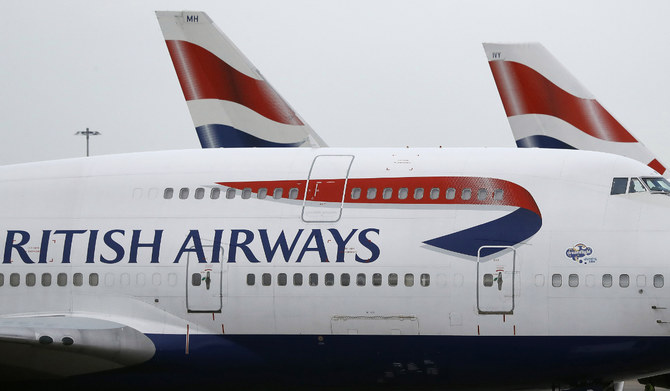
In this file photo dated Tuesday, Jan. 10, 2017, British Airways planes are parked at Heathrow Airport in London. (AP file photo)
Short Url
Updated 01 July 2024
Follow

UK government, British Airways sued over 1990 Kuwait hostage crisis

  • British government files released in November 2021 revealed that the UK ambassador to Kuwait informed London about reports of an Iraqi incursion before the flight landed but the message was not passed on to BA

LONDON: Passengers and crew of a British Airways flight who were taken hostage in Kuwait in 1990 have launched legal action against the UK government and the airline, a law firm said Monday.
People on BA flight 149 were taken off the Kuala Lumpur-bound plane when it landed in the Gulf state on August 2 that year, hours after Iraq’s then leader Saddam Hussein invaded the country.
Some of the 367 passengers and crew spent more than four months in captivity, including as human shields against Western attacks on the Iraqi dictator’s troops during the first Gulf war.
Ninety-four of them have filed a civil claim at the High Court in London, accusing Britain’s government and BA of “deliberately endangering” civilians, said McCue Jury & Partners.
“All of the claimants suffered severe physical and psychiatric harm during their ordeal, the consequences of which are still felt today,” the law firm added.
The action claims that the UK government and the airline “knew the invasion had started” but allowed the flight to land anyway.
They did so because the flight was used to “insert a covert special ops team into occupied Kuwait,” the firm added.
“We were not treated as citizens but as expendable pawns for commercial and political gain,” said Barry Manners, who was on the flight and is taking part in the claim.
“A victory over years of cover-up and bare-faced denial will help restore trust in our political and judicial process,” he added.
British government files released in November 2021 revealed that the UK ambassador to Kuwait informed London about reports of an Iraqi incursion before the flight landed but the message was not passed on to BA.
There have also been claims, denied by the government, that London knowingly put passengers at risk by using the flight to deploy undercover operatives and delayed take-off to allow them to board.
The UK government refused to comment on ongoing legal matters.
British Airways has always denied accusations of negligence, conspiracy and a cover-up.
The airline did not respond to a request for comment from AFP but said last year that the records released in 2021 “confirmed British Airways was not warned about the invasion.”
McCue Jury & Partners had announced in September its intention to file the suit, saying then that the hostages “may claim an estimated average of £170,000 ($213,000) each in damages.”
In 2003, a French court ordered BA to pay 1.67 million euros to the flight’s French hostages, saying it had “seriously failed in its obligations” to them by landing the plane.


In Ethiopia, Tigrayans fear return to ‘full-scale war’

Updated 44 min 10 sec ago
Follow

In Ethiopia, Tigrayans fear return to ‘full-scale war’

  • Flights have been suspended into Tigray since Thursday and local authorities reported drone strikes on goods lorries
  • The international community fears the fighting could turn into an international conflict between Ethiopia and Eritrea

ADDIS ABABA: Tigrayans in northern Ethiopia fear a return to all-out war amid reports that clashes were continuing between local and federal forces on Monday, barely three years after the last devastating conflict in the region.
The civil war of 2020-2022 between the Ethiopian government and Tigray forces killed more than 600,000 people and a peace deal known as the Pretoria Agreement has never fully resolved the tensions.
Fighting broke out again last week in a disputed area of western Tigray called Tselemt and the Afar region to the east of Tigray.
Abel, 38, a teacher in Tigray’s second city Adigrat, said he still hadn’t recovered from the trauma of the last war and had now “entered into another round of high anxiety.”
“If war breaks out now... it could lead to an endless conflict that can even be dangerous to the larger east African region,” added Abel, whose name has been changed along with other interviewees to protect their identity.
Flights have been suspended into Tigray since Thursday and local authorities reported drone strikes on goods lorries on Saturday that killed at least one driver.
In Afar, a humanitarian worker, speaking to AFP on condition of anonymity, said there had been air strikes on Tigrayan forces and that clashes were ongoing on Monday, with tens of thousands of people displaced.
AFP could not independently verify the claims and the government has yet to give any comment on the clashes.
In the regional capital Mekele, Nahom, 35, said many people were booking bus tickets this weekend to leave, fearing that land transport would also be restricted soon.
“My greatest fear is the latest clashes turning into full-scale war and complete siege like what happened before,” he told AFP by phone, adding that he, too, would leave if he could afford it.
Gebremedhin, a 40-year-old civil servant in the city of Axum, said banks had stopped distributing cash and there were shortages in grocery stores.
“This isn’t only a problem of lack of supplies but also hoarding by traders who fear return of conflict and siege,” he said.
The region was placed under a strict lockdown during the last war, with flights suspended, and banking and communications cut off.
The international community fears the fighting could turn into an international conflict between Ethiopia and Eritrea, whose relations have been increasingly tense in recent months.
The Ethiopian government accuses the Tigrayan authorities and Eritrea of forging closer ties.
United Nations Secretary-General Antonio Guterres is “deeply concerned about... the risk of a return to a wider conflict in a region still working to rebuild and recover,” his spokesman said.
The EU said that an “immediate de-escalation is imperative to prevent a renewed conflict.”