The reasons behind the thawing of ties between Ankara and Damascus

1 / 2
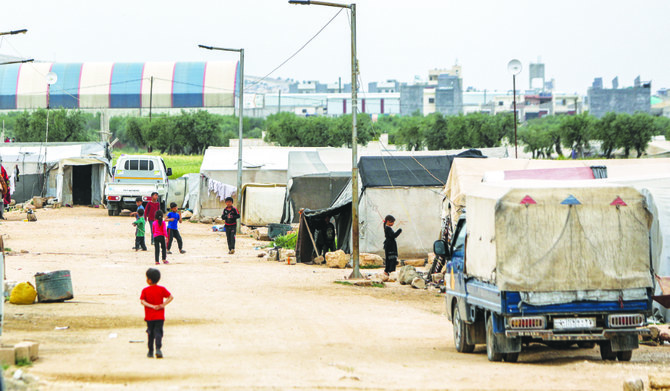
Children play outside tents at a camp for people displaced by conflict in Syria’s northern Aleppo province. The refugees face an uncertain future. (AFP file photo)
2 / 2
Turkish President Recep Tayyip Erdogan (L) and Syria’s Assad Al-Assad. (Supplied)
Short Url
Updated 30 June 2024
Follow

The reasons behind the thawing of ties between Ankara and Damascus

  • Gaza war creates new regional dynamics for Assad regime, necessitates closer relations with Turkiye, says expert
  • Erdogan signals possible policy shift as Turkiye considers rapprochement with Syria

ANKARA: Turkish President Recep Tayyip Erdogan has signaled a possible restoration of relations with Syria’s Assad regime in a surprising move that marks a significant departure from years of hostility between the two nations.

Erdogan’s comments, which were made after Friday prayers, suggest a willingness to revive diplomatic ties with Damascus, emphasizing historical precedent and family ties as potential foundations for future engagement.

“There is no reason why it should not happen,” Erdogan said.

“Just as we kept our relations very lively in the past, we even had talks between our families with Assad. It is certainly not possible to say that this will not happen in the future. It can happen; the Syrian people are our brothers.”

The Turkish leader’s comments echo similar sentiments recently expressed by Syrian President Bashar Assad, who has indicated his willingness to pursue steps toward normalization, provided they respect Syria’s sovereignty and contribute to counter-terrorism efforts.

The remarks came during a meeting with Alexander Lavrentiev, Russian President Vladimir Putin’s special envoy to Syria.

The concurrent statements are seen as part of a broader effort to reconcile Ankara and Damascus, but the path to rapprochement remains fraught with uncertainty and complexity.

Erdogan, then prime minister of Turkiye, hosted Assad in 2009 for a family holiday in the Aegean resort of Bodrum, and they enjoyed amicable visits to nurture their friendship.

But since severing all ties with the Assad regime in 2011, Turkiye has been a vocal supporter of his opponents in Syria and called for the ousting of Assad from power.

Ankara’s involvement has escalated with several cross-border military operations and the establishment of a safe zone in northern Syria, in which Turkish troops are stationed.

The Turkish and Syrian foreign ministers met in Moscow last year, marking the highest-level contact between the two countries since the start of the Syrian Civil War.

But the talks, along with an earlier meeting between the two countries’ defense ministers, did not bring about any change in bilateral relations.

Oytun Orhan, coordinator of Levant studies at the Ankara-based think tank ORSAM, says there is a glimmer of hope for a resumption of the dialogue process.

He told Arab News: “There have been some developments in recent weeks. It is said that Turkish and Syrian officials could meet in Baghdad with the mediation of Iraq, and surprising developments in Turkish-Syrian relations are expected in the coming period.”

Efforts were being made to bring the parties together, he added.

Orhan believes that with Russia’s softening position in Ukraine, the Kremlin has begun to pay more attention to Turkish-Syrian relations, and the Gaza conflict also requires new regional dynamics and presents new security challenges for the Assad regime, which necessitates closer Turkish-Syrian relations.

He said: “Discussions about a possible US withdrawal after the upcoming presidential elections are another factor to consider.”

The Assad regime has recently been in talks with the Syrian Kurdish People’s Protection Units and “is trying to corner Turkiye by signaling that it could reach an agreement with the YPG if Turkiye does not accept its conditions, while at the same time opening channels with Turkiye,” he added.

Ankara considers the Kurdish People’s Protection Units, or YPG, a terrorist group closely linked to the outlawed Kurdistan Workers’ Party, which has been waging a decades-long insurgency in southeast Turkiye.

Experts say that both parties are trying to consolidate their positions in line with regional changes and consider their red lines for domestic security concerns.

But Orhan does not expect Turkish troops to withdraw in the short term, and added: “First, there may be an agreement between the parties on how to deal with the YPG.

“At that point Turkiye may have to take some steps regarding its relationship with the opposition. However, there will not be a situation where the Syrian opposition is completely abandoned or its support is cut off. A gradual road map can be agreed.”

Orhan expects that a mechanism of guarantees involving Russia or even Iran could be agreed upon for a road map for withdrawal from Syria.

He said: “Gradual steps will be taken based on criteria such as the complete elimination of the PKK/YPG threat and the creation of conditions for the safe return of Syrian refugees to their country.

“A common will against the PKK is not very likely at this stage because the Syrian regime still wants to use the YPG as a trump card against Turkiye. It believes that after a possible US withdrawal, it can reach an agreement with the YPG and solve this problem with minor concessions.”

Experts believe a partnership between Ankara and Damascus, like the one between Iraq and Turkiye, is unlikely at the moment.

But Orhan believes common ground can be found in the fight against the PKK, depending on the gradual steps taken by Turkiye.

He said: “Instead of a joint military operation, Turkiye’s continued military moves against the YPG, followed by an agreement on areas that Syrian regime forces can retake and control, can be agreed upon.”

Turkiye currently hosts 3.1 million Syrian refugees, according to official figures. One of Ankara’s expectations from a possible rapprochement between Turkiye and Syria would be the safe return of these refugees to their homeland.

Orhan said: “The return of Syrian refugees can only be possible after a lasting solution in Syria.

“It is a long-term, difficult problem to solve. From the Assad regime’s point of view, it sees this as a bargaining chip and a burden on Turkiye’s shoulders.”

He added that the return of Syrian refugees was also seen as providing a risk factor for the Assad regime.

The refugees are seen as “people who fled the country, and it is questionable how willing Assad is to repatriate them,” said Orhan.

Sinan Ulgen, a former Turkish diplomat and current chairman of the Istanbul-based think tank EDAM, has spoken of the profound shifts in regional security dynamics in the wake of the war in Gaza and amid uncertainties surrounding US policy in the Middle East, particularly in Syria.

He told Arab News: “For Syria, which now faces an even more unpredictable security environment, this forces the Syrian leadership to reassess its position for negotiations with Turkiye in response to the evolving geopolitical realities.”

Ulgen believes that from Turkiye’s point of view, this represents a potentially favorable opportunity, provided that Syria is willing to reconsider the terms of engagement that have so far prevented meaningful dialogue.

He added: “Until now, these conditions have been a major obstacle to starting a substantive negotiation process.”

Ulgen said that Syria’s willingness to revise these conditions will be crucial in determining whether formal negotiations can begin.

He added: “The critical question now is whether Damascus will stick to its preconditions, some of which may prove untenable, such as the demand for an immediate withdrawal of Turkish troops from border areas.”

Progress in reconciliation efforts would depend on the lifting of such conditions, Ulgen said.


Iraq’s political future in limbo as factions vie for power

Updated 58 min 20 sec ago
Follow

Iraq’s political future in limbo as factions vie for power

  • The government that eventually emerges will be inheriting a security situation that has stabilized in recent years

BAGHDAD: Political factions in Iraq have been maneuvering since the parliamentary election more than a month ago to form alliances that will shape the next government.
The November election didn’t produce a bloc with a decisive majority, opening the door to a prolonged period of negotiations.
The government that eventually emerges will be inheriting a security situation that has stabilized in recent years, but it will also face a fragmented parliament, growing political influence by armed factions, a fragile economy, and often conflicting international and regional pressures, including the future of Iran-backed armed groups.
Uncertain prospects
Prime Minister Mohammed Shia Al-Sudani’s party took the largest number of seats in the election. Al-Sudani positioned himself in his first term as a pragmatist focused on improving public services and managed to keep Iraq on the sidelines of regional conflicts.
While his party is nominally part of the Coordination Framework, a coalition of Iran-backed Shiite parties that became the largest parliamentary bloc, observers say it’s unlikely that the Coordination Framework will support Al-Sudani’s reelection bid.
“The choice for prime minister has to be someone the Framework believes they can control and doesn’t have his own political ambitions,” said Sajad Jiyad, an Iraqi political analyst and fellow at The Century Foundation think tank.
Al-Sudani came to power in 2022 with the backing of the Framework, but Jiyad said that he believes now the coalition “will not give Al-Sudani a second term as he has become a powerful competitor.”
The only Iraqi prime minister to serve a second term since 2003 was Nouri Al-Maliki, first elected in 2006. His bid for a third term failed after being criticized for monopolizing power and alienating Sunnis and Kurds.
Jiyad said that the Coordination Framework drew a lesson from Al-Maliki “that an ambitious prime minister will seek to consolidate power at the expense of others.”
He said that the figure selected as Iraq’s prime minister must generally be seen as acceptable to Iran and the United States — two countries with huge influence over Iraq — and to Iraq’s top Shiite cleric, Grand Ayatollah Ali Al-Sistani.
Al-Sudani in a bind
In the election, Shiite alliances and lists — dominated by the Coordination Framework parties — secured 187 seats, Sunni groups 77 seats, Kurdish groups 56 seats, in addition to nine seats reserved for members of minority groups.
The Reconstruction and Development Coalition, led by Al-Sudani, dominated in Baghdad, and in several other provinces, winning 46 seats.
Al-Sudani’s results, while strong, don’t allow him to form a government without the support of a coalition, forcing him to align the Coordination Framework to preserve his political prospects.
Some saw this dynamic at play earlier this month when Al-Sudani’s government retracted a terror designation that Iraq had imposed on the Lebanese Hezbollah militant group and Yemen’s Houthi rebels — Iran-aligned groups that are allied with Iraqi armed factions — just weeks after imposing the measure, saying it was a mistake.
The Coalition Framework saw its hand strengthened by the absence from the election of the powerful Sadrist movement led by Shiite cleric Muqtada Sadr, which has been boycotting the political system since being unable to form a government after winning the most seats in the 2021 election.
Hamed Al-Sayed, a political activist and official with the National Line Movement, an independent party that boycotted the election, said that Sadr’s absence had a “central impact.”
“It reduced participation in areas that were traditionally within his sphere of influence, such as Baghdad and the southern governorates, leaving an electoral vacuum that was exploited by rival militia groups,” he said, referring to several parties within the Coordination Framework that also have armed wings.
Groups with affiliated armed wings won more than 100 parliamentary seats, the largest showing since 2003.
Other political actors
Sunni forces, meanwhile, sought to reorganize under a new coalition called the National Political Council, aiming to regain influence lost since the 2018 and 2021 elections.
The Kurdish political scene remained dominated by the traditional split between the Kurdistan Democratic Party and Patriotic Union of Kurdistan parties, with ongoing negotiations between the two over the presidency.
By convention, Iraq’s president is always a Kurd, while the more powerful prime minister is Shiite and the parliamentary speaker Sunni.
Parliament is required to elect a speaker within 15 days of the Federal Supreme Court’s ratification of the election result, which occurred on Dec. 14.
The parliament should elect a president within 30 days of its first session, and the prime minister should be appointed within 15 days of the president’s election, with 30 days allotted to form the new government.
Washington steps in
The incoming government will face major economic and political challenges.
They include a high level of public debt — more than 90 trillion Iraqi dinars ($69 billion) — and a state budget that remains reliant on oil for about 90 percent of revenues, despite attempts to diversify, as well as entrenched corruption.
But perhaps the most delicate question will be the future of the Popular Mobilization Forces, a coalition of militias that formed to fight the Daesh group as it rampaged across Iraq more than a decade ago.
It was formally placed under the control of the Iraqi military in 2016 but in practice still operates with significant autonomy. After the Hamas-led attack in southern Israel on Oct. 7, 2023 sparked the devastating war in Gaza, some armed groups within the PMF launched attacks on US bases in the region in retaliation for Washington’s backing of Israel.
The US has been pushing for Iraq to disarm Iran-backed groups — a difficult proposition, given the political power that many of them hold and Iran’s likely opposition to such a step.
Two senior Iraqi political officials, who spoke on condition of anonymity because they weren’t authorized to comment publicly, said that the United States had warned against selecting any candidate for prime minister who controls an armed faction and also cautioned against letting figures associated with militias control key ministries or hold significant security posts.
“The biggest issue will be how to deal with the pro-Iran parties with armed wings, particularly those... which have been designated by the United States as terrorist entities,” Jiyad said.