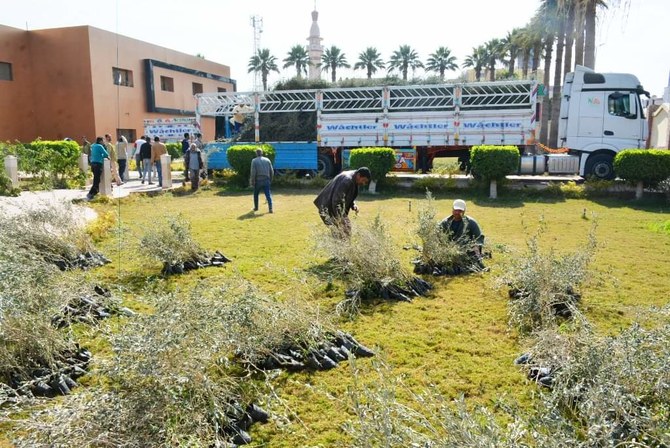
CAIRO: Several Egyptian ministries have initiated the “100 Million Trees” campaign across the country in response to its climate challenges and rising population, as part of a nationwide strategy to increase per-capita green space.
The project involves “reviewing and monitoring new tree plantings, tracking existing plantings, and creating a detailed plan for the types of trees planted in each governorate based on their unique characteristics,” according to a statement. Tree species with high economic value that promote investment in green projects are being targeted by the program.
The Environment Ministry is stepping up preparations for the initiative’s second phase this week. Omar Rayan, an official at the ministry, told Arab News that the second phase would be implemented in cooperation with ministries including Local Development, Housing, Water Resources and Irrigation, Agriculture, and Higher Education.
Rayan highlighted the government’s commitment to criminalizing encroachment on agricultural land and to implementing several afforestation initiatives nationwide.
According to the Egyptian prime minister’s website, the initiative will cost 3 billion Egyptian pounds ($62.5 million). It targets around 9,900 locations, and covers areas totaling 6,600 acres to be developed as forested areas or gardens utilizing treated wastewater.
The Ministry of Local Development is responsible for planting 80 million trees over the seven-year period from 2022 to 2029, while the Ministries of Environment and Housing are responsible for the remaining 20 million.
Ahmed Al-Fakharany, an official at the Ministry of Local Development, told Arab News that the second phase will see 15 million trees planted by the ministries of Agriculture, Environment, and Housing.
He said governorates were preparing reports on the number and types of trees required for this phase.
“The role of the Ministry of Local Development is to arrange for the supply of trees, study locations for new gardens in cities and districts, and ensure local units and directorates plant trees that enhance aesthetic appeal and environmental conservation, carefully selecting species that meet the specifications,” Al-Fakharany said.
He added that Cairo leads the governorates in the initiative so far, having planted 1.5 million trees.
“Giza, south of Cairo, is in second place with 585,000 trees, followed by Sohag in Upper Egypt with 404,000 trees, and Sharqia in northern Cairo with 393,900 trees,” he said.

Egypt launches new phase of ‘100 Million Trees’ initiative
Short Url
https://arab.news/zw9v4
Egypt launches new phase of ‘100 Million Trees’ initiative
- Government allocates $62.5 million and targets around 9,900 locations for campaign
- The Environment Ministry is stepping up preparations for the initiative’s second phase this week
UN declares famine over in Gaza, says ‘situation remains critical’
ROME: A famine declared in Gaza in August is now over thanks to improved access for humanitarian aid, the United Nations said on Friday, but warned the food situation in the Palestinian territory remained dire.
More than 70 percent of the population is living in makeshift shelters, it said, with hunger exacerbated by winter floods and an increasing risk of hypothermia as temperatures plummet.
Although a ceasefire between Israel and militant group Hamas that took effect in October has partially eased restrictions on goods and aid, delivery fluctuates daily and is limited and uneven across the territory, it said.
“No areas are classified in Famine,” said the Integrated Food Security Phase Classification Initiative (IPC), a coalition of monitors tasked by the UN to warn of impending crises.
But it stressed that “the situation remains critical: the entire Gaza Strip is classified in Emergency.”
The US-sponsored ceasefire halted two years of fighting, sparked by Hamas’s attack on Israel on October 7, 2023.
Yet the deal remains fragile as Israel and Hamas accuse each other almost daily of violations.
“Following the ceasefire... the latest IPC analysis indicates notable improvements in food security and nutrition compared to the August 2025 analysis, which detected famine,” the IPC said.
However, around 1.6 million people are still forecast to face “crisis” levels of food insecurity in the period running to April 15, it said.
And under a worst-case scenario involving renewed hostilities and a halt in humanitarian aid and commercial goods, the territories of North Gaza, Gaza Governorate, Deir Al-Balah and Khan Younis risk famine, it said.
’Alarmingly high’ -
The UN’s agencies said that despite the roll-back of famine, hunger, malnutrition, disease and the scale of agricultural destruction remains “alarmingly high.”
“Humanitarian needs remain staggering, with current assistance addressing only the most basic survival requirements,” the food, agriculture, health, and childrens’ agencies said in a joint statement.
“Only access, supplies and funding at scale can prevent famine from returning,” they said.
The UN’s declaration of famine in August — the first time it has done so in the Middle East — infuriated Israel, with Prime Minister Benjamin Netanyahu slamming the IPC report as “an outright lie.”
On Friday, foreign ministry spokesman Oren Marmorstein said on X that faced with “overwhelming and unequivocal evidence, even the IPC had to admit that there is no famine in Gaza.”
But he also accused the IPC of continuing to present a “distorted” picture by relying “primarily on data related to UN trucks, which account for only 20 percent of all aid trucks.”
Oxfam said that despite the end of the famine, the levels of hunger in Gaza remain “appalling and preventable,” and accused Israel of blocking aid requests from dozens of well-established humanitarian agencies.
“Oxfam alone has $2.5m worth of aid including 4,000 food parcels, sitting in warehouses just across the border. Israeli authorities refuse it all,” said Nicolas Vercken, Campaigns and Advocacy Director at Oxfam France.
- ‘Rapidly deteriorating’ -
The IPC said hunger was not the only challenge to those in the Palestinian territory.
Access to water, sanitation and hygiene is severely limited, it said, with open defecation and overcrowded living conditions increasing the risk of disease outbreaks.
Over 96 percent of cropland in the Gaza Strip is either damaged, inaccessible, or both, it said, while livestock has been decimated.
“It breaks my heart to see the ongoing scale of human suffering in Gaza,” UN Secretary-General Antonio Guterres said Friday.
“We need more crossings, the lifting of restrictions on critical items, the removal of red tape, safe routes inside Gaza, sustained funding, and unimpeded access — including for NGOs,” he said.
Guterres also urged the world “not lose sight of the rapidly deteriorating situation in the West Bank,” where Palestinians “face escalating Israeli settler violence, land seizures, demolitions and intensified movement restrictions.”
More than 70 percent of the population is living in makeshift shelters, it said, with hunger exacerbated by winter floods and an increasing risk of hypothermia as temperatures plummet.
Although a ceasefire between Israel and militant group Hamas that took effect in October has partially eased restrictions on goods and aid, delivery fluctuates daily and is limited and uneven across the territory, it said.
“No areas are classified in Famine,” said the Integrated Food Security Phase Classification Initiative (IPC), a coalition of monitors tasked by the UN to warn of impending crises.
But it stressed that “the situation remains critical: the entire Gaza Strip is classified in Emergency.”
The US-sponsored ceasefire halted two years of fighting, sparked by Hamas’s attack on Israel on October 7, 2023.
Yet the deal remains fragile as Israel and Hamas accuse each other almost daily of violations.
“Following the ceasefire... the latest IPC analysis indicates notable improvements in food security and nutrition compared to the August 2025 analysis, which detected famine,” the IPC said.
However, around 1.6 million people are still forecast to face “crisis” levels of food insecurity in the period running to April 15, it said.
And under a worst-case scenario involving renewed hostilities and a halt in humanitarian aid and commercial goods, the territories of North Gaza, Gaza Governorate, Deir Al-Balah and Khan Younis risk famine, it said.
’Alarmingly high’ -
The UN’s agencies said that despite the roll-back of famine, hunger, malnutrition, disease and the scale of agricultural destruction remains “alarmingly high.”
“Humanitarian needs remain staggering, with current assistance addressing only the most basic survival requirements,” the food, agriculture, health, and childrens’ agencies said in a joint statement.
“Only access, supplies and funding at scale can prevent famine from returning,” they said.
The UN’s declaration of famine in August — the first time it has done so in the Middle East — infuriated Israel, with Prime Minister Benjamin Netanyahu slamming the IPC report as “an outright lie.”
On Friday, foreign ministry spokesman Oren Marmorstein said on X that faced with “overwhelming and unequivocal evidence, even the IPC had to admit that there is no famine in Gaza.”
But he also accused the IPC of continuing to present a “distorted” picture by relying “primarily on data related to UN trucks, which account for only 20 percent of all aid trucks.”
Oxfam said that despite the end of the famine, the levels of hunger in Gaza remain “appalling and preventable,” and accused Israel of blocking aid requests from dozens of well-established humanitarian agencies.
“Oxfam alone has $2.5m worth of aid including 4,000 food parcels, sitting in warehouses just across the border. Israeli authorities refuse it all,” said Nicolas Vercken, Campaigns and Advocacy Director at Oxfam France.
- ‘Rapidly deteriorating’ -
The IPC said hunger was not the only challenge to those in the Palestinian territory.
Access to water, sanitation and hygiene is severely limited, it said, with open defecation and overcrowded living conditions increasing the risk of disease outbreaks.
Over 96 percent of cropland in the Gaza Strip is either damaged, inaccessible, or both, it said, while livestock has been decimated.
“It breaks my heart to see the ongoing scale of human suffering in Gaza,” UN Secretary-General Antonio Guterres said Friday.
“We need more crossings, the lifting of restrictions on critical items, the removal of red tape, safe routes inside Gaza, sustained funding, and unimpeded access — including for NGOs,” he said.
Guterres also urged the world “not lose sight of the rapidly deteriorating situation in the West Bank,” where Palestinians “face escalating Israeli settler violence, land seizures, demolitions and intensified movement restrictions.”
© 2025 SAUDI RESEARCH & PUBLISHING COMPANY, All Rights Reserved And subject to Terms of Use Agreement.