Geneva: After warning of increasing attacks on women and gender rights around the world, the UN finds itself a key arena for a war of words over how those rights are defined.
UN rights chief Volker Turk has long warned of “systematic” efforts to strip women of their hard-won rights.
Speaking before the UN Human Rights Council last week, he highlighted extreme cases like Afghanistan and Iran, but warned the pushback was happening worldwide.
“No country is immune from regression in women’s rights,” he said, also decrying “ongoing discrimination and exclusion on the basis of sexual orientation and gender identity.”
The UN itself has meanwhile become a key battleground in the fight.
Diplomats describe growing efforts to remove references to women’s rights or to sexual orientation and gender identity that had long gone uncontested in resolutions and texts across the UN system.
“What we’re seeing is a concerted effort to push back on issues related to gender and sexual orientation and gender identity in ... the work of international organizations in Geneva broadly,” said a woman diplomat based in Geneva, who asked not to be named.
Gurchaten Sandhu, program director at the International Lesbian, Gay, Bisexual, Trans and Intersex Association (ILGA), described “coordinated efforts” of various actors “to push back on equality.”
“There is a heightened sense of paranoia” around any gender-related terms used in UN texts, he told AFP.
The United Nations working group on discrimination against women and girls presented a report to the rights council this week highlighting an “escalating gender backlash” and a clear “resurgence of a conservative and retrogressive narrative in international fora.”
Reacting to the report, Russian representative Ilia Barmin told the council Thursday that his country regretted that the text contained “controversial concepts,” including on the right to reproductive and sexual health.
“There is no such right in international law,” he insisted, adding that Russia also opposed the inclusion of “new categories of human rights” in the report, like “the right to bodily autonomy.”
The rights council is not the only UN forum where words are being hotly debated.
The World Health Organization’s decision-making assembly last month was for instance forced for the first time to take a resolution to a vote instead of adopting it by consensus due to opposition over gender-related terminology.
A conservative alliance of countries, including Egypt, Russia and Saudi Arabia, balked at the term “gender-responsive” in the text, although they ultimately failed in their bid to change it.
And last year, the UN labor agency’s budget barely passed amid a dramatic standoff over references — which had gone uncontested in previous budgets — to discrimination based on gender identity and sexual orientation.
The tensions have especially pitted mainly Western countries against conservative, largely Muslim states.
But Sandhu warned it would be “a mistake to think it’s coming from one direction.”
A range of African countries also figure among those taking part in efforts to remove language on gender rights from UN texts.
So too do Russia and China, although observers suggested their motivations are less about conviction than a desire to build alliances and to upset Western opponents.
Others highlight the Vatican’s role.
“The earliest reference to ‘gender ideology’ as a dangerous, subversive phenomenon that needed to be stopped came from the Vatican,” said Erin Kilbride, a researcher with Human Rights Watch.
Pope Francis earlier this year doubled down on the issue, publishing a document listing gender theory among the world’s “grave violations of human dignity.”
Lobbying by “anti-rights groups” is also on the rise at the UN, the woman diplomat said.
The groups, typically funded by Gulf states, Russia and influential US religious movements, had become “increasingly vocal and coordinated,” she warned.
They were pushing talking points on traditional gender roles, anti-abortion and anti-LGBTQ rights on countries, which then use them in UN debates, she added.
A Western diplomat, who asked not to be named, decried “a very strong offensive.”
There is a group of countries, he warned, “intent on felling a whole host of social rights gained over the past 30 years.”


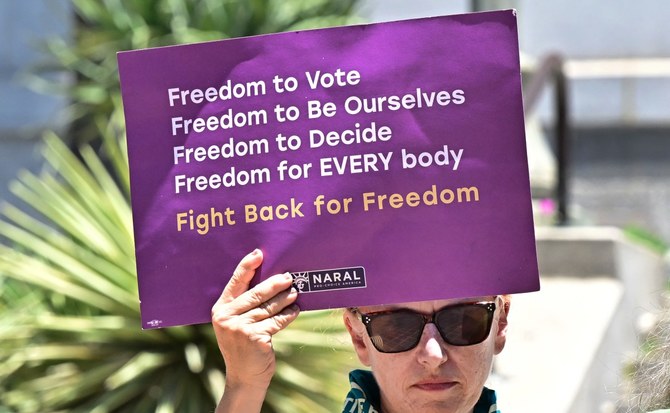
War of words rages at UN over women, gender rights
https://arab.news/m5mnn
War of words rages at UN over women, gender rights

- UN rights chief Volker Turk has long warned of “systematic” efforts to strip women of their hard-won rights.
- A range of African countries also figure among those taking part in efforts to remove language on gender rights from UN texts


Federal judge issues order to prohibit immigration officials from detaining Kilmar Abrego Garcia
- His lawyers had sent an urgent request to the judge, warning that ICE officials could immediately place him back into custody
- Instead, Abrego Garcia exited the building after a short appointment, emerging to cheers from supporters who had gathered outside
BALTIMORE, USA: A federal judge blocked US immigration authorities on Friday from re-detaining Kilmar Abrego Garcia, saying she feared they might take him into custody again just hours after she had ordered his release from a detention center.
The order came as Abrego Garcia appeared at a scheduled appointment at an Immigration and Customs Enforcement field office roughly 14 hours after he walked out of immigration detention facility in Pennsylvania.
His lawyers had sent an urgent request to the judge, warning that ICE officials could immediately place him back into custody. Instead, Abrego Garcia exited the building after a short appointment, emerging to cheers from supporters who had gathered outside.
Speaking briefly to the crowd, he urged others to “stand tall” against what he described as injustices carried out by the government.
Abrego Garcia became a flashpoint of the Trump administration’s immigration crackdown earlier this year when he was wrongly deported to a notorious prison in El Salvador. He was last taken into custody in August during a similar check-in.
Officials cannot re-detain him until the court conducts a hearing on the motion for the temporary restraining order, US District Judge Paula Xinis in Maryland said. She wrote that Abrego Garcia is likely to succeed on the merits of any further request for relief from ICE detention.
“For the public to have any faith in the orderly administration of justice, the Court’s narrowly crafted remedy cannot be so quickly and easily upended without further briefing and consideration,” she wrote.
Abrego Garcia on Friday stopped at a news conference outside the building, escorted by a group of supporters chanting “We are all Kilmar!”
Abrego Garcia says he has ‘so much hope’
“I stand before you a free man and I want you to remember me this way, with my head held up high,” Abrego Garcia said through a translator. “I come here today with so much hope and I thank God who has been with me since the start with my family.”
He urged people to keep fighting.
After Abrego Garcia spoke, he went through security at the field office, escorted by supporters.
When Abrego Garcia’s attorney, Simon Sandoval-Moshenberg, announced to the crowd assembled outside that his client would walk back out the field office’s doors again, he stressed that the legal fight was not over.
“Yesterday’s order from Judge Xinis and now the temporary restraining order this morning represent a victory of law over power,” Sandoval-Moshenberg said.
The agency freed him just before 5 p.m. on Thursday in response to a ruling from Xinis, who wrote federal authorities detained him after his return to the United States without any legal basis.
Mistakenly deported and then returned
Abrego Garcia is a Salvadoran citizen with an American wife and child who has lived in Maryland for years. He immigrated to the US illegally as a teenager to join his brother, who had become a US citizen. In 2019, an immigration judge granted him protection from being deported back to his home country, where he faces danger from a gang that targeted his family.
While he was allowed to live and work in the US under ICE supervision, he was not given residency status. Earlier this year, he was mistakenly deported and held in a notoriously brutal Salvadoran prison despite having no criminal record.
Facing mounting public pressure and a court order, President Donald Trump’s Republican administration brought him back to the US in June, but only after issuing an arrest warrant on human smuggling charges in Tennessee. He has pleaded not guilty to those charges and asked a federal judge there to dismiss them.
A lawsuit to block removal from the US
The 2019 settlement found he had a “well founded fear” of danger in El Salvador if he was deported there. So instead ICE has been seeking to deport him to a series of African countries. Abrego Garcia has sued, claiming the Trump administration is illegally using the removal process to punish him for the public embarrassment caused by his deportation.
In her order releasing Abrego Garcia, Xinis wrote that federal authorities “did not just stonewall” the court, “They affirmatively misled the tribunal.” Xinis also rejected the government’s argument that she lacked jurisdiction to intervene on a final removal order for Abrego Garcia, because she found no final order had been filed.
ICE freed Abrego Garcia from Moshannon Valley Processing Center, about 115 miles (185 kilometers) northeast of Pittsburgh, on Thursday just before the deadline Xinis gave the government to provide an update on Abrego Garcia’s release.
He returned home to Maryland a few hours later.
Immigration check-in
Check-ins are how ICE keeps track of some people who are released by the government to pursue asylum or other immigration cases as they make their way through a backlogged court system. The appointments were once routine but many people have been detained at their check-ins since the start of Trump’s second term.
The Department of Homeland Security sharply criticized Xinis’ order and vowed to appeal, calling the ruling “naked judicial activism” by a judge appointed during the Obama administration.
“This order lacks any valid legal basis, and we will continue to fight this tooth and nail in the courts,” said Tricia McLaughlin, the department’s assistant secretary.
Sandoval-Moshenberg said the judge made it clear that the government can’t detain someone indefinitely without legal authority.
Abrego Garcia has also applied for asylum in the US in immigration court.
Charges in Tennessee
Abrego Garcia was hit with human smuggling and conspiracy to commit human smuggling charges when the US government brought him back from El Salvador. Prosecutors alleged he accepted money to transport within the United States people who were in the country illegally.
The charges stem from a 2022 traffic stop in Tennessee for speeding. Body camera footage from a Tennessee Highway Patrol officer shows a calm exchange with Abrego Garcia. There were nine passengers in the car, and the officers discussed among themselves their suspicions of smuggling. However, Abrego Garcia was eventually allowed to continue driving with only a warning.
A Department of Homeland Security agent testified at an earlier hearing that he did not begin investigating the traffic stop until after the US Supreme Court said in April that the Trump administration must work to bring back Abrego Garcia.