

Pakistan to discuss regional issues, economic ties at UAE summit this week

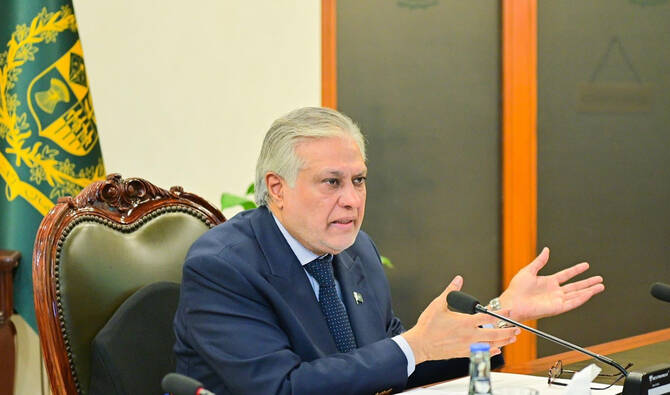
Deputy Prime Minister and Foreign Minister Ishaq Dar chairs a meeting at the Ministry of Foreign Affairs in Islamabad, Pakistan, on December 8, 2025. (MOFA/File)
Short Url
Updated 12 December 2025
Follow

Pakistan to discuss regional issues, economic ties at UAE summit this week

  • Deputy PM Ishaq Dar to attend Sir Bani Yas Forum from Dec. 12-14, says Pakistan foreign office
  • Senior statemen, policymakers expected to discuss security and economic cooperation at summit

ISLAMABAD: Pakistan’s Deputy Prime Minister Ishaq Dar will attend the Sir Bani Yas Forum in the UAE from Dec. 12-14 to discuss regional issues with world leaders and explore economic partnerships, the foreign ministry said on Friday. 

The three-day summit features senior statesmen, policymakers and global experts from around the world with discussions likely to revolve around key regional and international issues such as peace, security and economic cooperation.

Dar, who is also Pakistan’s foreign minister, attended the 15th edition of the Bani Yas Forum last year. He is attending this year’s summit at the invitation of his UAE counterpart, Sheikh Abdullah bin Zayed Al Nahyan, the foreign office said. 

“During the Forum, the Deputy Prime Minister/Foreign Minister will engage with international leaders and experts on matters related to regional stability, sustainable development, and the expansion of economic partnerships,” the statement said. 

“He will also present Pakistan’s perspectives on promoting dialogue, addressing regional challenges, and fostering enhanced opportunities for economic cooperation.”

The Forum is expected to feature important discussions on Israel’s war in Gaza and the fragile ceasefire in the Middle East. 

Pakistan has consistently criticized Israel for violating the ceasefire in Gaza and has called on the international community to intervene and ensure the fragile agreement does not collapse. 

Islamabad has also been eyeing economic partnerships with regional allies, particularly Gulf countries, at such global summits in recent months. 

It has entered into economic, defense, trade and investment agreements with traditional allies such as China, Saudi Arabia, UAE, Qatar and Central Asian states in recent months.


Pakistan says over 100 militants killed in ‘retributive strikes’ against Afghanistan

Updated 9 sec ago
Follow

Pakistan says over 100 militants killed in ‘retributive strikes’ against Afghanistan

  • Islamabad determined to carry out similar strikes in future if cross-border attacks continue, warns Pakistan parliamentary affairs minister 
  • Pakistan says struck seven militant camps in Afghanistan’s three provinces Saturday night, while Taliban accuse Islamabad of killing civilians

ISLAMABAD: Minister for Parliamentary Affairs Tariq Fazal Chaudhry has said that over 100 militants were killed in the recent “retributive strikes” launched by Pakistan against Afghanistan, state media reported on Tuesday, vowing that Islamabad is determined to carry out similar actions in future if cross-border attacks persist. 

Pakistan said on Sunday it launched “intelligence-based selective targeting” of seven militant camps along the Afghan border in response to a mosque bombing in Islamabad and violence in the northwestern border districts of Bajaur and Bannu, among other attacks. Authorities say many of the assaults have been carried out by the Tehreek-e-Taliban Pakistan (TTP) and other allied militant groups that Islamabad alleges are operating from sanctuaries in Afghanistan, whose government denies this.

A Pakistani security official said the strikes were launched at militant camps in Afghanistan’s Nangarhar, Paktika and Khost provinces. Afghanistan denied Pakistan’s claims, saying Islamabad had killed dozens of civilians, including women and children. Afghanistan’s Defense

Ministry warned Pakistan of retaliation at a “suitable time.”

“The Senate was informed today that over one hundred Khawarij were killed in retributive strikes carried out by the Pakistan Air Force against Fitna Al-Khawarij in Afghanistan,” state broadcaster Radio Pakistan said. 

Pakistan’s military frequently uses the term “Fitna Al-Khawarij” to describe the TTP, which has carried out some of the deadliest attacks against Pakistani citizens and law enforcers since 2007. 

Chaudhry said Islamabad carried out the strikes after the Afghan administration failed to prevent “terrorists” from using its soil for attacks targeting Pakistan. He said Islamabad had repeatedly shared credible evidence of militants using Afghan territory to carry out attacks against

Pakistan, but Kabul remained unable to curb their actions. 

“He made it clear that Pakistan reserves the right to respond to terrorist activities in self-defense and is determined to carry out similar retributive actions in the future if such activities continue,” Radio Pakistan said. 

Afghanistan’s foreign ministry on Sunday summoned Pakistan’s charge d’affaires to Afghanistan Ubaid-ur-Rehman Nizamani and lodged a protest through a formal démarche in response to the Pakistani military strikes.

Tensions between Islamabad and Kabul have escalated since the Afghan Taliban returned to power in 2021. Pakistan says cross-border militant attacks have increased since then and has accused the Taliban of failing to honor commitments under the 2020 Doha Agreement to prevent Afghan soil from being used for attacks against other countries.

The Taliban deny allowing such activity and have previously rejected similar accusations. Pakistan also blames India for supporting militant attacks in Pakistan by the TTP and separatist groups in southwestern Pakistan, charges India denies.