BALTIMORE: A federal judge on Monday temporarily blocked the deportation to Uganda of a Salvadoran man at the center of a row over US President Donald Trump’s immigration crackdown.
Kilmar Abrego Garcia, who was wrongly deported to El Salvador in March and then sent back to the United States, was arrested in Baltimore on Monday by Immigration and Customs Enforcement (ICE), Homeland Security Secretary Kristi Noem said on X.
Abrego Garcia, 30, who was released last week from a jail in Tennessee, where he is facing human smuggling charges, and allowed to go home to Maryland pending trial, “will be processed for removal to Uganda,” the Department of Homeland Security said.
Lawyers for Abrego Garcia immediately filed a lawsuit contesting his deportation and District Judge Paula Xinis temporarily blocked his removal from the country while she holds further hearings on his case.
Abrego Garcia was required to check in with ICE in Baltimore on Monday as one of the conditions of his release.
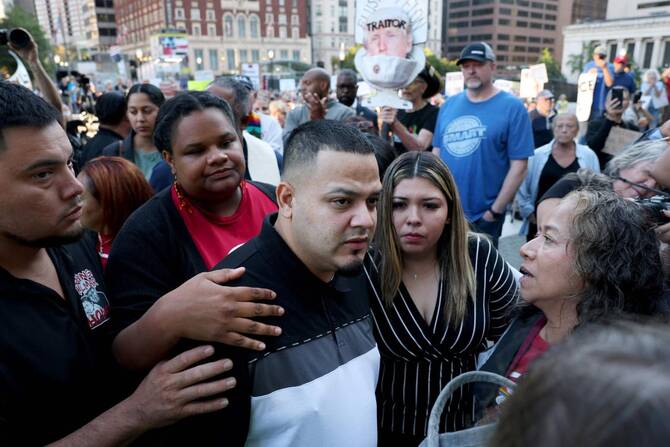
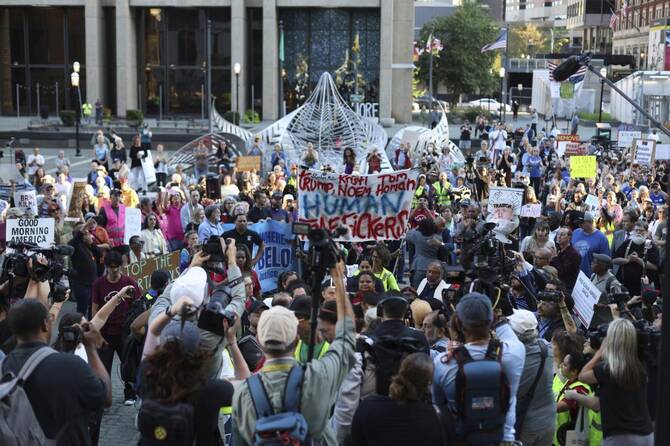
Simon Sandoval-Moshenberg, one of Abrego Garcia’s lawyers, told a crowd of supporters outside the ICE field office that his client was immediately taken into custody when he turned up for the appointment.
“Shame, shame,” chanted the protesters, who were holding signs reading “Free Kilmar” and “Remove Trump.”
The attempt to deport Abrego Garcia to Uganda adds a new twist to a saga that became a test case for Trump’s sprawling crackdown on illegal immigration — and, critics say, his trampling of the law.
Abrego Garcia had been living in the United States under protected legal status since 2019, when a judge ruled he should not be deported because he could be harmed in his home country.
Then he became one of more than 200 people sent to El Salvador’s CECOT mega-prison in March as part of Trump’s crackdown on undocumented migrants.
But Justice Department lawyers admitted that the Salvadoran had been wrongly deported due to an “administrative error.”
He was returned to US soil only to be detained again in Tennessee on human smuggling charges.
Abrego Garcia denies any wrongdoing, while the Trump administration alleges he is a violent MS-13 gang member involved in smuggling of other undocumented migrants.
On Thursday, when it became clear that Abrego Garcia would be released the following day, government officials made him a plea offer: remain in custody, plead guilty to human smuggling and be deported to Costa Rica.
He declined the offer.
“That they’re holding Costa Rica as a carrot and using Uganda as a stick to try to coerce him to plead guilty to a crime is such clear evidence that they’re weaponizing the immigration system in a manner that is completely unconstitutional,” Sandoval-Moshenberg said.
The case has become emblematic of Trump’s crackdown on illegal migration.
Right-wing supporters praise the Republican president’s toughness, but legal scholars and human rights advocates have blasted what they say is a haphazard rush to deport people without even a court hearing, in violation of basic US law.


![]()
![]()

US judge temporarily blocks deportation of Salvadoran man in immigration row
Short Url
https://arab.news/mmfja
US judge temporarily blocks deportation of Salvadoran man in immigration row
- Lawyers for Abrego Garcia immediately filed a lawsuit contesting his deportation and District Judge Paula Xinis temporarily blocked his removal from the country
- Attempt to deport Abrego Garcia to Uganda adds a new twist to a saga that became a test case for Trump’s sprawling crackdown on illegal immigration


Latest updates


© 2026 SAUDI RESEARCH & PUBLISHING COMPANY, All Rights Reserved And subject to Terms of Use Agreement.