

Pakistan affirms full political support for CPEC during Chinese Communist Party official’s Islamabad visit

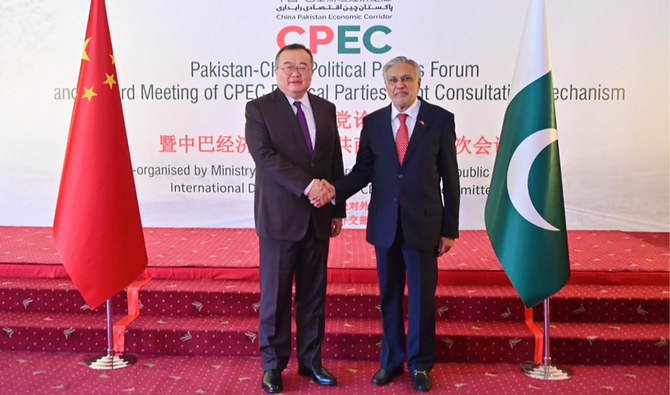
Pakistan's Deputy Prime Minister Ishaq Dar (right) meets a senior Chinese Communist Party leader Liu Jianchao in Islamabad, Pakistan on June 21, 2024. (@ForeignOfficePk/X)
Short Url
Updated 21 June 2024
Follow

Pakistan affirms full political support for CPEC during Chinese Communist Party official’s Islamabad visit

  • Liu Jianchao is visiting Islamabad to co-chair the meeting of the Pakistan-China Joint Consultative Mechanism on CPEC
  • Ishaq Dar says the Pakistan-China relations and CPEC have opened new vistas of progress, prosperity and development

ISLAMABAD: Deputy Prime Minister Ishaq Dar announced on Friday the China-Pakistan Economic Corridor (CPEC) enjoyed the complete support of political parties in his country while welcoming a senior Chinese Communist Party leader Liu Jianchao at the foreign office in Islamabad.

The Chinese official arrived in the country on Thursday night to co-chair the 3rd Meeting of the Pakistan-China Joint Consultative Mechanism (JCM), focusing on the progress of CPEC projects.

Established in 2019, the JCM for political parties on CPEC serves as a regular consultation platform between the Communist Party of China and Pakistani political parties.

Its inaugural meeting took place in Beijing in March 2019, and the second meeting, held virtually in August 2020.

Welcoming Liu, the deputy PM said Pakistan and China had always been strategic partners and trusted neighbors who had consistently supported each other’s core concerns on the world stage.

“Pakistan-China relations and CPEC [enjoy] full support and confidence of all political parties in Pakistan as [they have] opened up new vistas of progress, prosperity and development,” the foreign office quoted him as saying in a social media post.

The Chinese official also described the bilateral ties between the two states as unique, with “no parallel in modern inter-state relations.”

He also underscored China’s commitment to work with Pakistan to add further substance and scope to relationship and upgrade CPEC as envisaged by the leadership of both countries.

The two officials agreed to maintain the momentum of high-level engagements and to further enhance communication on important regional and global issues.

Liu is expected to meet Prime Minister Shehbaz Sharif during his stay in the country.

He will also interact with leaders of various political parties and Pakistan’s top military officials.

Pakistan and China have agreed to advance CPEC into its second phase, expanding beyond infrastructure and energy to broader economic and social development, including rural revitalization, agricultural modernization, industrialization, and green development.

This phase also emphasizes establishing Special Economic Zones to promote industrial growth and job creation.


Pakistan minister calls for integrating ocean awareness into education to preserve ecosystems

Updated 14 min 43 sec ago
Follow

Pakistan minister calls for integrating ocean awareness into education to preserve ecosystems

  • Pakistan’s maritime sector posted a record $360 million profit in 2025 following a year of sweeping reforms
  • Junaid Anwar Chaudhry says education equips youth to make informed decisions, contribute to blue economy

KARACHI: Pakistan’s Maritime Affairs Minister Junaid Anwar Chaudhry has urged integrating ocean awareness into formal education systems and empowering youth as active partners in order to preserve marine ecosystems, his ministry said on Saturday.

Chaudhry said this at a meeting with Minister of State for Education and Professional Training, Wajiha Qamar, who called on him and discussed strategies for enhancing marine education, literacy, and youth engagement in sustainable ocean management.

Pakistan’s maritime sector posted a record Rs100 billion ($360 million) profit in 2025 following a year of sweeping reforms aimed at improving port efficiency, cost-cutting, and safeguarding marine ecosystems to boost the blue economy.

“Understanding our oceans is no longer optional, it is essential for climate resilience, sustainable development, and the long-term health of our maritime resources,” Chaudhry said, highlighting the critical role of marine literacy.

The minister said education equips youth to make informed decisions and actively contribute to marine conservation and the blue economy, urging inclusion of marine ecosystems, conservation and human-ocean interactions into curricula, teacher training and global citizenship programs.

“Initiatives like ‘Ocean Literacy for All’ can mainstream these elements in national policies, school programs, and community workshops to build proactive citizenship on marine challenges,” he added.

Ocean Literacy for All is a UNESCO Intergovernmental Oceanographic Commission–coordinated global initiative under the UN Ocean Decade (2021–2030) that promotes ocean awareness, education, and conservation.

Chaudhry announced reforms in maritime education, including granting degree-awarding status to the Pakistan Marine Academy, and the establishment of the Maritime Educational Endowment Fund (MEEF) to provide scholarships for deserving children from coastal communities.

“The scholarship program promotes inclusive development by enabling access to quality education for youth from over 70 coastal and fishing communities, particularly in Sindh and Balochistan,” he said.

The discussions underscored raising awareness about oceans, coastal ecosystems and marine resources, according to the Pakistani maritime affairs ministry. Both ministers stressed the need to integrate climate and marine education from classrooms

to community programs, addressing risks like rising sea temperatures, coastal erosion, biodiversity loss and pollution.

“Incorporating marine science and ocean literacy into curricula can help students connect local challenges with global trends,” Qamar said, underscoring education’s transformative power in building social resilience.

The meeting explored translating complex marine science into accessible public knowledge through sustained, solution-oriented awareness campaigns, according to the maritime affairs ministry.

With coastline facing pressures from climate change, pollution, and overexploitation, the ministers called for a coordinated approach blending formal education, informal learning and youth-led advocacy.

“A joint effort by the Ministries of Maritime Affairs and Education can cultivate an ocean-literate generation, transforming vulnerability into resilience and ensuring the long-term sustainability of coastal and marine ecosystems,” Chaudhry said.