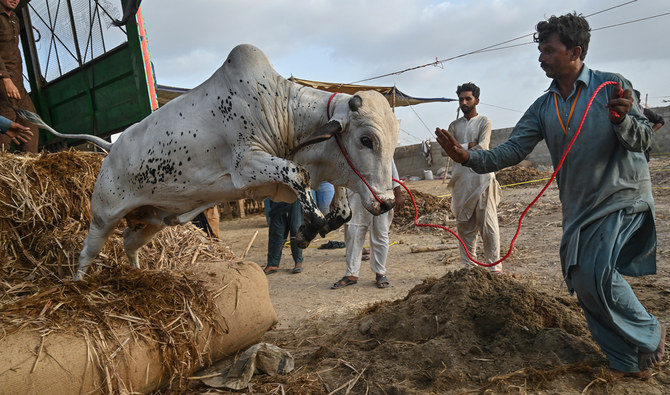
KARACHI: Pakistani Muslims have sacrificed more than 6 million animals worth around Rs500 billion ($1.8 billion) during the three-day Eid Al-Adha festival, according to estimates shared by Pakistani tanners on Wednesday, with charities cutting their reliance to generate revenues.
Muslims celebrate three-day Eid Al-Adha, or the Feast of the Sacrifice, by slaughtering animals such as cattle and goats and sharing their meat among family and friends and the poor. It commemorates Prophet Ibrahim’s willingness to sacrifice his son, Ismail, on God’s command.
This year 6.8 million animals, including 2.9 million cows, 3.3 million goats, 385,000 sheep, 98,700 camels and 165,000 buffalos, were sacrificed, according to preliminary data compiled by the Pakistan Tanners Association (PTA). The value of their hides was estimated at Rs8.4 billion ($30 million).
“Our estimates show that this year animals worth Rs500 billion ($1.8 billion) have been slaughtered across Pakistan,” Agha Saidain, a member of the PTA central executive committee who prepared the data, told Arab News.
He, however, said that nearly 40 percent of the hides, a basic raw material for leather products, have been wasted due to the hot weather and a lack of proper handling.
“Eid provides about 20 percent of raw material required by the [Pakistani] leather industry, but this year the ratio will further decline due to wastage,” Saidain added.
Pakistani charities as well as religious and political organizations, which used to heavily rely on animal hides on Eid Al-Adha for their revenue generation, say the revenue stream has almost lost its value due to a decline in demand and prices of hides.
“In the past when dollar used to be [equal to] Rs60 in Pakistan, the hide used to be Rs4,500 and now when dollar is around Rs300, the hide is being sold for Rs950,” Maulana Bashir Ahmed Farooqui, founding chairman of Saylani Welfare International Trust (SWIT), told Arab News.
“It has lost its value drastically.”
The SWIT, one of the largest charity organizations in Pakistan, provides three meals a day to 200,000 destitute people daily in addition to extending basic humanitarian aid services to 400,000 deserving people on a daily basis, according to Farooqui. The charity, which prides itself with serving people in about 63 aspects of life, has an annual budget of around Rs13 billion ($47 million).
“Out of Rs13 billion, the organization collects skins and hides worth about Rs20 million, because skins and hides have no value now,” he said. “There was a time when traders would struggle to buy them months before and would pay asking prices even in advance.”
Pakistan’s exports of leather products declined from $677 million to $624 million from July 2023 to May 2024, according to the country’s statistics bureau. A surge in demand for artificial leather globally is one of the key factors behind this decline.
As a result, many Pakistani charities have been forced to look for alternative fundraising sources and methods to support their operations.
“Once skin and hides were a 100 percent source to fund organization’s operations, but now this source of revenue meets about 2-3 percent of the expenditures,” Qazi Sadaruddin, a director at Al-Khidmat Foundation, told Arab News.
In the past, the collection of animal skins and hides worth billions of rupees also led to violence in Pakistan’s commercial capital of Karachi, but this has stopped now.
“The incidents of snatching of skins started when Edhi Foundation was targeted by ethnic groups involved in the activity,” said Professor Dr Tauseef Ahmed Khan, a historian, while referring to a major social welfare organization operating across Pakistan.
He adding the act of snatching hides used to be a source of undocumented revenue, which these groups adjusted in extortion money.
Khan said the situation improved since the government took strict action and implemented regulatory measures in addition to launching an operation against militants in Karachi several years ago. Besides, he added, the business was no more attractive due to almost no demand for the commodity.
“Now the cost of collecting skins and hides is more than the prices,” Khan said. “As it lost market value, it lost the attraction.”
In Pakistan, Eid Al-Adha significantly boosts the livestock sector, involving more than 8 million rural families. The festive period sees an increase in demand for animals, which in turn provides economic opportunities to rural communities.


![]()

Pakistanis sacrifice animals worth $1.8 billion on Eid Al-Adha as charities cut reliance on hides
Short Url
https://arab.news/vpyrw
Pakistanis sacrifice animals worth $1.8 billion on Eid Al-Adha as charities cut reliance on hides
- Pakistan’s exports of leather products declined from $677 million to $624 million from July 2023 to May 2024, statistics bureau says
- The decline affected prices of animal hides and Eid Al-Adha now provides 20 percent of the raw materials to the country’s leather industry
Latest updates


© 2026 SAUDI RESEARCH & PUBLISHING COMPANY, All Rights Reserved And subject to Terms of Use Agreement.