Indonesians top global intake of microplastics, new study shows

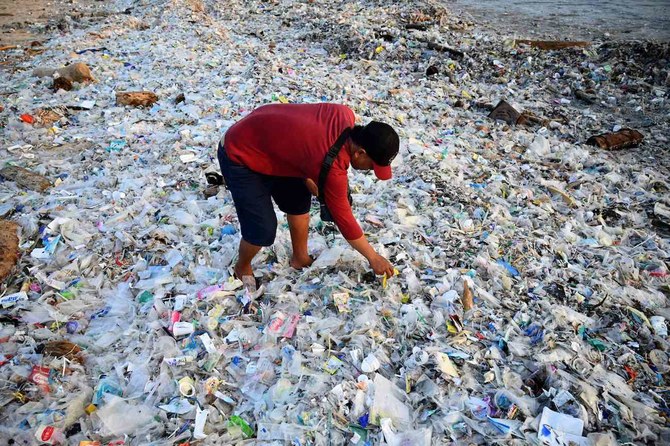
A man looks through plastic and other debris washed ashore at Kedonganan Beach near Denpasar on Indonesia’s resort island of Bali. (File/AFP)
Short Url
Updated 19 June 2024
Follow

Indonesians top global intake of microplastics, new study shows

  • Southeast Asia’s largest economy is second-largest ocean plastic polluter after China
  • No report on illnesses related to microplastics so far, Health Ministry says

JAKARTA: Indonesians are the top global consumers of microplastics, a recent Cornell University study shows, estimating that they ingest about 15 grams of plastic particles per month.

The study, published in the Environmental Science & Technology journal, mapped microplastic uptake in 109 countries and found that people in Southeast Asian countries, including Malaysia, the Philippines and Vietnam, are the top consumers of microplastics worldwide.

Indonesians topped the list as they consume the equivalent of three credit cards in microplastics every month, the majority from fish and seafood. Using existing data models, Cornell researchers said that Indonesians’ daily consumption of plastic particles increased by 59 times from 1990 to 2018.

“This latest finding adds to the long list of the alarming dangers of plastic pollution in Indonesia … the existence of microplastics cannot be separated from the massive production of plastics,” Afifah Rahmi Andini, plastic lead researcher at Greenpeace Indonesia, told Arab News.

Indonesia, an archipelago of more than 270 million people, is the second-largest ocean plastic polluter, just behind China, according to a 2015 study published in the journal Science.

Despite being a major producer and consumer of plastics, Southeast Asia’s largest economy still lags behind when it comes to waste management.

“Our waste management capacity is still far from ideal. Our recycling capacity alone is less than 10 percent of the total plastic waste we produce. So, it’s not that surprising if right now we have to face the bitter truth that Indonesians are at the highest risk of being exposed to microplastics,” Andini said.

Over the years, the Indonesian government has designed various regulations to address the issue of plastic pollution, including a national action plan that aims to reduce marine plastic debris by 70 percent by 2025, which covers strategies for waste reduction, improving waste management infrastructure and public education campaigns.

Major regions, including the capital Jakarta and the popular holiday destination Bali, have also introduced bans on single-use plastics.

“But the existing regulations are not ideal enough to address the issue of microplastic contamination … we must adapt, because it’s now a fact that microplastics are part of our environment and our bodies that we can no longer avoid,” Andini said.

The Cornell study also built on earlier research exploring the presence of plastic particles in fish in Jakarta, crabs in Central Java and chicken eggs in East Java.

“Unfortunately, up to now, Indonesia has yet to include microplastics as a parameter into our food and environmental quality standards.”

The Indonesian Ministry of Health has yet to receive a report on clinical illnesses related to microplastics, but the Cornell study serves as “useful information,” its environmental health director, Dr. Anas Ma’ruf, told Arab News.

“Though it needs to be studied further, it can still serve as information on how health risks caused by microplastics require attention,” he said.

“As Indonesia is the largest maritime country and a main producer of microplastics in the world … public education campaigns must be increased.”


Britain’s PM Starmer faces MPs as pressure grows over Mandelson scandal

Updated 58 min 42 sec ago
Follow

Britain’s PM Starmer faces MPs as pressure grows over Mandelson scandal

  • Keir Starmer set to be grilled in parliament about his judgment in appointing Peter Mandelson as US ambassador
  • New allegations former envoy passed confidential information to the late US sex offender Jeffrey Epstein

LONDON: British Prime Minister Keir Starmer faced growing pressure Wednesday over his appointment of Peter Mandelson as US ambassador, after fresh revelations about the disgraced politician’s close ties to Jeffrey Epstein.
Starmer was set to be grilled in parliament about his judgment in appointing Mandelson, following new allegations that the ex-envoy had passed confidential information to the late US sex offender Epstein nearly two decades ago.
UK police have announced they are now probing the claims, which emerged from email exchanges between the pair that revealed the extent of their warm relations, financial dealings as well as private photos.
Around that time, Epstein was serving an 18-month jail term for soliciting a minor in Florida while Mandelson was a UK government minister.
For decades a pivotal and often divisive figure in British politics, Mandelson has had a chequered career having twice been forced to resign from public office for alleged misconduct.
Starmer sacked him as UK ambassador to the US last September after an earlier Epstein files release showed their ties had lasted longer than previously revealed. He had only been in the post for seven months.
On Tuesday, Mandelson resigned from the upper house of parliament — the unelected House of Lords — after the latest release of Epstein files sparked a renewed furor.
Opposition pressure
The main Conservative opposition will use its parliamentary time Wednesday to try to force the release of papers on his appointment in Washington.
They want MPs to order the publication of all documents related to Mandelson getting the job in February last year.
They want to see details of the vetting procedure — including messages exchanged with senior ministers and key figures in Starmer’s inner circle — amid growing questions about Starmer’s lack of judgment on the issue.
Starmer’s center-left government appeared willing to comply on Wednesday, at least in part. It proposed releasing the documents apart from those “prejudicial to UK national security or international relations.”
London’s Metropolitan Police confirmed on Tuesday it had launched an investigation into 72-year-old Mandelson for misconduct in public office offenses following the latest revelations.
If any charges were brought and he was convicted, he could potentially face imprisonment.
Starmer sacked the former minister and ex-EU trade commissioner as Britain’s top diplomat in the US after an earlier release from the Epstein files detailed his cozy ties with the disgraced American.
‘Let his country down’
The scandal resurfaced after the release by the US Justice Department of the latest batch of documents. They showed Mandelson had forwarded in 2009 an economic briefing to Epstein intended for then-prime minister Gordon Brown.
In another 2010 email the US financier, who died by suicide in prison in 2019, asked Mandelson about the European Union’s bailout of Greece.
The latest release also showed Epstein appeared to have transferred a total of $75,000 in three payments to accounts linked to the British politician between 2003 and 2004.
Mandelson has told the BBC he had no memory of the money transfers and did not know whether the documents were authentic.
He quit his House of Lords position on Tuesday shortly after Starmer said he had “let his country down.”
The UK leader said Tuesday he feared more revelations could come, and has pledged his government would cooperate with any police inquiries into the matter.
The Met police confirmed they had received a referral on the matter from the UK government.
The EU is also investigating whether Mandelson breached any of their rules during his time from 2004-2008 as EU trade commissioner.