
DUBAI: When it comes to the planet’s unfolding environmental crisis, plastic waste is just one among many threats. But the danger it poses specifically to the health of the oceans is on an altogether different scale.
Against this grim backdrop, the UN is launching a global campaign targeting plastic pollution, “Play it Out,” to mark World Oceans Day on June 8.
The 8 million metric tons of plastic that leak into the ocean every year inflict enormous damage on a delicate ecosystem, killing an estimated 100,000 marine animals, experts say.
Most plastics are expected to remain intact for decades, or even centuries, after being used. Those that disintegrate end up as micro-plastics, which are swallowed by fish, seabirds, turtles and mammals, and make their way into the global food chain.
“Plastics essentially never decompose, they just break into smaller bits,” said Natalie Banks, a UAE-based marine conservationist. “Currently more than 5 trillion pieces are estimated to be floating in the sea.”
Following decades of overuse, a surge in single-use plastic bags is raising the spectre of global ecological disaster. Experts in the Gulf region are urging people to think globally and act locally when using plastic to make an impact.
“Plastic pollution forms the greatest threat to ocean health worldwide,” said Lachlan Jackson, founder and managing director of Dubai-based Ecocoast, which is developing solutions to create cleaner, healthier oceans and coastlines.
Pointing to the largest accumulation of ocean plastic in the world — the so-called great Pacific garbage patch, which lies between San Francisco and Hawaii — as one of nature’s warning signs, Jackson said: “It is estimated that 1.15 to 2.41 million tons of plastic are entering the oceans each year from rivers.”
INNUMBERS
1m — Number of species in the world’s oceans
30% — Percentage of carbon dioxide produced by humans absorbed by oceans
2.6bn — People dependent on oceans as primary source of protein
200m — People employed directly or indirectly by marine fisheries
40% Percentage of ocean heavily affected by human activities
3bn — People dependent on marine and coastal biodiversity for their livelihoods
Source: UN
Oceans cover three-quarters of the Earth’s surface and represent 99 percent of the living space on the planet by volume. Scientists believe the sea is home to about 1 million species of animals. So far, they have found nearly 200,000 marine virus species organized into five distinct ecological zones.
The ocean’s economic significance can hardly be overstated. More than 3 billion people depend on marine and coastal biodiversity for their livelihoods, according to estimates, with the so-called ocean economy expected to grow from $1.5 trillion in 2010 to $3 trillion in 2030.
While as much as 40 percent of the ocean is heavily affected by pollution, depleted fisheries, loss of coastal habitats and other human activities are accelerating the decline. The Maldives, for example, was hit by three major coral-bleaching incidents between 1998 and 2016, causing a spiral of coral death and reef decline.
All three events were said to be due to changes in weather patterns that resulted in higher ocean temperatures. Indeed, climate change is suspected to be one of the primary causes of coral bleaching.
“Last year, 7 km of land was reclaimed to build tourist islands in the Maldives similar to the World Islands in Dubai,” Jackson said. “Dredging and dumping of millions of tons of sand causes a significant threat to the marine environment. It can kill off a large number of corals, turning reefs into dead coral wastelands.”
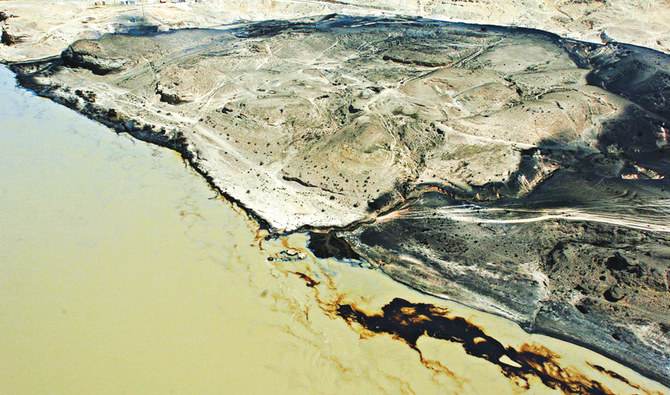
There there is the issue of oil spills. Such incidents occur in the Gulf region with troubling frequency and affect not only people living along the coastline but also, indirectly, everyone from fishermen and hoteliers to tourists, diving centers and protected area authorities.
Compounding the problems afflicting the Gulf’s waters are brine disposal from desalination plants and the threat of invasive marine species.
“Clean, healthy oceans are critical to our survival,” Jackson said. “Yet the world — our environment and technology — is changing at an exponential rate. The world needs more pioneering solutions to support and protect our marine environment against the impact of development. With less rubbish in our waters, our marine life will be safer and healthier, as will be the seafood we consume.”
Jackson said Ecocoast strives to eliminate rubbish, debris and other pollutants from waterways and oceans, which could result in cleaner water and a healthier marine ecosystem.
“We launched the Middle East’s first innovation lab for pioneering marine technologies in 2018 — Ecolabs — to solve the world’s most pressing marine problems,” said Dana Liparts, co-founder and director at Ecocoast and Ecolabs.
“The philosophy behind Ecolabs is that no single company or individual can solve the world’s most pressing marine problems. Collaboration is paramount and it will work as a platform that will bridge the gap between marine problems and solutions.”
Tatiana Antonelli Abella, founder and managing director of the UAE-based green social enterprise Goumbook, pointed out that oceans absorb pollutants and about 30 percent of the carbon dioxide produced by humans, buffering the impact of global warming. “If we don’t fix all the different problems, we’ll lose our biggest ally in combating climate change,” she said.
“The most important source of clean air is our oceans. They provide us with 70 percent of the air we breathe. We need to act fast and make sure that the health of our oceans is preserved. For every 10 breaths we take, seven come from the oceans.”
According to Banks, the UAE-based marine conservationist, despite the ocean’s known life-sustaining role, almost all the problems that face it — from global warming and acidification to overfishing and plastic pollution — can be attributed to human activity.
“The Paris Accords aim to curb ocean warming in the sense that when countries move away from burning fossil fuels, they help to reduce acidification of ocean waters,” Banks told Arab News.
“With regard to the fishing industry, much of it loses money and is subsidized as a result, and in many places there is little or no regulation of catch or gear, and very little enforcement.”
On the positive side, Banks said, large-scale marine protected areas closed to fishing have made a big difference. Likewise, though on a smaller scale, the practice of declaring certain areas off-limits to all except local people who manage their own fishing is a promising development.
“Illegal fishing, including unreported catches, is a problem with global dimensions,” Banks said, adding that subsidies for fishing must eventually end and the importance of satellite tracking of fishing boats should be recognized.
“What is needed to replace petroleum-based plastics completely is a new era of engineering materials that perform like plastic but are truly biodegradable and have lifetimes scaled to actual use. I have recently come across materials grown from fungi and seaweed to replace plastic packaging.”
Banks said the diversity and productivity of oceans is vitally important for humankind.
“Our security, our economy, and our very survival require healthy oceans,” she said. “People need air to breathe, water to drink, food to eat, medicines, a climate we can live in, inspiration and recreation. The oceans provide all that and much more.”