

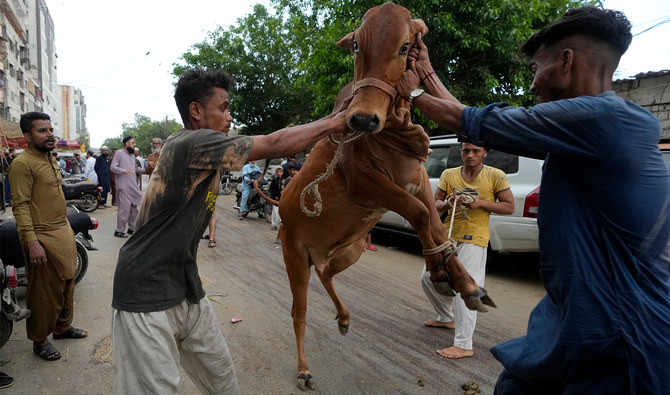

KARACHI: Qayamuddin Qureshi, a 70-year-old butcher affectionately known as Qamo Bhai, works year-round near Jubilee Chowk in the Old City Area of Pakistan’s largest city of Karachi.
But ahead of Eid Al-Adha each year, the third-generation butcher’s phone rings off the hook as customers call him for advance bookings to visit their homes and slaughter cows, sheep and goats to mark the annual religious holiday.
The demand for professional butchers surges on Eid Al-Adha, or the Feast of the Sacrifice, traditionally marked by the slaughter of animals, whose meat is shared with family members and the poor, while amateur and seasonal butchers also try to make an extra buck during the holiday season.
“People book us [professional butchers] in advance and those who book in advance get the benefit of this early reservation,” Qureshi, a self-described ‘man of his word’ who has been working as a butcher since the age of 10, told Arab News, as he cut up a piece of meat at a shop in Hassan Ali Hothi Market.
“By the grace of Allah, I am a family butcher... and this is our second and third generation in the profession … I do a lot of work, execute the job in the best manner and make customers satisfied and that’s why they keep calling me back again.”
Last year, Pakistanis sacrificed over six million animals worth $1.9 billion during the three-day Eid Al-Adha festival, according to estimates shared by the Pakistan tanners’ association.
“What we earn during the three days [of Eid Al-Adha] is enough to eat for the six months,” Qureshi said.
Earlier this month, the Meat Merchants Association in Karachi announced the official rates for animal slaughtering services during Eid, with the price for cows set at around $70, for goats at $32 and camels at $144. Amateur butchers often charge as low as $18.
The service charges are highest on the first day of Eid.
“There is a lot of demand for the first day. For example, a cow that costs about a million rupees would be slaughtered for Rs50,000 on the first day,” Qureshi said, adding that the charges gradually decreased by the third day.
Muhammad Naseem Qureshi, another longtime butcher, said he had many returning customers.
“You can’t find good butchers,” he said. “So the people catch us by themselves. They know that we are good butchers.”
Naseem said he was now refusing orders as his services were fully booked.
“We have so much work that we have to refuse people,” he said. “We have a ‘Housefull’ sign displayed outside.”
SEASONAL BUTCHERS
Old hands like Qureshi said amateur butchers were easy to identify, particularly though their “tools and slaughtering skills.”
“They slaughter and work on one animal with the help of four people, but a professional butcher works on the animal alone,” he said.
But with butchers in such high demand over Eid, not everyone gets to book the craftsman of their choice, particularly as the professionals charge more.
“The animals are also very expensive,” Karachi resident Hajji Noshad said. “We are [often] compelled to bring in unprofessional butchers who mostly ruin the meat and our sacrifice.”
But for seasonal butchers, Eid Al-Adha is too good an opportunity to let go to generate some extra income.
“We have a family business of sanitary hardware,” Saeed Akbar Ali, who works as a butcher over Eid, told Arab News.
“The job of butcher we do... we slaughter 10-12 animals a day... to meet the expenses for Eid.”


