LONDON: NATO is in talks to deploy more nuclear weapons, taking them out of storage and placing them on standby, in the face of a growing threat from Russia and China, the head of the alliance said on Monday.
Jens Stoltenberg told Britain’s Telegraph newspaper that there were live consultations between members to use transparency around its nuclear arsenal as a deterrent.
“I won’t go into operational details about how many nuclear warheads should be operational and which should be stored, but we need to consult on these issues. That’s exactly what we’re doing,” he told the paper.
“Transparency helps to communicate the direct message that we, of course, are a nuclear alliance.”
“NATO’s aim is, of course, a world without nuclear weapons, but as long as nuclear weapons exist, we will remain a nuclear alliance, because a world where Russia, China and North Korea have nuclear weapons, and NATO does not, is a more dangerous world.”
Stoltenberg said last week that nuclear weapons were NATO’s “ultimate security guarantee” and a means to preserve peace.
Russian President Vladimir Putin has repeatedly warned that Moscow could use nuclear weapons to defend itself in extreme circumstances. It accuses the US and its European allies of pushing the world to the brink of nuclear confrontation by giving Ukraine billions of dollars worth of weapons, some of which are being used against Russian territory.
NATO, which has taken on a greater role in coordinating arms supplies to Kyiv, rarely talks about weapons publicly, although it is known that the US has deployed nuclear bombs to several locations in Europe.


![]()


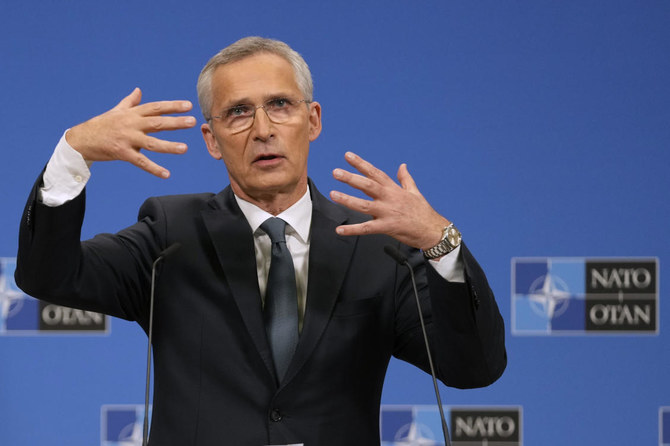
NATO in talks to put nuclear weapons on standby, Stoltenberg tells UK’s Telegraph
Short Url
https://arab.news/b48tk
NATO in talks to put nuclear weapons on standby, Stoltenberg tells UK’s Telegraph
- Jens Stoltenberg tells paper there are live consultations between members to use transparency around its nuclear arsenal as a deterrent
- ‘Transparency helps to communicate the direct message that we, of course, are a nuclear alliance’


Bangladesh police deploy to guard ‘risky’ polling centers
DHAKA: Bangladesh’s police chief said Tuesday that more than 150,000 officers will be deployed for this week’s elections, warning that more than half of polling stations were flagged as vulnerable to violence.
Police records show that five people were killed and more than 600 injured in political clashes during the campaign period from December 11 to February 9.
More than 157,000 police officers, backed by 100,000 soldiers and other security forces, will guard Thursday’s vote — the first since a mass uprising toppled the autocratic government of Sheikh Hasina in 2024.
“We are 1,000 percent confident about doing our part,” Inspector General of Police Baharul Alam told reporters in Dhaka.
The country of 170 million has remained in political turmoil since the uprising against Hasina, when police carried out a deadly crackdown during her failed bid to cling to power.
Alam said police had assessed that “more than 24,000 polling centers have been marked as either high-risk or moderately risky” for possible unrest, violence or ballot stuffing — more than half of the 42,000 centers nationwide.
“The location of some centers is very remote, and there is intense competition, and hostility among candidates and their supporters,” he said, adding that 1,300 police guns looted during the 2024 unrest have still not been recovered.
“In high-risk and moderately risky centers, police will carry out patrol duty with body-worn cameras for the first time.”
Rights organization Ain o Salish Kendra counted 158 people killed and more than 7,000 injured in political violence between August 2024 and December 2025.
Transparency International Bangladesh (TIB) raised concerns over the law-and-order situation, accusing parties of forming “mobs” and setting up roadblocks.
Alam said the police were determined to ensure the polls were peaceful, but said he accepted that distrust of his force remained.
“It is quite understandable why people do not trust the police,” he said. “Over the last 15 years, based on what we have delivered — in fact, for the last 150 years, our predecessors mostly beat people.”
Police records show that five people were killed and more than 600 injured in political clashes during the campaign period from December 11 to February 9.
More than 157,000 police officers, backed by 100,000 soldiers and other security forces, will guard Thursday’s vote — the first since a mass uprising toppled the autocratic government of Sheikh Hasina in 2024.
“We are 1,000 percent confident about doing our part,” Inspector General of Police Baharul Alam told reporters in Dhaka.
The country of 170 million has remained in political turmoil since the uprising against Hasina, when police carried out a deadly crackdown during her failed bid to cling to power.
Alam said police had assessed that “more than 24,000 polling centers have been marked as either high-risk or moderately risky” for possible unrest, violence or ballot stuffing — more than half of the 42,000 centers nationwide.
“The location of some centers is very remote, and there is intense competition, and hostility among candidates and their supporters,” he said, adding that 1,300 police guns looted during the 2024 unrest have still not been recovered.
“In high-risk and moderately risky centers, police will carry out patrol duty with body-worn cameras for the first time.”
Rights organization Ain o Salish Kendra counted 158 people killed and more than 7,000 injured in political violence between August 2024 and December 2025.
Transparency International Bangladesh (TIB) raised concerns over the law-and-order situation, accusing parties of forming “mobs” and setting up roadblocks.
Alam said the police were determined to ensure the polls were peaceful, but said he accepted that distrust of his force remained.
“It is quite understandable why people do not trust the police,” he said. “Over the last 15 years, based on what we have delivered — in fact, for the last 150 years, our predecessors mostly beat people.”
Latest updates


Recommended


© 2026 SAUDI RESEARCH & PUBLISHING COMPANY, All Rights Reserved And subject to Terms of Use Agreement.