MOSCOW: President Vladimir Putin told Western countries on Thursday they risked provoking a nuclear war if they sent troops to fight in Ukraine, warning that Moscow had the weapons to strike targets in the West.
The war in Ukraine has triggered the worst crisis in Moscow’s relations with the West since the 1962 Cuban Missile Crisis. Putin has previously spoken of the dangers of a direct confrontation between NATO and Russia, but his nuclear warning on Thursday was one of his most explicit.
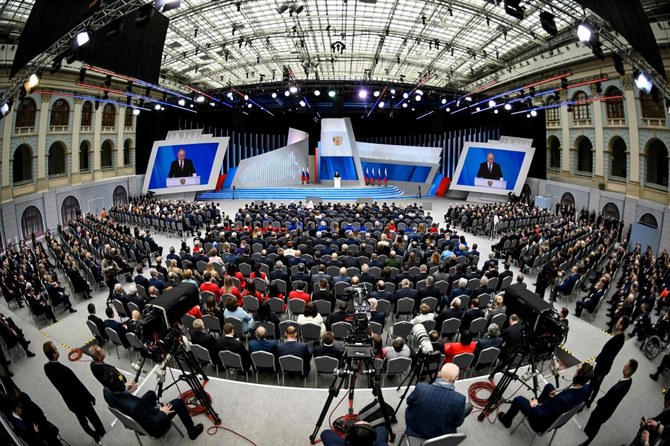
Addressing lawmakers and other members of the country’s elite, Putin, 71, repeated his accusation that the West was bent on weakening Russia, and he suggested Western leaders did not understand how dangerous their meddling could be in what he cast as Russia’s own internal affairs.
He prefaced his nuclear warning with a specific reference to an idea, floated by French President Emmanuel Macron on Monday, of European NATO members sending ground troops to Ukraine — a suggestion that was quickly rejected by the United States, Germany, Britain and others.
“(Western nations) must realize that we also have weapons that can hit targets on their territory. All this really threatens a conflict with the use of nuclear weapons and the destruction of civilization. Don’t they get that?!” said Putin.
Speaking ahead of a March 15-17 presidential election when he is certain to be re-elected for another six-year term, he lauded what he said was Russia’s vastly modernized nuclear arsenal, the largest in the world.
“Strategic nuclear forces are in a state of full readiness,” he said, noting that new-generation hypersonic nuclear weapons he first spoke about in 2018 had either been deployed or were at a stage where development and testing were being completed.
Visibly angry, Putin suggested Western politicians recall the fate of those like Nazi Germany’s Adolf Hitler and France’s Napoleon Bonaparte who had unsuccessfully invaded Russia in the past.
“But now the consequences will be far more tragic,” said Putin. “They think it (war) is a cartoon,” he said, accusing Western politicians of forgetting what real war meant because they had not faced the same security challenges as Russians had in the last three decades.
MORE TROOPS FOR WESTERN BORDER
Russian forces now have the initiative on the battlefield in Ukraine and are advancing in several places, Putin said. Russia must also boost the troops it has deployed along its western borders with the European Union after Finland and Sweden decided to join the NATO military alliance, he added.
The veteran Kremlin leader dismissed Western suggestions that Russian forces might go beyond Ukraine and attack European countries as “nonsense.” He also said Moscow would not repeat the mistake of the Soviet Union and allow the West to “drag” it into an arms race that would eat up too much of its budget.
“Therefore, our task is to develop the defense-industrial complex in such a way as to increase the scientific, technological and industrial potential of the country,” he said.
Putin said Moscow was open to discussions on nuclear strategic stability with the United States but suggested that Washington had no genuine interest in such talks and was more focused on making false claims about Moscow’s alleged aims.
“Recently there have been more and more unsubstantiated accusations against Russia, for example that we are allegedly going to deploy nuclear weapons in space. Such innuendo... is a ploy to draw us into negotiations on their terms, which are favorable only to the United States,” he said.
“...On the eve of the US presidential election, they simply want to show their citizens and everyone else that they still rule the world.”

Russia’s Putin warns West of risk of nuclear war, says Moscow can strike Western targets
Short Url
https://arab.news/wc7p5
Russia’s Putin warns West of risk of nuclear war, says Moscow can strike Western targets
- War in Ukraine has triggered the worst crisis in Moscow’s relations with the West since the 1962 Cuban Missile Crisis
Uganda army denies seizing opposition leader as vote result looms
KAMPALA: Uganda’s army denied claims on Saturday that opposition leader Bobi Wine had been abducted from his home, as counting continued in an election marred by reports of at least 10 deaths amid an Internet blackout.
President Yoweri Museveni, 81, looked set to be declared winner and extend his 40-year rule later on Saturday, with a commanding lead against Wine, a former singer turned politician.
Wine said Friday that he was under house arrest, and his party later wrote on X that he had been “forcibly taken” by an army helicopter from his compound.
The army denied that claim.
“The rumors of his so-called arrest are baseless and unfounded,” army spokesman Chris Magezi told AFP.
“They are designed to incite his supporters into acts of violence,” he added.
AFP journalists said the situation was calm outside Wine’s residence early Saturday, but they were unable to contact members of the party due to continued communications interruptions.
A nearby stall-owner, 29-year-old Prince Jerard, said he heard a drone and helicopter at the home the previous night, with a heavy security presence.
“Many people have left (the area),” he said. “We have a lot of fear.”
With more than 80 percent of votes counted on Friday, Museveni was leading on 73.7 percent to Wine’s 22.7, the Electoral Commission said.
Final results were due around 1300 GMT on Saturday.
Wine, 43, whose real name is Robert Kyagulanyi, has emerged as the main challenger to Museveni in recent years, styling himself the “ghetto president” after the slum areas where he grew up in the capital, Kampala.
He has accused the government of “massive ballot stuffing” and attacking several of his party officials under cover of the Internet blackout, which was imposed ahead of Thursday’s polls and remained in place on Saturday.
His claims could not be independently verified, but the United Nations rights office said last week that the elections were taking place in an environment marked by “widespread repression and intimidation” against the opposition.
- Reports of violence -
Analysts have long viewed the election as a formality.
Museveni, a former guerrilla fighter who seized power in 1986, has total control over the state and security apparatus, and has ruthlessly crushed any challenger during his rule.
Election day was marred by significant technical problems after biometric machines — used to confirm voters’ identities — malfunctioned and ballot papers were undelivered for several hours in many areas.
There were reports of violence against the opposition in other parts of the country.
Muwanga Kivumbi, member of parliament for Wine’s party in the Butambala area of central Uganda, told AFP’s Nairobi office by phone that security forces had killed 10 of his campaign agents after storming his home.
President Yoweri Museveni, 81, looked set to be declared winner and extend his 40-year rule later on Saturday, with a commanding lead against Wine, a former singer turned politician.
Wine said Friday that he was under house arrest, and his party later wrote on X that he had been “forcibly taken” by an army helicopter from his compound.
The army denied that claim.
“The rumors of his so-called arrest are baseless and unfounded,” army spokesman Chris Magezi told AFP.
“They are designed to incite his supporters into acts of violence,” he added.
AFP journalists said the situation was calm outside Wine’s residence early Saturday, but they were unable to contact members of the party due to continued communications interruptions.
A nearby stall-owner, 29-year-old Prince Jerard, said he heard a drone and helicopter at the home the previous night, with a heavy security presence.
“Many people have left (the area),” he said. “We have a lot of fear.”
With more than 80 percent of votes counted on Friday, Museveni was leading on 73.7 percent to Wine’s 22.7, the Electoral Commission said.
Final results were due around 1300 GMT on Saturday.
Wine, 43, whose real name is Robert Kyagulanyi, has emerged as the main challenger to Museveni in recent years, styling himself the “ghetto president” after the slum areas where he grew up in the capital, Kampala.
He has accused the government of “massive ballot stuffing” and attacking several of his party officials under cover of the Internet blackout, which was imposed ahead of Thursday’s polls and remained in place on Saturday.
His claims could not be independently verified, but the United Nations rights office said last week that the elections were taking place in an environment marked by “widespread repression and intimidation” against the opposition.
- Reports of violence -
Analysts have long viewed the election as a formality.
Museveni, a former guerrilla fighter who seized power in 1986, has total control over the state and security apparatus, and has ruthlessly crushed any challenger during his rule.
Election day was marred by significant technical problems after biometric machines — used to confirm voters’ identities — malfunctioned and ballot papers were undelivered for several hours in many areas.
There were reports of violence against the opposition in other parts of the country.
Muwanga Kivumbi, member of parliament for Wine’s party in the Butambala area of central Uganda, told AFP’s Nairobi office by phone that security forces had killed 10 of his campaign agents after storming his home.
© 2026 SAUDI RESEARCH & PUBLISHING COMPANY, All Rights Reserved And subject to Terms of Use Agreement.


