

Khamenei’s top adviser visits Oman as Iran and US prepare for talks

1 / 2
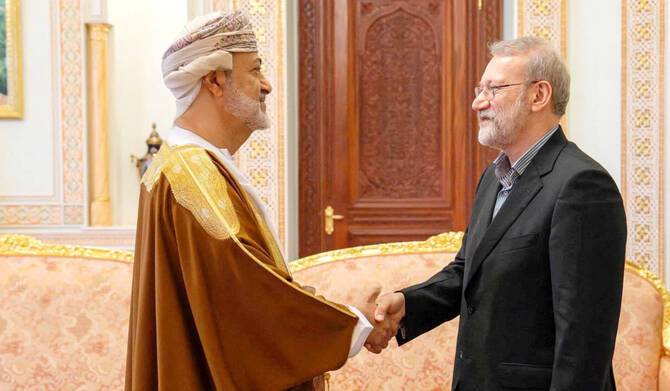
Iran's Secretary of the National Security Council, Ali Larijani meets with Sultan of Oman, Haitham bin Tariq Al Said, in Muscat, Oman, February 10, 2026. (REUTERS)
2 / 2
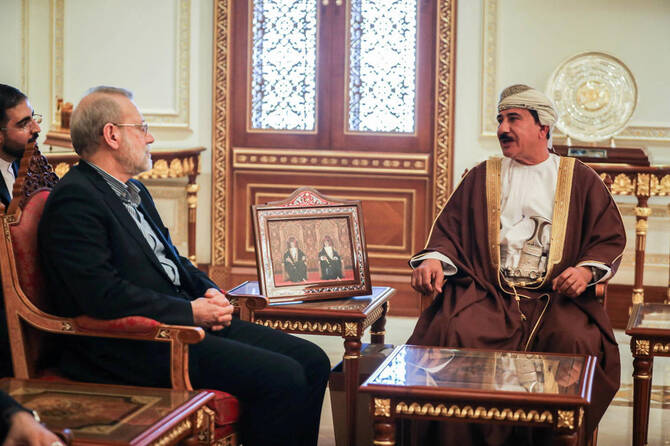
Secretary of the National Security Council, Ali Larijani meets with the Minister of the Royal Office in the Sultanate of Oman, Sultan bin Mohammed al Numani, in Muscat, Oman, February 10, 2026. (Reuters)
Short Url
Updated 10 February 2026
Follow

Khamenei’s top adviser visits Oman as Iran and US prepare for talks

  • The date ‌and venue of the next round of US-Iran talks have yet to be announced
  • The US is seeking to expand the scope of talks with Iran beyond the nuclear issue to curb Iran’s ballistic missile program

MUSCAT: A top adviser to Iran’s supreme leader discussed ways to reach a “balanced and just” agreement ​with the US during talks in Oman on Tuesday, as Washington and Tehran prepare to resume negotiations aimed at averting a new conflict. 
Oman facilitated talks between Iran and the US last week, which a spokesperson for Iran’s Foreign Ministry said had allowed Tehran to gauge Washington’s seriousness and showed enough consensus for diplomacy to continue. 
The talks came after the US positioned a naval flotilla in the region, raising fears of new military action. 
“After the talks, we felt there was understanding and ‌consensus to continue ​the diplomatic ‌process,” said the Iranian Foreign Ministry spokesman, Esmaeil Baghaei. 
Baghaei said Tuesday’s trip to Oman by Ali Larijani, an adviser to Ayatollah Ali Khamenei, had been pre-planned, and that Larijani would travel next to Qatar, which has also mediated in several Middle East crises. 
Oil prices eased on Tuesday as traders remained focused on Iran-US tensions.
Oman’s state news agency said Larijani and Omani Sultan Haitham bin Tariq discussed ways to reach a “balanced and just” agreement between Iran and the US, stressing the importance of returning to dialogue to bridge differences and promote regional and global peace and security. 
Iranian state media said the meeting lasted nearly three hours. The date ‌and venue of the next round of US-Iran talks have yet to be announced. 
The US is seeking to expand the scope of talks with Iran beyond the nuclear issue to curb Iran’s ballistic missile program. 


Tunisia court blocks closure of factory blamed for pollution

Updated 6 sec ago
Follow

Tunisia court blocks closure of factory blamed for pollution

  • The facility in the city of Gabes emits sulfur gases, nitrogen and fluorine
  • “The court ruled that there was no sufficient proof of harm,” Adouni said

TUNIS: A Tunisian court on Thursday rejected demands to suspend operations at a fertilizer factory, a lawyer told AFP, after thousands of protesters blamed the plant for a rise in health problems.
The facility in the city of Gabes emits sulfur gases, nitrogen and fluorine, according to an audit last July for the African Development Bank, which reported “major non-compliance” on air and marine pollution.
Mounir Adouni, head of the Gabes bar association that launched the legal action, said Thursday’s decision was an emergency ruling and a final verdict was pending.
“The court ruled that there was no sufficient proof of harm, saying allegations of pollution lacked technical and scientific evidence,” Adouni said.
Locals in Gabes have for years rallied against the phosphate-processing factory, which makes fertilizers mainly for export.
The bar association lodged its complaint after thousands protested against the plant in October, blaming it for an increase in health problems in the local community.
This month local campaign group Stop Pollution said 12 of its members had been sentenced to a year in prison over a 2020 protest at the plant.
Adouni said the bar will file an appeal on Friday because no date had been set for a hearing on a final ruling.
Despite a 2017 promise to gradually shut the plant down, authorities last year said they were ramping up production.
Taking advantage of rising prices for fertilizer on global markets, Tunisia now wants its output to increase more than fourfold by 2030.
The African Development Bank last month said it would provide Tunisia with $110 million to “support the environmental upgrading and rehabilitation” of the factory.
President Kais Saied has long vowed to revive Tunisia’s phosphate sector, hindered by years of underinvestment and unrest, calling it a “pillar of the national economy.”